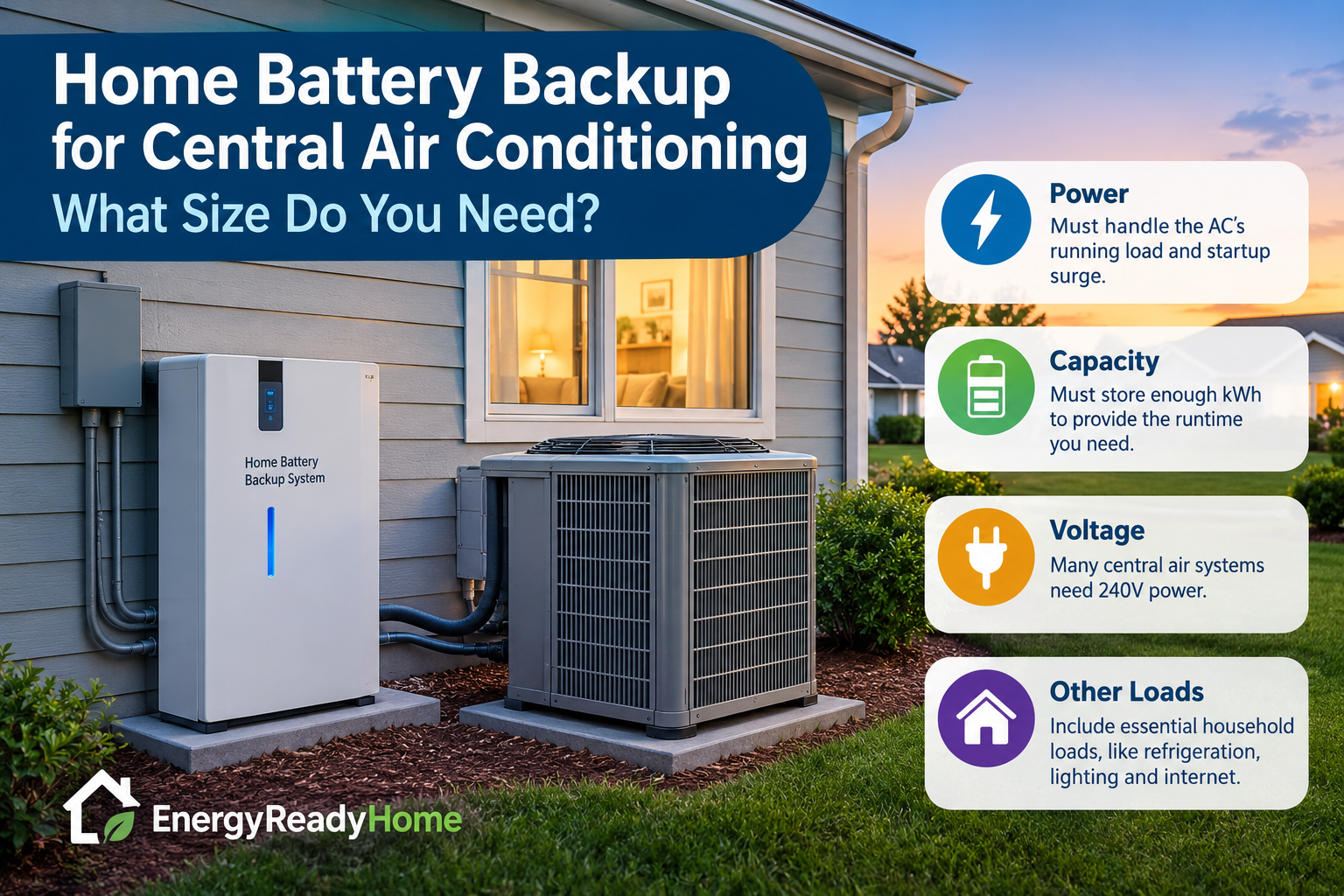
Yes, a home battery backup system can run central air conditioning—but the battery must be sized for more than just the air conditioner’s normal running power. Central AC is one of the more demanding loads in a home because the compressor may require substantial power when it starts, and many central air systems operate on 240 volts.
For homeowners who want air conditioning during a power outage, three numbers matter most: the AC system’s running power, startup power, and how many hours you want it to operate. Those requirements determine both the power output and usable battery capacity your backup system needs.
A smaller battery may be able to operate essential circuits such as a refrigerator, lights, internet equipment, and electronics but still be unable to start a central air conditioner. A larger whole-home battery system—or multiple batteries working together—may be required if cooling is a priority during an extended outage.
This guide explains how to estimate the battery system needed for central air conditioning and why AC tonnage alone does not tell you how large your battery backup should be.
Quick Answer: What Size Battery Backup Do You Need for Central Air?
There is no single battery size that works for every central air conditioner. A practical home battery system must satisfy two separate requirements:
- Power: The battery inverter must be capable of starting and continuously operating the AC equipment.
- Energy: The battery must store enough usable kilowatt-hours (kWh) to operate the AC for the amount of time you expect to need it.
For example, two homes could each have a 3-ton central air conditioner but require different battery systems because the equipment efficiency, compressor technology, startup characteristics, thermostat settings, outdoor temperature, home insulation, and other electrical loads may be different.
That is why sizing should begin with the electrical requirements of the actual HVAC equipment, not simply the home’s square footage or the air conditioner’s tonnage.
Why Central Air Conditioning Is a Challenging Battery Load
Central air conditioning combines several characteristics that make it more demanding than many common household loads.
First, most conventional central AC systems use a compressor. Depending on the equipment design, starting that compressor can create a short power demand substantially higher than its normal operating demand. A battery inverter that cannot supply the required starting power may shut down even when the battery has plenty of stored energy remaining.
Second, many residential central air conditioners require a 240-volt circuit. A battery system intended to operate the AC must therefore provide the voltage and electrical integration required by the home’s HVAC equipment.
Third, air conditioning can operate for many hours during hot weather. That makes battery capacity just as important as inverter output.
The U.S. Department of Energy emphasizes that HVAC equipment should be sized using an accurate assessment of a home’s heating and cooling loads rather than simple rules of thumb. For battery-backup planning, the same principle is useful: homeowners should base decisions on the characteristics of their actual home and HVAC equipment rather than assuming that every system of a given tonnage will behave identically. DOE guidance on proper HVAC system sizing explains why accurate heating and cooling load calculations matter.
The Four Numbers You Need Before Sizing the Battery
Before choosing a home battery system for central air, identify four basic requirements.
1. AC Running Power
Running power is the electricity the HVAC system requires while operating normally. This determines how much continuous inverter output the battery must provide while the air conditioner is running.
Do not estimate this solely from the AC system’s tonnage. Check the equipment nameplate, manufacturer documentation, electrical specifications, or have an HVAC or electrical professional measure the system.
2. AC Startup or Surge Requirement
A conventional compressor may briefly require considerably more power when starting than while running. The battery system must be able to handle this event.
This is one reason a battery advertised with several kilowatts of continuous output should not automatically be assumed capable of starting every central air conditioner. Continuous output and short-duration startup capability are different specifications.
3. Battery Usable Capacity
Battery capacity is usually expressed in kilowatt-hours. Think of this as the system’s stored-energy supply.
If an AC system averaged 3 kW of electrical demand while operating, one hour of continuous operation at that load would theoretically consume about:
3 kW × 1 hour = 3 kWh
Four hours at the same continuous load would theoretically require:
3 kW × 4 hours = 12 kWh
Real-world operation is more complicated because an air conditioner normally cycles rather than running continuously, and battery/inverter losses and other household loads also consume energy. The calculation is therefore a planning example—not a prediction of actual runtime.
4. Other Loads You Want to Run
Central air probably will not be the only equipment using the battery during an outage.
A realistic backup plan may also include:
- Refrigerator and freezer
- Well or sump pump
- Lights
- Internet equipment
- Televisions and electronics
- Kitchen appliances
- Medical equipment
- Other essential household circuits
Those loads must be added to both the home’s peak-power requirement and its total energy consumption.
A Simple Central-Air Battery Sizing Framework
EnergyReadyHome recommends separating the decision into three questions rather than asking only, “How big a battery do I need?”
- Can the battery system start the air conditioner?
- Can it continuously power the air conditioner plus the other loads that may be operating?
- Does it store enough usable energy to provide the runtime you want?
A battery system must pass all three tests.
For example, a system could have enough stored energy for several hours of cooling but insufficient inverter power to start the compressor. Conversely, a high-output battery could start the AC successfully but have too little capacity to provide useful runtime during a long outage.
Central AC Battery Sizing Example
Consider a hypothetical home where the central air system draws an average of approximately 3 kW when it is operating.
| Cooling Scenario | Approximate AC Energy Use |
|---|---|
| 1 hour of actual compressor operation | 3 kWh |
| 2 hours of actual compressor operation | 6 kWh |
| 4 hours of actual compressor operation | 12 kWh |
| 8 hours of actual compressor operation | 24 kWh |
EnergyReadyHome sizing example. These figures assume a constant 3 kW load and are intended to demonstrate the relationship between power and energy. Actual central-air consumption and runtime can vary substantially.
This table also explains why the phrase “run the air conditioner for eight hours” can be misleading. During an eight-hour outage, the compressor may not actually operate continuously for eight hours. It cycles according to thermostat demand, outdoor conditions, equipment efficiency, and the home’s cooling load.
If a 3 kW AC operated an average of 50% of the time during an eight-hour period, its simplified energy requirement would instead be:
3 kW × 4 hours of actual operation = 12 kWh
Other household loads and system losses would still need to be added.
How Much Battery Capacity Does Central Air Actually Need?
The answer depends heavily on how long the compressor operates during the outage. Battery capacity is measured in kilowatt-hours (kWh), while the air conditioner’s electrical demand at any moment is measured in kilowatts (kW).
This distinction is critical. A home battery might have enough inverter output to start and run an air conditioner but not enough stored energy to operate it for very long.
Consider a simplified example using the same 3 kW operating load from Part 1:
| Average AC Duty Cycle | Actual AC Operation During 8 Hours | Approximate AC Energy Use |
|---|---|---|
| 25% | 2 hours | 6 kWh |
| 50% | 4 hours | 12 kWh |
| 75% | 6 hours | 18 kWh |
| 100% | 8 hours | 24 kWh |
EnergyReadyHome scenario analysis assuming a 3 kW operating load. It excludes other household loads and system losses and should not be interpreted as predicted runtime for a particular HVAC or battery system.
This illustrates why a relatively modest battery can provide useful cooling in some conditions while a much larger system may be necessary during extreme heat. On a mild day, the compressor may cycle frequently. During very hot weather, it could operate for much longer periods.
Why Battery Output Can Matter More Than Capacity
Homeowners often focus first on battery capacity because manufacturers prominently advertise storage in kWh. For central air conditioning, however, the battery system’s power-delivery capability can be the first limiting factor.
Imagine a battery with plenty of stored energy but an inverter that cannot supply the AC system’s required startup power. The battery could theoretically contain enough energy for hours of cooling and still be unable to start the compressor.
When evaluating a battery system for central air, compare the HVAC equipment’s requirements with the battery system’s:
- Continuous output
- Short-duration or surge capability, where specified
- 120V/240V capability
- Maximum supported loads
- Whole-home or electrical-panel integration requirements
Manufacturer terminology differs, so specifications should be reviewed carefully rather than assuming similarly sized batteries have identical power capabilities.
Does AC Tonnage Tell You What Size Battery You Need?
No. AC tonnage is a measure of cooling capacity, not electrical consumption.
A 3-ton air conditioner has a nominal cooling capacity of approximately 36,000 BTU per hour, but that does not mean every 3-ton system draws the same electrical power.
Equipment efficiency, compressor design, age, operating conditions, blower requirements, and other factors affect electricity use. Two central air systems with similar cooling capacity can therefore impose different loads on a battery backup system.
Use tonnage as useful information about the HVAC system, but use the equipment’s actual electrical specifications when determining battery compatibility.
Can One Home Battery Run Central Air?
Possibly—but not in every home.
Some home battery systems have enough power output and usable capacity to operate compatible central air equipment. Other installations may require multiple battery units, load-management equipment, or a different backup architecture.
The answer depends on factors including:
- The air conditioner’s running demand
- Compressor startup requirements
- Battery inverter output
- Available surge capability
- Usable battery capacity
- Whether the HVAC system requires 240V
- Other loads operating simultaneously
- Desired cooling runtime
This is why the number of batteries should be determined from the home’s actual loads rather than from a generic recommendation such as “one battery per air conditioner.”
Would Two Batteries Be Better for Central Air?
Adding battery modules can potentially solve two different problems, depending on the system architecture.
First, additional batteries can increase stored energy, allowing the home to operate supported loads for longer. Second, some battery platforms can increase available system power when additional units are installed.
Those two benefits should not be assumed to occur together. Adding storage capacity does not necessarily increase inverter output on every battery platform.
Before adding another battery specifically for air conditioning, verify what the additional unit changes:
- Total usable kWh
- Continuous system output
- Startup or surge capability
- Supported 240V loads
- Maximum system configuration
That distinction can prevent an expensive mistake. More battery capacity does little to solve an AC startup problem if the system’s available power output remains below what the equipment requires.
Can a Soft Starter Reduce the Battery Requirement?
A properly selected soft-start device may reduce the compressor’s starting demand on some conventional air-conditioning systems. That can make startup easier for certain backup-power systems.
However, a soft starter should not be treated as a universal solution. Compatibility depends on the HVAC equipment, battery system, electrical configuration, and manufacturer requirements.
It also does not eliminate the air conditioner’s ongoing energy consumption. Even if startup demand is reduced, the battery still needs enough stored energy to operate the AC for the desired amount of time.
Homeowners considering a soft starter should have compatibility confirmed for their particular HVAC and backup-power equipment before installation.
Central Air Plus Essential Loads: A More Realistic Example
Planning only for the air conditioner can underestimate the battery system a home actually needs.
Consider this simplified EnergyReadyHome outage scenario:
| Load | Illustrative Operating Power |
|---|---|
| Central air conditioner | 3,000 W |
| Refrigerator | 150 W |
| Internet equipment | 30 W |
| LED lighting | 100 W |
| Television/electronics | 150 W |
| Illustrative simultaneous load | 3,430 W |
These are illustrative planning values rather than specifications for a particular home. Actual appliance and HVAC loads should be measured or obtained from equipment documentation.
And even this example does not capture every possible load. A well pump, sump pump, electric water heater, electric range, clothes dryer, EV charger, or other high-demand appliance can significantly increase the home’s power requirement.
That is why homeowners who prioritize air conditioning during an outage may benefit from separating must-have loads from loads that can temporarily remain off.
Load Management Can Reduce the Battery System You Need
A backup system does not necessarily need to power every appliance at the same time.
During an outage, a homeowner might prioritize:
- Central air conditioning
- Refrigeration
- Lighting
- Internet
- Medical or other essential equipment
At the same time, high-demand discretionary loads such as an electric dryer, range, pool equipment, or EV charging could be restricted.
This type of load management can help keep simultaneous demand within the battery system’s capabilities and preserve stored energy for higher-priority uses.
Whole-Home Backup vs Critical-Load Backup With Central Air
Running central air does not necessarily mean every circuit in the house must be backed up.
A system can be designed around selected loads while still including compatible HVAC equipment. The objective is to determine which circuits must remain available during an outage and size the battery and electrical integration accordingly.
This distinction becomes particularly important when air conditioning is the largest backed-up load. Supporting central AC plus a carefully selected group of essentials can require substantially less energy than attempting to operate the home exactly as if the grid were available.
For homeowners deciding between these approaches, our guide Whole-Home vs Partial-Home Battery Backup: Which Do You Need? explains the broader system-design tradeoffs.
What About Multi-Day Power Outages?
Central air can consume a substantial portion of stored battery energy, so multi-day outages require a different strategy than short interruptions.
During a prolonged outage, runtime can potentially be extended by:
- Raising the thermostat setting
- Cooling only when necessary
- Reducing other household loads
- Using available solar generation to recharge the battery
- Prioritizing occupied portions of the home where practical
- Using load-management controls
Solar can be especially valuable during extended outages because it may replenish some of the energy consumed during the previous cooling period. Actual recharge performance depends on the solar array, weather, battery configuration, household consumption, and system operating limits.
How to Estimate Your Central-Air Battery Requirement
Homeowners can use the following process as a starting point before requesting professional system designs or quotes.
- Identify the HVAC equipment. Record the model numbers and electrical specifications for the outdoor and indoor equipment.
- Determine running demand. Use manufacturer information or professional measurement rather than estimating from tonnage alone.
- Determine startup requirements. This is particularly important for conventional compressor systems.
- List other essential loads. Include refrigeration, pumps, lighting, internet, medical equipment, and anything else that must operate during an outage.
- Calculate simultaneous power. Determine how much power the battery may need to supply at one time.
- Estimate daily energy use. Calculate approximate kWh consumption based on expected operating time for the AC and other loads.
- Add a practical margin. Avoid designing a backup plan around perfect theoretical conditions.
- Verify electrical integration. Confirm that the proposed system can support the home’s voltage, circuits, HVAC equipment, and required transfer or control equipment.
When Should You Consider Multiple Home Batteries?
Multiple batteries become more relevant when the homeowner wants to combine central air conditioning with longer runtime or additional large household loads.
Situations that may justify greater battery capacity include:
- Long-duration outages
- Hot climates with extended AC operation
- Larger or less-efficient HVAC systems
- Multiple HVAC zones or systems
- Well pumps or other motor loads
- Electric-heavy homes
- Whole-home rather than selected-load backup
The objective is not to install the largest battery system possible. It is to match the system to the loads the homeowner actually considers important during an outage.
EnergyReadyHome Central-Air Battery Decision Matrix
| Backup Goal | Primary Design Concern | Likely Priority |
|---|---|---|
| AC plus a few essentials | Compressor startup and essential-load demand | Power capability + targeted capacity |
| AC for several hours | Cooling energy consumption | Greater usable kWh |
| AC plus most household circuits | High simultaneous demand | Higher output + greater capacity |
| AC during multi-day outages | Stored energy depletion | Expandable storage + recharge strategy |
| Large conventional compressor | Startup demand | Verified starting capability |
This matrix highlights an important point: central-air battery sizing is both a power problem and an energy problem. Solving only one of them can leave the backup system unable to meet the homeowner’s expectations.
Frequently Asked Questions
Can a home battery run a 3-ton central air conditioner?
Potentially, yes. But tonnage alone cannot determine compatibility. The battery system must support the air conditioner’s actual running demand, startup requirements, voltage, and desired runtime. Other household loads must also be considered.
How many kWh of battery do I need to run central AC?
There is no universal kWh requirement. If an AC averaged 3 kW while operating, each hour of actual compressor operation would theoretically consume about 3 kWh before accounting for system losses and other loads. Actual consumption varies by equipment and operating conditions.
Can a 10 kWh battery run central air?
It may be able to run compatible central air equipment, but 10 kWh of capacity alone does not establish compatibility or runtime. The system must also provide sufficient output and startup capability, and some of the battery’s stored energy may be needed for other household loads.
Can a 20 kWh battery run central air overnight?
Possibly, but it cannot be guaranteed from battery capacity alone. Overnight runtime depends on the AC system’s actual power consumption, compressor duty cycle, thermostat setting, outdoor temperature, home efficiency, other electrical loads, usable battery capacity, and system losses.
Does a central air conditioner need 240V battery backup?
Many residential central air-conditioning systems operate from 240V circuits. The proposed backup system must be compatible with the voltage and electrical requirements of the actual HVAC equipment.
Will solar panels keep central air running during an outage?
Solar can help recharge a compatible home battery during an outage, but available solar production changes throughout the day and with weather conditions. The system must also be specifically configured to operate during a grid outage; a conventional grid-tied solar installation should not automatically be assumed to provide outage power.
Is central air worth including in a battery-backup plan?
For households where maintaining safe indoor temperatures is a priority, central air can be an important backup load. The tradeoff is that cooling can consume substantial battery capacity, potentially requiring a larger system or more aggressive load management than a backup plan focused only on basic essentials.
Bottom Line
A home battery can run central air conditioning when the system is designed for the HVAC equipment’s actual electrical requirements. The key is not simply buying a battery with a large kWh rating.
The battery system must have enough power to start the compressor, enough continuous output to operate the AC alongside essential household loads, the correct electrical integration for the HVAC equipment, and enough usable capacity to provide the desired cooling runtime.
Start with the actual HVAC specifications, decide which other loads must remain powered, and then calculate both peak power and expected energy consumption. That approach produces a much more useful battery-sizing estimate than relying on AC tonnage or battery capacity alone.