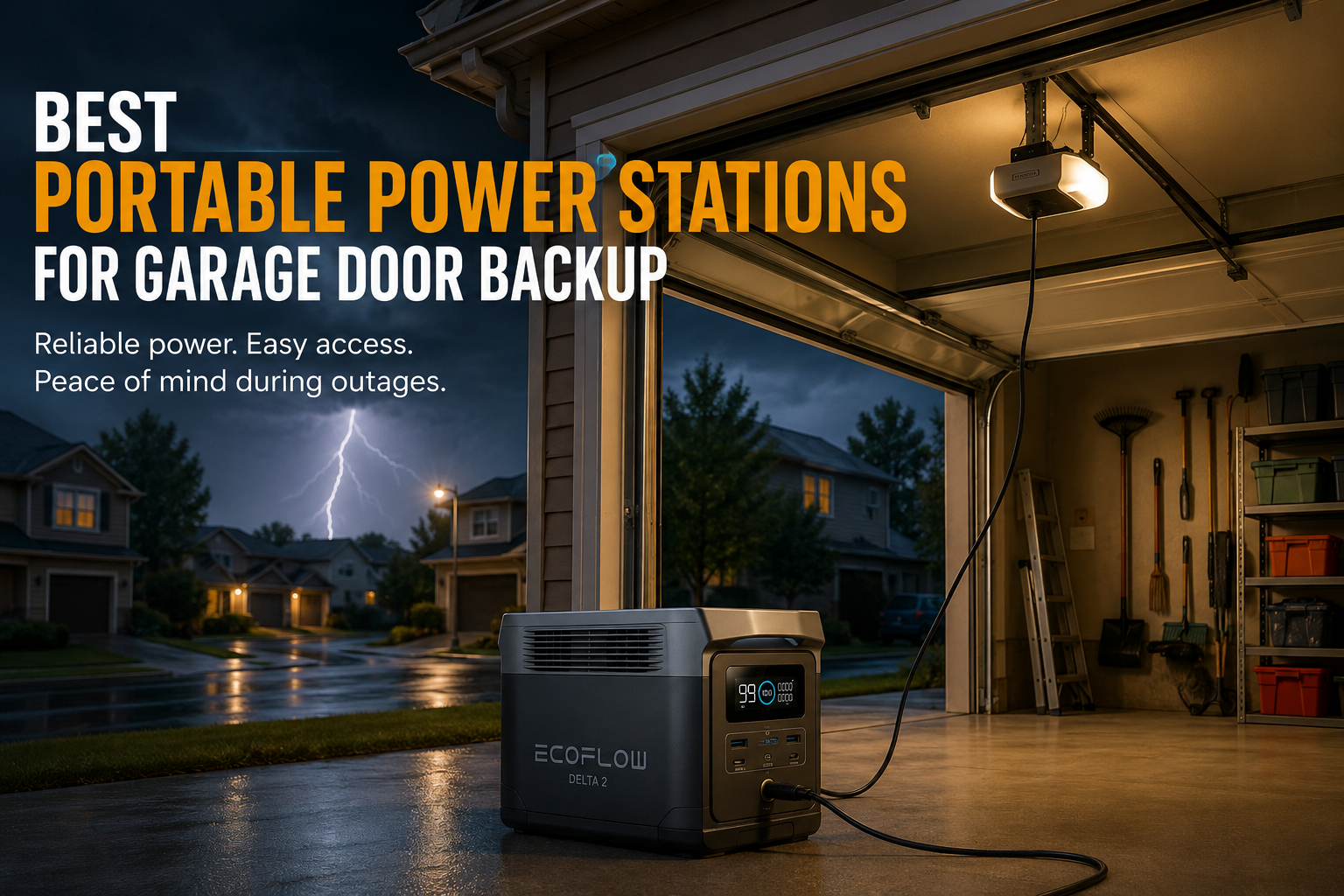
Most homeowners don’t think about their garage door until the power goes out.
Suddenly, your vehicle is trapped inside, or you can’t get your car into the garage during a storm. While nearly every garage door opener includes a manual release cord, opening a heavy garage door by hand isn’t always easy—especially for older adults or anyone with mobility limitations.
A portable power station offers a simple solution. Unlike permanently installed backup generators, these battery-powered units can provide enough electricity to operate most residential garage door openers safely and quietly during an outage.
However, not every portable power station is powerful enough for every garage door system. The right choice depends on your opener’s power requirements, the size and weight of your garage door, and whether you want to power additional devices at the same time.
This guide explains how to choose the right portable power station for garage door backup, what size you’ll need, and which models provide the best combination of performance, reliability, and value.
Can a Portable Power Station Run a Garage Door Opener?
Yes. Most modern portable power stations can easily power a residential garage door opener.
Typical garage door openers use surprisingly little electricity during normal operation. Once the motor starts, it usually consumes between 300 and 600 watts, although startup surges can briefly require 600 to 1,200 watts, depending on the motor type and door weight.
Fortunately, many mid-sized portable power stations are designed to handle these short surge demands without difficulty.
The exact power requirements depend on several factors, including:
- Garage door size
- Door material (steel, wood, aluminum, insulated)
- Horsepower of the opener
- Belt-drive, chain-drive, or screw-drive system
- Age and condition of the opener
If your garage door operates normally under household power, a properly sized portable power station will usually have no trouble running it during an outage.
How Much Power Does a Garage Door Opener Use?
Most residential garage door openers fall into one of these categories:
| Garage Door Opener | Typical Running Watts | Startup Surge |
|---|---|---|
| 1/3 HP | 300–400W | 600–700W |
| 1/2 HP | 350–500W | 700–900W |
| 3/4 HP | 500–700W | 900–1,200W |
| 1 HP Heavy-Duty | 700–900W | 1,200–1,500W |
Garage door opener safety and maintenance recommendations. This links readers to the Door & Access Systems Manufacturers Association (DASMA), the industry’s primary authority on garage door systems and safety.
Because the motor only runs for 10–20 seconds per cycle, the total energy used is very small.
In fact, even a modest portable power station can often open and close a garage door dozens of times before needing to be recharged.
What Size Portable Power Station Do You Need?
Choosing the correct size is less about battery capacity and more about ensuring the inverter can handle the motor’s startup surge.
Small Portable Power Stations (300–500Wh)
These units work well for:
- Standard 1/3 HP openers
- Lightweight single-car garage doors
- Emergency-only use
- Homeowners wanting a compact backup solution
They’re affordable and easy to carry but leave little capacity for powering other household devices.
Medium Portable Power Stations (700–1,200Wh)
For most homeowners, this is the ideal size.
These models typically provide:
- Plenty of startup power
- Enough battery capacity for many garage door cycles
- Power for phones, lights, Wi-Fi routers, and small electronics
- Good balance between portability and performance
This size category is the best choice for the majority of residential garages.
Large Portable Power Stations (1,500Wh and Above)
Larger units are recommended if you also want to power additional household equipment during an outage, such as:
- Refrigerators
- Freezers
- Medical equipment
- Internet equipment
- Television
- Laptop computers
- Multiple lights
Rather than purchasing separate backup devices, a larger portable power station can become your central emergency power source while easily handling garage door operation.
Features to Look For
Not all portable power stations are created equal. Before purchasing one for garage door backup, consider these important features.
Pure Sine Wave Inverter
Garage door openers contain sensitive electronic components.
A pure sine wave inverter provides electricity that closely matches utility power, helping protect the motor and electronic controls while ensuring smooth operation.
High Surge Capacity
Startup power is often the deciding factor.
Choose a portable power station that offers surge capacity comfortably above your opener’s maximum startup requirement. Having extra overhead improves reliability and allows for future upgrades.
Lithium Iron Phosphate (LiFePO₄) Batteries
Many of today’s best portable power stations use LiFePO₄ battery chemistry.
Advantages include:
- Longer service life
- Improved safety
- Better temperature tolerance
- Thousands of charge cycles
- Lower long-term ownership cost
For emergency backup applications that may last many years, LiFePO₄ technology is an excellent investment.
Multiple AC Outlets
During a power outage, you’ll likely want to power more than just your garage door.
Having multiple AC outlets lets you operate:
- Phone chargers
- Wi-Fi router
- LED lighting
- Laptop
- Battery chargers
- Small appliances
This flexibility makes the power station significantly more useful during extended outages.
Our Top Portable Power Station Recommendations
The following portable power stations offer an excellent combination of inverter capacity, battery life, reliability, and overall value for homeowners who want dependable garage door backup.
Best Overall: EcoFlow DELTA 2
The EcoFlow DELTA 2 is an outstanding all-around choice for most homeowners.
Highlights
- 1,024Wh battery
- 1,800W continuous output
- 2,700W surge capacity
- LiFePO₄ battery
- Fast AC charging
- Expandable battery capacity
Best For
- Single and double garage doors
- Whole-home emergency essentials
- Home office backup
- Refrigerator backup
Its powerful inverter easily handles virtually every residential garage door opener while leaving plenty of capacity for additional emergency devices.
Best Value: Jackery Explorer 1000 Plus
Jackery has built a reputation for reliability and user-friendly design.
Highlights
- 1,264Wh battery
- 2,000W continuous output
- LiFePO₄ battery
- Expandable system
- Quiet operation
Best For
- Homeowners wanting dependable emergency backup
- Multiple garage door cycles
- Weekend power outages
Its combination of capacity and portability makes it one of the strongest values available.
Best for Heavy Loads: Bluetti AC200MAX
If you expect your portable power station to support numerous household appliances during extended outages, the Bluetti AC200MAX deserves consideration.
Highlights
- 2,048Wh battery
- 2,200W inverter
- Excellent surge capability
- Expandable battery system
- Numerous AC and DC outputs
Best For
- Larger homes
- Heavy-duty garage door systems
- Extended outages
- Whole-home emergency preparedness
How Many Times Can a Portable Power Station Open Your Garage Door?
Because a garage door opener only operates for a few seconds, energy consumption is surprisingly low.
Approximate estimates:
| Battery Size | Approximate Open/Close Cycles* |
|---|---|
| 300Wh | 40–70 |
| 500Wh | 70–120 |
| 1,000Wh | 150–250 |
| 2,000Wh | 300–500+ |
*Actual results vary depending on door weight, motor efficiency, inverter losses, temperature, and the number of additional devices powered.
For most families, even a mid-sized portable power station provides enough capacity to operate the garage door repeatedly during a prolonged outage.
Should You Leave the Power Station Connected?
Some homeowners wonder whether they should permanently connect a portable power station to the garage door opener.
Generally, this is not recommended unless the manufacturer specifically supports pass-through operation for your intended use.
Instead:
- Keep the power station fully charged.
- Store it in a cool, dry location.
- Connect it when an outage occurs.
- Recharge it after use.
This approach maximizes battery life and ensures the unit is ready when needed.
Other Devices You Can Power at the Same Time
One advantage of purchasing a slightly larger portable power station is its versatility.
During an outage, you can often power:
- Wi-Fi router
- Internet modem
- Smartphone chargers
- LED lamps
- Laptop computers
- Television
- CPAP machine
- Small fans
- Refrigerator (with appropriately sized models)
This makes a portable power station a valuable investment for overall emergency preparedness, not just garage door access.
Frequently Asked Questions
Can a portable power station damage my garage door opener?
No. A quality portable power station with a pure sine wave inverter produces electricity comparable to household utility power and is safe for modern garage door openers.
Can I power two garage doors?
Yes, provided the portable power station has sufficient inverter capacity and battery reserves. Since garage doors are normally operated one at a time, most mid-sized and larger models can easily handle two residential openers.
What if my garage door won’t operate?
If the opener repeatedly trips the inverter, the startup surge may exceed the power station’s capability.
Check:
- Opener horsepower
- Door balance
- Mechanical condition
- Inverter surge rating
A poorly balanced garage door can require substantially more power than a properly maintained system.
Is a portable power station better than a gas generator?
For garage door backup, many homeowners prefer portable power stations because they are:
- Quiet
- Emission-free
- Safe for indoor use
- Maintenance-free
- Instantly available
- Easy to operate
Gas generators remain a better option for powering an entire home over multiple days, but portable power stations excel for short-term outages and everyday emergency preparedness.
Final Thoughts
A portable power station can provide a simple, reliable way to keep your garage door operating during a power outage. Choosing the right model comes down to matching its inverter capacity and battery size to your garage door opener while considering any additional devices you may want to power.
For most homeowners, a 700Wh to 1,200Wh portable power station with a pure sine wave inverter and LiFePO₄ battery offers the best balance of performance, portability, and long-term value. Models such as the EcoFlow DELTA 2, Jackery Explorer 1000 Plus, and Bluetti AC200MAX provide enough power for virtually any residential garage door while also serving as versatile emergency backup systems for the rest of your home.
With the right portable power station on hand, you’ll be prepared to access your garage safely and keep essential electronics running when the grid goes down.
Related Articles
- Can a Portable Power Station Run a Garage Door Opener?
- Can a Portable Power Station Run a Home Security System During a Power Outage?
- Can a Portable Power Station Run a Video Doorbell?
- Can a Portable Power Station Run a Wi-Fi Router?
- Best Ways to Extend Portable Power Station Runtime During an Outage
- What Happens If a Portable Power Station Runs Out of Battery?