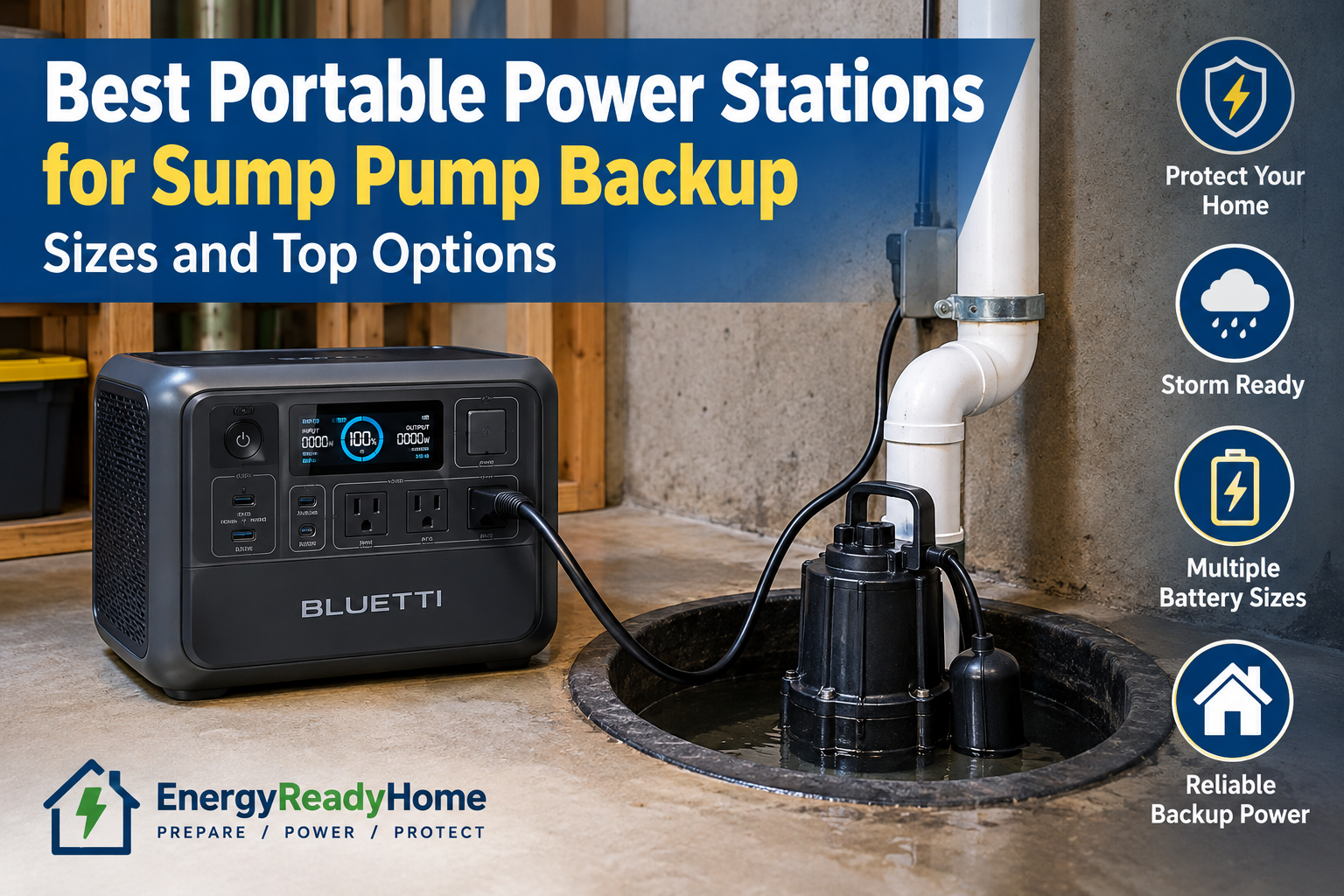
A power outage during heavy rain is one of the worst times for a sump pump to stop working. If water continues entering the sump pit while utility power is unavailable, a properly sized portable power station can provide another way to keep a compatible sump pump operating.
But sump pumps are more demanding than many household electronics. Their motors can require substantially more power for a brief period when starting than while running. That means choosing a backup system requires looking at AC output, motor-starting requirements, battery capacity, and how frequently the pump cycles—not battery capacity alone.
For many homeowners, a portable power station in roughly the 2kWh class can be a practical starting point for sump pump backup. Heavier pump cycling, longer outages, or plans to power additional household essentials can justify moving into the 3kWh or 4kWh class.
Important: Always check the electrical requirements of your actual sump pump before choosing a portable power station. Horsepower alone does not tell you everything you need to know about motor-starting requirements.
Quick Recommendations
| Backup Need | Capacity Class to Consider | ERH Recommendation |
|---|---|---|
| Smaller backup setup / lighter cycling | About 2kWh | BLUETTI Elite 200 V2 |
| More runtime / moderate-to-frequent cycling | About 3kWh | BLUETTI Elite 300 |
| Extended runtime / larger energy reserve | About 4kWh | BLUETTI Elite 400 |
| Premium broader home backup | 4kWh expandable platform | EcoFlow DELTA Pro 3 |
These recommendations are intended as starting points for comparison. A particular power station should not be considered compatible until you have compared its electrical capabilities with your specific sump pump.
Why Sump Pump Backup Requires More Than Battery Capacity
A portable power station has two different jobs when operating a sump pump.
First, its inverter must be capable of starting and running the pump motor. Second, its battery must store enough energy to continue operating the pump as it cycles during the outage.
This distinction matters because a large battery does not automatically mean a power station can start every motor-driven appliance.
If you want to understand your pump’s electrical requirements in more detail before choosing a backup system, our guide How Much Power Does a Sump Pump Use? explains running wattage, startup demand, and how pump size can affect power requirements.
Flood preparation matters because an outage can remove the electricity your primary sump pump depends on at exactly the time water is entering the basement. Ready.gov’s flood-preparedness guidance specifically advises homeowners to consider a sump pump with battery backup when protecting property from flooding.
How to Size a Portable Power Station for Your Sump Pump
Start with the sump pump rather than the battery.
Look for the manufacturer’s label or owner’s manual and identify the pump’s voltage, amperage, horsepower, and any published starting-current or motor-starting requirements. Manufacturer specifications for the actual pump are more useful than relying on a generic horsepower estimate.
Then evaluate four factors.
1. Continuous AC Output
The portable power station must provide enough continuous AC power for the sump pump while it is operating.
If you intend to power other equipment at the same time—such as a refrigerator, freezer, internet equipment, lights, or chargers—those loads also consume part of the power station’s available inverter output.
2. Motor-Starting Demand
A sump-pump motor can require substantially more power when it starts than after it is already running.
That is why comparing only the pump’s normal running wattage with a portable power station’s battery capacity can produce the wrong conclusion. The inverter must be capable of handling the pump’s starting behavior as well as its normal operating load.
EnergyReadyHome recommends leaving meaningful operating headroom instead of designing an emergency backup system around the absolute minimum specification.
3. Battery Capacity
Battery capacity is measured in watt-hours (Wh). In simple terms, more watt-hours provide more stored energy.
A 3,000Wh-class battery contains substantially more nominal stored energy than a 2,000Wh-class battery, but that does not mean runtime can be predicted by dividing battery capacity by the pump’s rated wattage.
Real-world operation includes inverter losses, system consumption, battery state of charge, temperature, and—most importantly for a sump pump—how often the pump actually runs.
4. How Often the Pump Cycles
This may be the biggest variable in sump-pump runtime.
A pump that runs for a few minutes each hour can operate from stored battery energy far longer than the same pump running repeatedly because heavy rain or a high water table is continuously filling the sump pit.
Before deciding how much battery capacity you need, think about how your basement behaves during the storms that concern you most.
What Size Portable Power Station Should You Consider?
| Sump Pump Situation | Portable Power Station Class to Consider | Why |
|---|---|---|
| Smaller pump with occasional cycling | About 2kWh | Useful battery reserve without immediately moving into a much larger backup system |
| Typical residential pump with moderate cycling | About 2–3kWh | Additional stored energy for repeated pump operation |
| Frequent cycling or longer outage | About 3–4kWh | Greater battery reserve when the pump may operate repeatedly for hours |
| Sump pump plus multiple household essentials | 4kWh-class or expandable system | More capacity and inverter headroom for a broader emergency-backup plan |
These are planning categories rather than universal requirements. A smaller battery with appropriate inverter capability may successfully operate a particular pump, while a larger battery is not automatically suitable if its electrical output does not match the motor’s requirements.
Best Overall for Many Sump Pump Backup Needs: BLUETTI Elite 200 V2
For homeowners who want a substantial portable power station primarily for a sump pump and other essential 120V outage loads, the BLUETTI Elite 200 V2 provides an attractive balance of battery capacity, inverter output, and portability.
BLUETTI specifies the Elite 200 V2 at 2,073.6Wh of battery capacity and 2,600W of AC output. That places it firmly above small camping-oriented power stations while avoiding the additional size and weight of many 3kWh and 4kWh systems.
Why We Like It for Sump Pump Backup
- 2,073.6Wh LiFePO4 battery capacity
- 2,600W standard AC output
- Substantial output for a relatively compact 2kWh-class system
- Fast AC recharging capability
- Solar charging capability
- Useful for refrigeration, communications, lighting, and other outage essentials when the sump pump is not operating
The Elite 200 V2 makes the most sense when its electrical output has been verified as compatible with your specific sump pump and you do not need the substantially larger energy reserve of a 3kWh or 4kWh system.
Best fit: Homeowners looking for a capable 2kWh-class sump-pump backup system that can also serve other essential 120V household loads during an outage.
BLUETTI Elite 200 V2
Affiliate disclosure: EnergyReadyHome may earn a commission if you purchase through this link, at no additional cost to you.
Which Portable Power Station Should You Choose?
Best for More Runtime: BLUETTI Elite 300
If your sump pump cycles frequently during storms or you want more battery reserve than a 2kWh-class system provides, the BLUETTI Elite 300 is a logical step up.
BLUETTI specifies the Elite 300 at 3,014Wh of battery capacity and 2,400W of AC output. For sump-pump backup, the larger battery is the primary reason to move up from the Elite 200 V2.
That additional stored energy can become especially valuable when a pump must cycle repeatedly for hours after utility power fails.
Why We Like It for Sump Pump Backup
- 3,014Wh LiFePO4 battery capacity
- 2,400W AC output
- More stored energy than a 2kWh-class system
- Fast recharging capability
- Solar charging support
- Useful capacity for combining sump-pump backup with selected household essentials
Best fit: Moderate-to-frequent sump-pump cycling, longer outages, and homeowners who want additional runtime reserve.
BLUETTI Elite 300
Affiliate disclosure: EnergyReadyHome may earn a commission if you purchase through this link, at no additional cost to you.
Best for Extended Runtime: BLUETTI Elite 400
The BLUETTI Elite 400 moves sump-pump backup into the 4kWh battery class. BLUETTI specifies the system at 3,840Wh of battery capacity and 2,600W of AC output.
The reason to choose a system this size is not that every sump pump needs nearly 4kWh of stored energy. The advantage is additional runtime reserve when the pump cycles frequently, the outage lasts longer than expected, or the power station also needs to support other essential loads.
Why We Like It for Longer Outages
- 3,840Wh LiFePO4 battery capacity
- 2,600W AC output
- Large stored-energy reserve for repeated pump cycling
- Fast recharging options
- Solar charging capability
- Better suited to supporting additional emergency loads alongside the sump pump
Best fit: Frequent pump cycling, extended outages, high water-table conditions, or homeowners who want a larger emergency energy reserve.
BLUETTI Elite 400
Affiliate disclosure: EnergyReadyHome may earn a commission if you purchase through this link, at no additional cost to you.
Best Premium Home-Backup Option: EcoFlow DELTA Pro 3
The EcoFlow DELTA Pro 3 makes the most sense when sump-pump protection is part of a broader home-backup strategy rather than the only reason you are purchasing a portable power station.
EcoFlow specifies the DELTA Pro 3 at 4,096Wh of battery capacity and 4,000W of continuous AC output. It also provides 120V/240V capability and an expandable battery architecture.
That is considerably more capability than many residential sump pumps require. But the additional output and battery capacity can be valuable if the same system will also support refrigeration, communications equipment, lighting, or other essential household loads during an outage.
Why We Like It for Broader Home Backup
- 4,096Wh LiFePO4 battery capacity
- 4,000W continuous AC output
- 120V/240V capability
- Expandable battery architecture
- Multiple recharging options
- Designed for broader home-backup requirements
Best fit: Homeowners who want sump-pump protection as part of a larger, expandable home-backup strategy.
EcoFlow DELTA Pro 3
Affiliate disclosure: EnergyReadyHome may earn a commission if you purchase through this link, at no additional cost to you.
| Model | Battery Capacity | Standard AC Output | Best Sump-Pump Use Case |
|---|---|---|---|
| BLUETTI Elite 200 V2 | 2,073.6Wh | 2,600W | Balanced everyday sump-pump backup |
| BLUETTI Elite 300 | 3,014Wh | 2,400W | More runtime for moderate or frequent cycling |
| BLUETTI Elite 400 | 3,840Wh | 2,600W | Extended runtime and larger energy reserve |
| EcoFlow DELTA Pro 3 | 4,096Wh | 4,000W | Premium sump-pump plus broader home backup |
There is no reason to buy a 4kWh system solely because it is larger. If your pump’s electrical requirements are compatible and it cycles only occasionally, a properly sized 2kWh-class system may provide the better balance of cost, capacity, and portability.
Conversely, homeowners whose pumps run frequently during prolonged storms should place greater value on stored energy. Once the inverter can reliably operate the pump, runtime becomes the next major sizing question.
How Long Can a Portable Power Station Run a Sump Pump?
There is no reliable universal runtime number because a sump pump normally operates intermittently.
Consider a simplified EnergyReadyHome scenario using a sump pump that draws 700 watts while operating.
| Pump Activity | Approximate Run Time Per Hour | Theoretical Energy Used Per Hour |
|---|---|---|
| Light cycling | 6 minutes | About 70Wh |
| Moderate cycling | 15 minutes | About 175Wh |
| Heavy cycling | 30 minutes | About 350Wh |
For example, if the 700W pump operates for 15 minutes during an hour:
700W × 0.25 hours = 175Wh
If heavy water intrusion causes that same pump to operate for 30 minutes during the hour:
700W × 0.5 hours = 350Wh
These are theoretical load calculations, not guaranteed battery runtimes. Actual operation will also be affected by inverter losses, power-station standby consumption, battery state of charge, temperature, pump efficiency, and any other devices connected to the system.
This illustrates why two homes using the same sump pump and the same portable power station can experience dramatically different backup times during the same storm.
If you are planning for a longer outage involving multiple household loads, our Best Portable Power Stations for a 24-Hour Power Outage guide explains how to build a broader one-day emergency energy plan.
Portable Power Station vs Dedicated Sump-Pump Battery Backup
A portable power station and a dedicated sump-pump battery backup solve the outage problem differently.
A purpose-built sump-pump backup system may use a separate backup pump and can be designed to activate automatically when utility power fails or the primary pump cannot keep up.
A portable power station offers greater versatility because its stored electricity can also be used for refrigeration, communications equipment, lighting, electronics, and other emergency loads.
However, you should not assume that placing a portable power station near your sump pump automatically provides the same unattended failover capability as a purpose-built sump-pump backup system.
If automatic operation is important, verify exactly how your particular pump and power station behave when utility power disappears. Test the system before severe weather arrives rather than discovering its limitations during an outage.
Test Your Backup Before You Need It
A sump-pump backup system should be tested under controlled conditions before you rely on it during a storm.
- Identify the exact electrical requirements of your sump pump.
- Fully charge the portable power station.
- Connect the pump according to the manufacturers’ instructions.
- Verify that the power station reliably handles repeated pump starts.
- Observe the actual power draw while the pump operates.
- Use the measured consumption and cycling frequency to improve your runtime estimate.
- Periodically recharge and retest the system so it remains ready for an outage.
Keep the portable power station in a dry location where rising water cannot reach it. Follow both manufacturers’ instructions for electrical connections, charging, moisture exposure, operating temperatures, and storage.
Can Solar Panels Extend Sump-Pump Backup?
Potentially, but solar charging should be treated as an extension strategy rather than guaranteed replacement energy.
The same storm producing enough rain to keep a sump pump busy may also bring heavy cloud cover. Actual solar production can therefore be substantially lower than the panels’ rated output when you need backup power most.
Solar becomes more useful when an outage continues after the storm and daylight conditions improve. During a multi-day outage, even partial replenishment can help preserve battery capacity.
Your initial battery system should still be sized around realistic outage conditions rather than assuming ideal solar production.
Frequently Asked Questions
Can a portable power station run a sump pump?
Yes, many modern portable power stations can operate compatible residential sump pumps. The power station must have sufficient inverter capability for both normal operation and motor starting, and enough battery capacity for the runtime you need.
What size portable power station do I need for a sump pump?
There is no single correct capacity. For many homeowners, approximately 2kWh is a useful starting class. Systems in the 3kWh to 4kWh range provide more stored energy for frequent cycling, longer outages, or additional household loads. Always verify the pump’s actual electrical requirements.
Is 2,000Wh enough for a sump pump?
It can be. A 2kWh-class power station may provide substantial backup time when a compatible pump cycles intermittently. Runtime can fall considerably when heavy water inflow causes the pump to operate frequently.
Can I leave a portable power station connected to my sump pump all the time?
Do not assume every portable power station is designed to function as a permanent sump-pump backup. Check the manufacturer’s instructions for UPS, pass-through, or standby operation and verify how the specific system responds when utility power fails.
Is a portable power station better than a generator for a sump pump?
They offer different advantages. A portable power station avoids gasoline storage, engine maintenance, and combustion exhaust at the point of use. A generator can potentially operate much longer when adequate fuel remains available. The better approach depends on your pump, expected outage duration, automatic-backup requirements, and other loads you need to power.
What happens if the portable power station runs out of battery?
The sump pump will no longer receive backup electricity from that power station. If water continues entering the sump pit, flooding can occur. Homes with significant water-intrusion risk should consider whether redundant backup methods are appropriate rather than relying on a single source of emergency power.
Bottom Line
The best portable power station for sump-pump backup is not automatically the model with the largest battery.
Start with your pump’s actual electrical requirements. Make sure the inverter can reliably operate it, and then choose enough battery capacity for the cycling frequency and outage duration you realistically expect.
For many homeowners, the BLUETTI Elite 200 V2 provides a strong balance of capacity, output, and portability. The BLUETTI Elite 300 adds more battery reserve, while the BLUETTI Elite 400 moves into a larger-capacity class for frequent cycling and longer outages. The EcoFlow DELTA Pro 3 makes the most sense when sump-pump protection is part of a broader home-backup strategy.
Whatever system you choose, test it with your actual sump pump before severe weather arrives. A backup system is useful only if you know it can operate the pump and provide enough stored energy when utility power goes out.