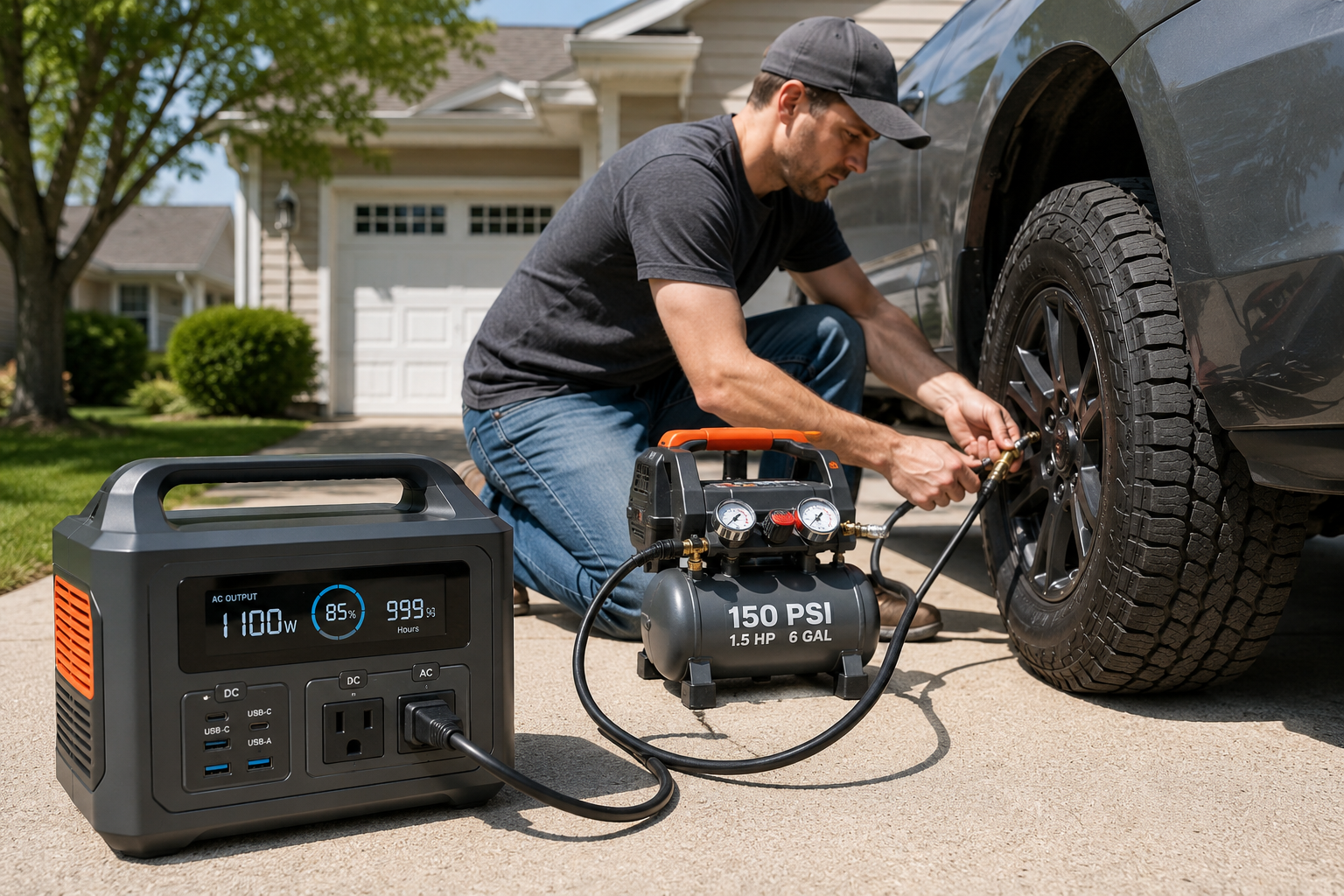
Air compressors are incredibly useful during home repairs, roadside emergencies, and job-site projects—but they’re also one of the more demanding tools to power. If you’re wondering whether a portable power station can run an air compressor, the answer is yes—but only if you choose a model with enough continuous output and enough surge capacity to handle startup.
Many smaller portable power stations cannot start an air compressor because the motor briefly draws significantly more power when it first turns on. Understanding both running watts and startup watts is the key to choosing the right portable power station.
Can a Portable Power Station Run an Air Compressor?
Yes. Many portable power stations can successfully operate an air compressor, but compatibility depends on four factors:
- The compressor’s running wattage
- The compressor’s startup (surge) wattage
- The portable power station’s continuous AC output
- The inverter quality (pure sine wave recommended)
Small inflators and compact pancake compressors are much easier to power than large garage or industrial air compressors.
Before purchasing a power station, always compare the compressor’s electrical requirements to the inverter specifications listed by the manufacturer.
How Much Power Does an Air Compressor Use?
Air compressor power requirements vary dramatically depending on size and motor design.
| Air Compressor Type | Running Watts | Startup Watts |
|---|---|---|
| Tire Inflator (12V) | 120–180W | Minimal |
| Small Portable Compressor | 300–700W | 600–1,200W |
| Pancake Compressor | 800–1,500W | 1,600–3,000W |
| 20–30 Gallon Compressor | 1,500–2,000W | 3,000–4,000W |
| Large Shop Compressor | 2,000W+ | 4,000W+ |
Because startup demand can be two to three times higher than normal operating power, many compressors fail to start even though they appear to be within the power station’s continuous rating.
Starting Watts vs. Running Watts
This is where many people choose the wrong portable power station.
When an electric motor starts, it experiences an inrush current that temporarily increases power demand.
For example:
- Running power: 900 watts
- Startup surge: 2,200 watts
A portable power station rated for:
- 1,000W continuous
- 2,000W surge
may shut down during startup even though it easily handles the compressor after it’s running.
Always size your portable power station for the startup surge, not just the running wattage.
Department of Energy electric motor efficiency and energy use guide.
What Size Portable Power Station Do You Need?
For most homeowners, these general recommendations work well.
| Air Compressor | Recommended Power Station |
|---|---|
| Tire inflator | 300–500W inverter |
| Small portable compressor | 700–1,000W |
| Pancake compressor | 1,500–2,000W |
| Medium garage compressor | 2,000–3,000W |
| Large shop compressor | Often better served by a generator |
If you’ll also be powering lights, chargers, or other tools, choose additional capacity beyond the compressor’s requirements.
Pure Sine Wave Matters
Most modern air compressors operate best using a pure sine wave inverter.
Pure sine wave output provides cleaner electricity that’s closer to utility power and helps motors start and run more reliably.
Modified sine wave inverters may:
- Reduce motor efficiency
- Cause overheating
- Produce unusual noise
- Shorten motor lifespan
When shopping for a portable power station, verify that it includes a pure sine wave inverter.
Common Mistakes to Avoid
Many users run into problems because they overlook one or more of these factors:
- Buying based only on battery capacity instead of inverter output
- Ignoring startup surge requirements
- Running multiple high-wattage tools simultaneously
- Using extension cords that are too small
- Choosing modified sine wave power stations
Avoiding these mistakes can prevent overload shutdowns and help protect both your portable power station and your air compressor.
ir Compressor Runtime Estimates
How long a portable power station can run an air compressor depends on two primary factors:
- The battery capacity (measured in watt-hours)
- How frequently the compressor motor cycles on and off
Unlike a refrigerator or fan, an air compressor rarely runs continuously. Once the tank reaches the target pressure, the motor shuts off until additional air is needed. This cycling can significantly extend runtime during light-duty tasks.
The table below assumes continuous operation for comparison purposes.
| Portable Power Station Battery | 500W Compressor | 800W Compressor | 1,200W Compressor |
|---|---|---|---|
| 500Wh | ~45 minutes | ~25 minutes | Not Recommended |
| 1,000Wh | ~1 hour 40 minutes | ~1 hour | ~45 minutes |
| 2,000Wh | ~3 hours 20 minutes | ~2 hours | ~1 hour 30 minutes |
Actual runtime is often longer because most compressors cycle on and off instead of running continuously.
Battery-Powered vs. Corded Air Compressors
If your primary goal is portability, battery-powered air compressors may be an even better solution than powering a traditional AC compressor from a portable power station.
Here’s a quick comparison.
| Feature | Corded Compressor + Power Station | Battery-Powered Compressor |
|---|---|---|
| Continuous Air Supply | Excellent | Limited |
| Maximum PSI | Higher | Usually Lower |
| Tank Capacity | Available | Often Tankless |
| Portability | Good | Excellent |
| Vehicle Tire Inflation | Excellent | Excellent |
| Construction Projects | Better Choice | Limited |
For inflating vehicle tires, bicycles, sports equipment, and small projects, battery-powered compressors are often more convenient. For nail guns, workshop tools, painting, and larger jobs, a traditional compressor paired with an appropriately sized portable power station generally delivers better performance.
When a Generator May Be the Better Choice
Although portable power stations are quiet, maintenance-free, and safe for indoor use, they are not always the best solution for every compressor.
A portable generator may be a better option if you:
- Need to operate a large 20–60 gallon compressor
- Use high-demand pneumatic tools all day
- Need continuous operation for construction work
- Frequently exceed 2,500–3,000 watts
Portable power stations excel for occasional home projects, emergency repairs, roadside assistance, RV travel, and situations where quiet operation is important.
Frequently Asked Questions
Can a 500-watt portable power station run an air compressor?
Usually only very small tire inflators or compact compressors. Most traditional air compressors require considerably more startup power.
Why won’t my air compressor start even though the wattage seems low?
Electric motors require a large surge of power during startup. If the portable power station cannot supply that brief surge, it may immediately shut down even though the running wattage is within its rating.
Is a pure sine wave inverter required?
Yes. Most manufacturers recommend using a pure sine wave inverter because it delivers cleaner power that helps electric motors start and operate more reliably.
Can I run other tools at the same time?
Only if the combined running wattage remains below the portable power station’s continuous output rating. Remember to account for startup surge from the air compressor.
Is battery capacity or inverter size more important?
Both matter, but inverter output is usually the limiting factor. A large battery with an undersized inverter still won’t start many air compressors.
Final Recommendation
Yes, a portable power station can run many air compressors, but success depends on matching the compressor’s electrical requirements to the power station’s inverter capacity. Always check both the running watts and the startup surge watts before purchasing.
For most homeowners using portable compressors for tire inflation, home maintenance, or light DIY projects, a 1,500- to 2,000-watt pure sine wave portable power station provides an excellent balance of performance and flexibility. Larger shop compressors, however, often require more power than most battery-powered stations can deliver and may be better served by a portable generator.
Related Articles
- Can a Portable Power Station Run a Microwave? (Power Requirements Explained)
- Can a Portable Power Station Run a Blender? (Power Requirements Explained)
- Can a Portable Power Station Run a Coffee Maker? (Power Requirements Explained)
- Can a Portable Power Station Run a Space Heater? (Important Safety & Power Guide)
- Can a Portable Power Station Run an Electric Blanket? (Power & Runtime Guide)
- Can a Portable Power Station Run a Window AC Unit? (Important Power Considerations)