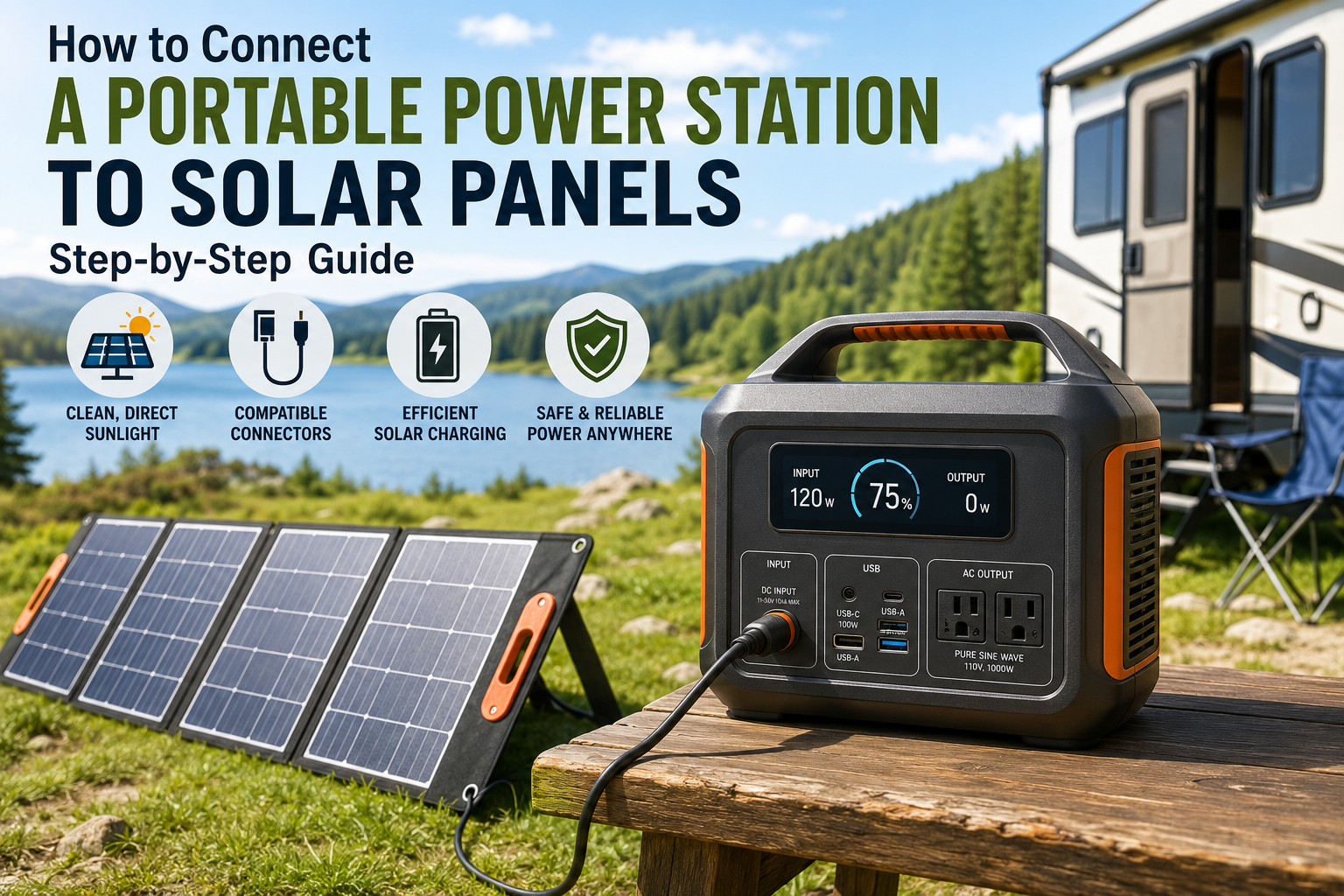
Portable power stations become even more useful when paired with solar panels. Instead of relying only on wall outlets or vehicle charging, you can recharge your power station using free energy from the sun. Whether you’re preparing for power outages, camping off-grid, or reducing your dependence on the electrical grid, learning how to properly connect solar panels to your portable power station is an essential skill.
The process is usually straightforward, but using the wrong panels, incompatible connectors, or incorrect voltage can prevent charging—or even damage your equipment. This guide explains exactly how to connect a portable power station to solar panels safely and efficiently.
Why Use Solar Panels with a Portable Power Station?
One of the biggest advantages of a portable power station is that it doesn’t require gasoline or propane to recharge. When paired with compatible solar panels, it can provide renewable electricity virtually anywhere the sun is shining.
Common uses include:
- Emergency home backup during power outages
- Camping and RV travel
- Boondocking and overlanding
- Outdoor events
- Remote job sites
- Cabins without grid power
- Disaster preparedness
Unlike fuel-powered generators, solar charging produces no exhaust fumes, requires very little maintenance, and operates silently.
How Solar Charging Works
Portable solar panels convert sunlight into direct current (DC) electricity.
That electricity flows through a charging cable into your portable power station, where the internal charge controller and Battery Management System (BMS) regulate the incoming power before charging the battery.
The charging process is automatic. Once everything is connected correctly, the power station manages the charging process without requiring manual adjustments.
What You’ll Need
Before you begin, gather the following equipment:
- Portable power station
- Compatible solar panel or solar panels
- Manufacturer-approved charging cable
- Appropriate adapter (if required)
- Stable location with full sunlight
Many portable power stations include charging cables, while others require adapters for certain solar panel brands.
Always verify compatibility before purchasing additional accessories.
Step 1: Verify Solar Panel Compatibility
Before connecting anything, confirm that your portable power station supports the solar panel you intend to use.
Pay close attention to:
- Maximum input voltage
- Maximum solar input wattage
- Maximum input current (amps)
- Connector type
Every portable power station has specific solar charging limits.
Connecting a panel that exceeds those limits can prevent charging and, in some cases, damage internal electronics.
The owner’s manual lists the acceptable solar input specifications. Solar Photovoltaic system basics.
Step 2: Identify the Correct Connectors
Not every solar panel uses the same connector.
Some of the most common include:
- MC4 connectors
- XT60 connectors
- Anderson Powerpole connectors
- DC7909 connectors
- Barrel connectors
Many manufacturers provide adapter cables that convert standard MC4 solar panel connectors into the input connector required by their portable power station.
Never force connectors together.
If the connectors don’t match naturally, you likely need the proper adapter.
Step 3: Position the Solar Panels Correctly
Proper panel placement has a major impact on charging performance.
For the best results:
- Face the panels toward direct sunlight.
- Minimize shading.
- Tilt the panels toward the sun whenever possible.
- Keep the panels clean.
- Avoid placing them under trees or near buildings that create shadows.
Even partial shade on one section of a solar panel can significantly reduce charging output.
Step 4: Connect the Solar Panels
Once the panels are positioned:
- Connect any required adapter cables.
- Plug the solar panel cable into the portable power station’s solar input.
- Confirm that the connectors are fully seated.
- Turn on the portable power station if required by your model.
Many portable power stations automatically detect incoming solar power and begin charging immediately.
Others may require selecting the charging input using the display menu.
Step 5: Verify Charging
After making the connection, check the display screen.
Most portable power stations show:
- Solar input wattage
- Charging status
- Battery percentage
- Estimated charging time
If the display shows incoming watts, your system is charging properly.
If no charging occurs, disconnect the system and verify:
- Connector compatibility
- Cable connections
- Panel orientation
- Available sunlight
- Input voltage compatibility
Many charging issues are caused by loose connections or insufficient sunlight rather than equipment failure.
Can You Connect Multiple Solar Panels?
Yes—but only if your portable power station supports the combined electrical output.
Many manufacturers allow multiple panels to be connected using:
- Parallel wiring
- Series wiring
- Manufacturer-approved expansion cables
The correct configuration depends on your power station’s maximum voltage and current limits.
Before expanding your solar array, always verify the allowable specifications in your owner’s manual.
Connecting panels incorrectly can exceed the unit’s solar input rating and prevent proper charging.
Step 6: Understand What Affects Solar Charging Speed
Solar charging is rarely as simple as looking at the panel’s advertised wattage. Real-world conditions often produce less power than the panel’s maximum rating.
Several factors influence charging performance:
Sunlight Intensity
Bright, direct sunlight produces the fastest charging.
Cloud cover, haze, smoke, or low-angle sunlight in the early morning and late afternoon reduce output significantly.
Panel Angle
Solar panels perform best when they face the sun directly.
Repositioning the panels every few hours can noticeably increase daily energy production.
Temperature
Most solar panels actually become less efficient as temperatures rise.
Cool, sunny days often generate more electricity than extremely hot summer afternoons.
Dirt and Debris
Dust, pollen, leaves, bird droppings, and snow can reduce panel efficiency.
Cleaning the panels regularly helps maintain maximum charging performance.
Should You Leave Solar Panels Connected All the Time?
Generally, yes.
Modern portable power stations include sophisticated Battery Management Systems (BMS) that automatically regulate charging and prevent overcharging.
When the battery reaches full capacity, the charging system slows or stops accepting additional power.
However, if severe weather is expected, disconnect and store portable solar panels to protect them from high winds, hail, or falling debris.
Can You Use Any Solar Panel?
Not necessarily.
While many portable power stations work with third-party solar panels, compatibility depends on:
- Input voltage
- Maximum amperage
- Connector type
- Maximum solar wattage
Many manufacturers recommend using their own panels because compatibility has already been verified.
Third-party panels often work perfectly well—but always confirm the specifications before connecting them.
Common Solar Connection Mistakes
Many charging problems result from simple setup errors.
Avoid these common mistakes:
Using Too Much Voltage
Exceeding the maximum solar input voltage can damage your power station.
Always verify the panel specifications before connecting.
Using the Wrong Adapter
Improper adapters may prevent charging entirely.
Use manufacturer-approved adapters whenever possible.
Partial Shade
Even one shaded corner of a panel can dramatically reduce power production.
Move panels into full sunlight whenever possible.
Incorrect Series or Parallel Wiring
Connecting multiple panels incorrectly may exceed your power station’s input limits.
Follow the manufacturer’s recommended wiring configuration.
Expecting Maximum Rated Output
A 200-watt solar panel rarely produces 200 watts continuously.
Real-world production often ranges between 60% and 90% of the advertised rating depending on weather and sun angle.
Frequently Asked Questions
Can I charge a portable power station while using it?
Yes.
Most modern portable power stations support pass-through charging, allowing the battery to recharge while simultaneously powering connected devices.
Check your owner’s manual to verify that your model supports this feature.
Can solar panels damage a portable power station?
Properly matched solar panels will not damage a portable power station.
Problems occur only when the panel exceeds the unit’s maximum voltage or current limits.
Always confirm compatibility before connecting.
How long does solar charging take?
Charging time depends on:
- Solar panel wattage
- Battery capacity
- Available sunlight
- Weather conditions
A small power station paired with a high-output solar panel may recharge in several hours under ideal conditions.
Larger power stations may require most of the day or multiple sunny days.
Can I leave my solar panels outside permanently?
Portable panels are designed for temporary deployment.
Although many are weather-resistant, storing them indoors when not in use helps extend their lifespan and reduces unnecessary exposure to moisture, UV radiation, and severe weather.
Do I need a separate solar charge controller?
No.
Portable power stations designed for solar charging already include an integrated charge controller and Battery Management System.
Simply connect compatible solar panels directly to the solar input using the correct cable or adapter.
Final Thoughts
Connecting a portable power station to solar panels is one of the easiest ways to create a reliable, renewable source of backup power. Once you’ve verified compatibility and connected the correct cables, the charging process is largely automatic.
Whether you’re preparing for emergencies, camping off-grid, or reducing your dependence on the electrical grid, understanding how solar charging works helps you get the most from your equipment while protecting your investment.
By using compatible components, positioning panels for maximum sunlight, and avoiding common connection mistakes, you can safely recharge your portable power station almost anywhere the sun shines.
Related Articles
- Portable Power Station Maintenance Checklist: Keep Your Battery Ready for the Next Emergency
- How to Store a Portable Power Station Long Term
- How Long Does It Take to Recharge a Portable Power Station?
- How Long Do Portable Power Station Batteries Last?
- Portable Power Station vs Solar Generator Whats The Difference
- How to Choose the Right Size Portable Power Station for Your Home