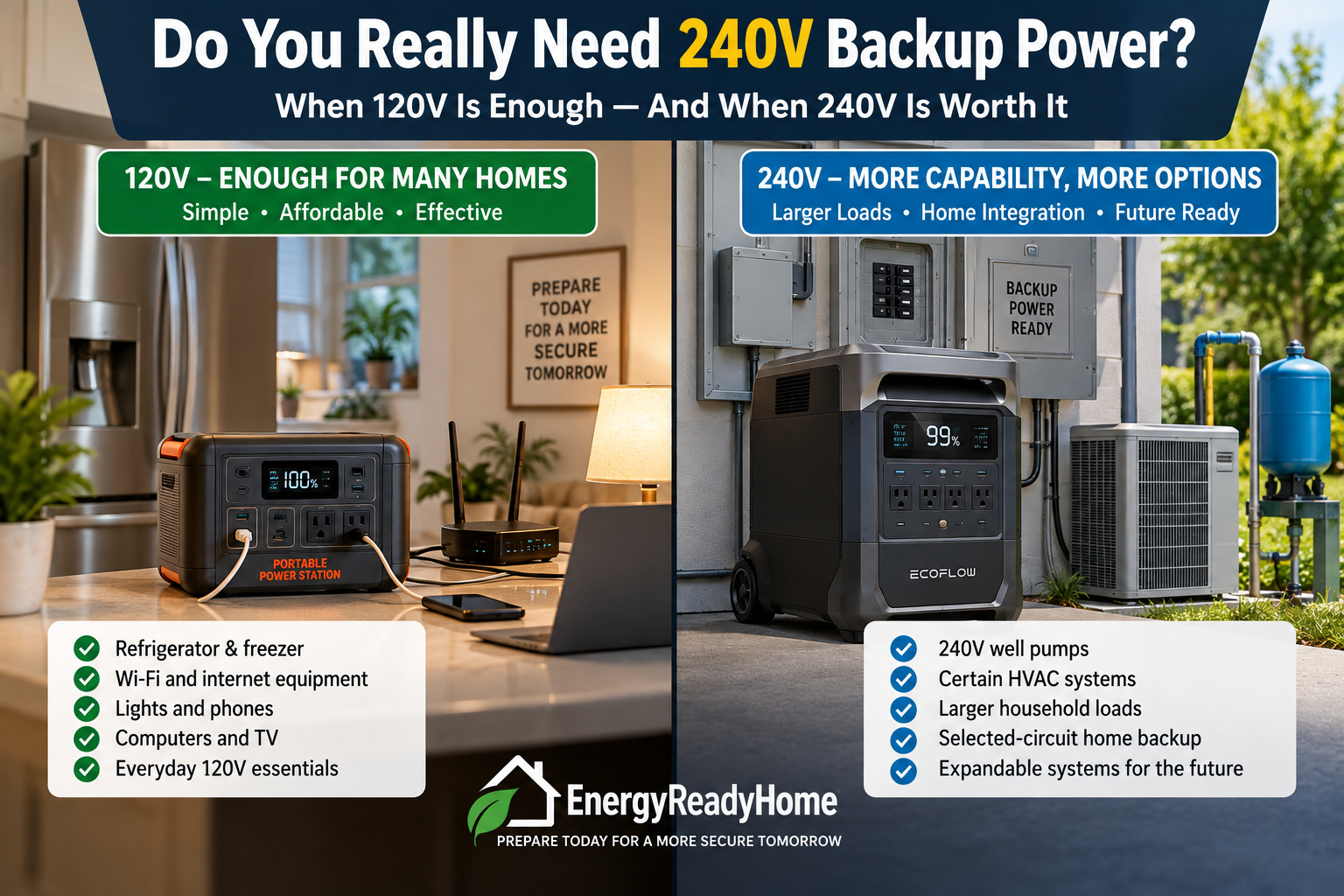
For many homeowners, no—you do not need a 240V portable power station for basic emergency backup.
If your outage plan is primarily to keep a refrigerator, freezer, internet equipment, lights, phones, laptops and a few ordinary outlets operating, a good 120V portable power station can often do the job for less money, with less weight and less complexity.
But 240V becomes much more valuable when your backup plan includes equipment such as a 240V well pump, certain HVAC systems or other large household loads, or when you’re building toward selected-circuit electrical-panel integration and a larger expandable home-backup system.
That’s the key distinction.
Don’t buy 240V because it sounds more powerful. Buy it because your backup plan actually requires—or will meaningfully benefit from—the capabilities that come with it.
Quick Answer: Is 240V Worth Paying For?
| Your Backup Goal | Is 240V Worth It? |
|---|---|
| Refrigerator, freezer, Wi-Fi and lights | Usually no |
| Phones, computers, TV and ordinary outlets | Usually no |
| CPAP and compatible small medical equipment | Usually no |
| Sump pump that operates on 120V | Not necessarily |
| 240V well pump | Often yes |
| Certain 240V HVAC equipment | Potentially yes |
| Selected-circuit home backup | Often useful |
| Larger expandable home-backup system | Often yes |
| Maximum future flexibility | Potentially yes |
This doesn’t mean every homeowner with a 240V appliance needs to back it up.
Sometimes the more economical decision is to exclude a large 240V load from your emergency-power plan rather than buy enough battery and inverter capacity to operate it.
What Does 240V Actually Mean?
Most ordinary U.S. household receptacles provide 120V power.
Many common outage essentials therefore operate at 120V, including:
- Refrigerators
- Freezers
- Internet routers
- Televisions
- Lamps
- Phone chargers
- Computers
- Many sump pumps
- Many small appliances
Homes also use 240V circuits for certain higher-demand equipment.
Examples can include:
- Well pumps
- Central air-conditioning systems
- Heat pumps
- Electric water heaters
- Electric ranges
- Clothes dryers
- EV charging equipment
- Other large motors and appliances
A 120V portable power station cannot directly provide the 240V supply required by a 240V appliance.
A power station designed for 120V/240V operation gives you another level of capability—but voltage alone doesn’t tell you whether it can run the appliance.
You still need to verify:
running watts + startup surge + voltage + connection method + available battery energy
That’s why simply seeing “240V” on a product specification shouldn’t determine your purchase.
The EnergyReadyHome 240V Value Test
Instead of starting with products, put your household into one of three categories.
Level 1 — 240V Is Probably Unnecessary
You primarily want to operate:
- Refrigerator
- Freezer
- Internet
- LED lights
- Phones
- Laptops
- Television
- Small kitchen appliances
- Other ordinary 120V essentials
If that’s your outage plan, don’t automatically pay a premium for 240V.
Your money may be better spent on:
- More battery capacity
- A better-quality 120V power station
- Additional battery expansion
- Solar panels
- Faster recharging
- Greater portability
For example, spending additional money simply to obtain 240V capability doesn’t help your refrigerator run longer.
Battery capacity does.
This is the group most likely to overspend on a 240V system.
Level 2 — 240V Is Useful
You don’t absolutely require 240V today, but you’re considering:
- Selected-circuit home backup
- Transfer-switch integration
- Larger household loads
- Greater inverter output
- Future battery expansion
- More sophisticated solar charging
- A backup system that can grow over time
Now 240V starts making more sense.
You’re no longer purchasing a battery only for today’s emergency loads.
You’re purchasing the foundation of a larger backup system.
That’s an important difference.
Level 3 — 240V Is Strategically Worthwhile
Your outage plan specifically includes a critical 240V load, or you already know that you want to build a substantial integrated home-backup system.
Examples could include:
- A critical 240V well pump
- Compatible 240V HVAC equipment
- Larger pumps
- Selected 240V household circuits
- Broader electrical-panel backup
- A high-output expandable home-power system
For these homeowners, buying a 120V-only system first can create a different problem:
You may eventually have to replace the platform rather than simply expand it.
That’s when paying more upfront for the appropriate 120V/240V architecture can be a better long-term decision.
The Question Isn’t Really 120V vs 240V
This is where portable-power-station shopping gets confusing.
A 240V system is often also:
- Higher output
- Larger capacity
- More expandable
- Better suited to home integration
- Capable of supporting more demanding loads
- Heavier
- More expensive
- More complex
So when someone says:
“I need a 240V power station.”
the better question is:
“What are you trying to power that your current 120V strategy cannot support?”
If the answer is nothing, you may not need 240V at all.
When a 120V Power Station Is the Better Buy
Imagine your emergency plan consists of:
- Refrigerator
- Freezer
- Router
- Several lights
- Phones
- Laptop
- Television
Suppose all those loads are compatible with a conventional 120V portable power station.
Moving to a premium 240V platform may give you substantially more capability—but you’re paying for capabilities your outage plan doesn’t require.
In this situation, we’d rather see the homeowner buy an appropriately sized 120V system and preserve money for runtime and replenishment.
That could mean purchasing more watt-hours, an expandable battery platform or useful solar capacity instead of buying voltage capability that sits unused.
This is an important EnergyReadyHome principle:
Unused capability has zero outage value.
When a 240V Well Pump Changes the Decision
A well pump is one of the clearest examples of when 240V can become genuinely important.
If your household depends on a 240V well pump for water during an outage, a conventional 120V portable power station doesn’t solve that requirement.
But don’t stop at voltage.
You must determine the pump’s:
- Operating voltage
- Running wattage
- Startup requirement
- Connection requirements
- Expected operating frequency
A system that provides 240V but cannot handle the pump’s startup demand still isn’t the right system.
Likewise, a high-output inverter attached to insufficient battery capacity may operate the pump but provide less overall outage runtime than you expect.
240V gets you into the right equipment category. It doesn’t finish the sizing calculation.
What About Central Air Conditioning?
Central air is another reason homeowners become interested in 240V systems.
Some current high-output portable power platforms are designed to support substantially larger loads than traditional portable power stations.
For example, Jackery currently specifies the Explorer 5000 Plus at 5,040Wh of capacity, 7,200W maximum AC output, 14,400W surge capability and 120V/240V operation.
According to Jackery’s official Explorer 5000 Plus specifications, the platform also supports compatible home-transfer equipment and substantial battery expansion.
That demonstrates how far portable battery systems have progressed.
But it does not mean every 240V air conditioner should automatically be included in your emergency plan.
HVAC can consume a tremendous amount of stored energy.
You must evaluate both:
Can the system run it?
and:
How long can the battery sustain it?
Those are completely different questions.
240V Does Not Mean Whole-House Backup
This is one of the biggest misconceptions in this product category.
A portable power station can provide 240V without being capable of supplying every electrical load in your house simultaneously.
Your home might contain:
- Central air conditioning
- Electric water heating
- Electric range
- Clothes dryer
- Well pump
- Refrigerator
- Freezer
- Lighting
- Electronics
- Numerous outlets
Turning several large loads on simultaneously can create enormous power demand.
And even if the inverter can handle that demand, high consumption can rapidly deplete the battery.
So when evaluating a 240V system, separate:
Power
Can it operate the required loads at the same time?
Measured primarily in watts.
Energy
How long can it keep those loads operating?
Measured primarily in watt-hours or kilowatt-hours.
Voltage
Can it provide the electrical supply required by the equipment?
A successful home-backup system has to satisfy all three.
Why 240V and Expandability Often Belong Together
This is one of the strongest arguments for buying 240V even when you don’t need it immediately.
Home-backup requirements tend to grow.
You may start by wanting:
refrigerator + Wi-Fi + lights
Later you may decide you want:
freezer + sump pump + more circuits + longer runtime
Eventually you may want:
electrical-panel integration + 240V equipment + solar replenishment + substantially more battery capacity
If that’s a realistic path for your household, purchasing an expandable 120V/240V platform at the beginning can prevent you from outgrowing your first system.
But this argument only works if expansion is genuinely likely.
Don’t spend thousands more today because you might someday want to operate an electric dryer during an outage.
Future-proofing has value.
Overbuying doesn’t.
Three 240V Platforms That Illustrate the Difference
The current market offers several approaches to larger 240V home backup.
BLUETTI Apex 300
The Apex 300 is particularly interesting for buyers who want to enter the 240V category without necessarily starting with an enormous battery bank.
Its modular architecture makes it attractive when the homeowner expects backup requirements to grow over time.
Best fit: Someone who wants 240V and an expansion path but prefers a modular starting point.
EcoFlow DELTA Pro 3
The DELTA Pro 3 occupies the middle ground between conventional portable power and a more integrated home-backup system.
Its combination of roughly 4kWh of starting battery capacity, high inverter output, 120V/240V capability and home-integration options makes it particularly relevant to homeowners whose requirements have moved beyond basic emergency loads.
Best fit: Someone who wants a substantial expandable home-backup platform without immediately moving into the largest system class.
Jackery Explorer 5000 Plus
The Explorer 5000 Plus makes more sense when you already know you want significant capacity and output from the starting system.
Its 5,040Wh battery and 7,200W 120V/240V output place it firmly in the serious home-backup category. Jackery also specifies compatibility with its 60A Smart Transfer Switch for selected household circuits.
Best fit: Someone building a larger selected-circuit backup system who wants substantial capability immediately.
ERH Decision: Should You Pay More for 240V?
Here’s the simplest test.
Ask yourself:
Do I have an essential 240V load?
If yes, evaluate a 240V system.
If no:
Do I realistically plan to integrate backup power with household circuits or build a substantially larger expandable system?
If yes, 240V may still be strategically worthwhile.
If no:
Would the money be more valuable if spent on battery capacity, recharging capability or a less expensive 120V system?
For many homeowners, the answer will be yes.
And that’s perfectly fine.
The objective isn’t to own the most capable portable power station.
The objective is to have the right backup system when the power actually goes out.
BLUETTI Apex 300
Affiliate disclosure: EnergyReadyHome may earn a commission if you purchase through this link, at no additional cost to you.
EcoFlow DELTA Pro 3
Affiliate disclosure: EnergyReadyHome may earn a commission if you purchase through this link, at no additional cost to you.
Jackery Explorer 5000 Plus
Affiliate disclosure: EnergyReadyHome may earn a commission if you purchase through this link, at no additional cost to you.
Frequently Asked Questions
Do I need a 240V portable power station for home backup?
Not necessarily.
If your backup plan focuses on ordinary 120V essentials such as a refrigerator, freezer, internet equipment, lights, phones, computers and selected outlets, a 120V portable power station may provide everything you actually need.
A 240V system becomes more relevant when you have an essential 240V load or want to build toward a larger, integrated and expandable home-backup system.
What household appliances normally use 240V?
Depending on the home and equipment, 240V loads can include:
- Well pumps
- Central air-conditioning equipment
- Heat pumps
- Electric water heaters
- Electric ranges
- Clothes dryers
- EV charging equipment
- Larger pumps and motors
Always verify the actual electrical requirements of your equipment. Two appliances serving the same purpose can have very different voltage, running-power and startup requirements.
Is 240V more powerful than 120V?
Not by itself.
Voltage is only one part of a backup system’s capability. You also need to consider the inverter’s continuous output, surge capability and the amount of energy stored in the battery.
A 240V-capable power station with insufficient output still may not start a demanding appliance. And a system with enormous inverter output but insufficient battery capacity may run a large load only briefly.
Can a 240V portable power station run a whole house?
Potentially, it can support significant portions of a home, but 240V capability does not automatically mean whole-house backup.
The actual answer depends on:
- Simultaneous household loads
- Continuous inverter output
- Startup surge requirements
- Battery capacity
- Connection equipment
- System configuration
- Load management
For many homeowners, backing up selected essential circuits is more practical and economical than attempting to reproduce normal whole-house electricity use during an outage.
Can a 240V portable power station run central air conditioning?
Some sufficiently capable systems may be able to operate compatible central-air equipment, but 240V capability alone isn’t enough.
You need to verify the air conditioner’s voltage, running wattage, startup demand and connection requirements against the complete backup system.
Runtime matters just as much. Even when a battery system can operate central air, HVAC can consume stored energy quickly.
Do I need 240V to run a well pump?
If your well pump requires 240V, your backup system must provide an appropriate 240V supply and enough power to handle both its running and startup requirements.
This is one of the situations where 240V capability can move from an optional feature to a genuine backup requirement.
Is 240V necessary for a transfer switch?
Not automatically.
A transfer switch is a method of safely supplying selected household circuits from a backup source. Whether your backup system needs 240V depends on the circuits and loads you intend to support and the design of the transfer equipment.
The transfer switch does not increase the power or battery capacity of the portable power station.
Should I buy 240V now in case I need it later?
Only when that future requirement is reasonably likely.
If you’re planning selected-circuit integration, expect to add battery capacity, anticipate an essential 240V load or want to build toward a larger home-backup system, purchasing an appropriate 120V/240V platform now can make sense.
If your foreseeable backup requirements remain refrigerator, freezer, Wi-Fi, lighting and electronics, buying 240V solely for hypothetical future use may be unnecessary.
What’s more important: 240V or battery capacity?
Neither is universally more important because they solve different problems.
Voltage determines whether the system can provide the type of electrical supply an appliance requires.
Output determines whether the system can handle the electrical load.
Battery capacity helps determine how long the system can operate those loads.
Your backup plan needs the right combination of all three.
Is a 240V portable power station worth the extra money?
It is worth considering when you will actually use the additional capability.
For homeowners with an essential 240V load, plans for deeper home integration or a clear path toward a larger expandable backup system, the additional investment can provide meaningful long-term value.
For homeowners whose emergency plan consists entirely of ordinary 120V essentials, a smaller system may offer better value.
Final Verdict
A 240V portable power station is not automatically the better home-backup system.
For basic emergency power, many homeowners can accomplish their goals with a properly sized 120V portable power station. Paying for capabilities you don’t need can divert money away from something that may matter much more during an outage—particularly additional battery capacity or recharging capability.
But once your backup requirements include a critical 240V load, selected-circuit integration or a deliberate plan to build a larger expandable system, 240V becomes much more compelling.
Use the EnergyReadyHome 240V Value Test:
Unnecessary: Your essential loads are 120V and your backup strategy is relatively simple.
240V Useful: You want greater system capability, expansion and potential home integration even though you don’t currently have a critical 240V load.
240V Strategically Worthwhile: A critical load requires 240V or you’re intentionally building a substantial integrated home-backup system.
The goal isn’t to buy the highest-voltage, highest-output or largest battery you can afford.
Buy the least complicated system that reliably supports the outage plan you actually need—with enough room to accommodate the future you’re reasonably likely to build.
Related Articles
- Best 240V Portable Power Stations for Home Backup (2026 Guide)
- BLUETTI Apex 300 Review: Is It Worth It for Home Backup in 2026?
- EcoFlow DELTA Pro 3 Review: Is It Worth It for Home Backup in 2026?
- Jackery Explorer 5000 Plus Review: Is It Worth It for Home Backup in 2026?
- Portable Power Station With a Transfer Switch: What Size System Do You Need?