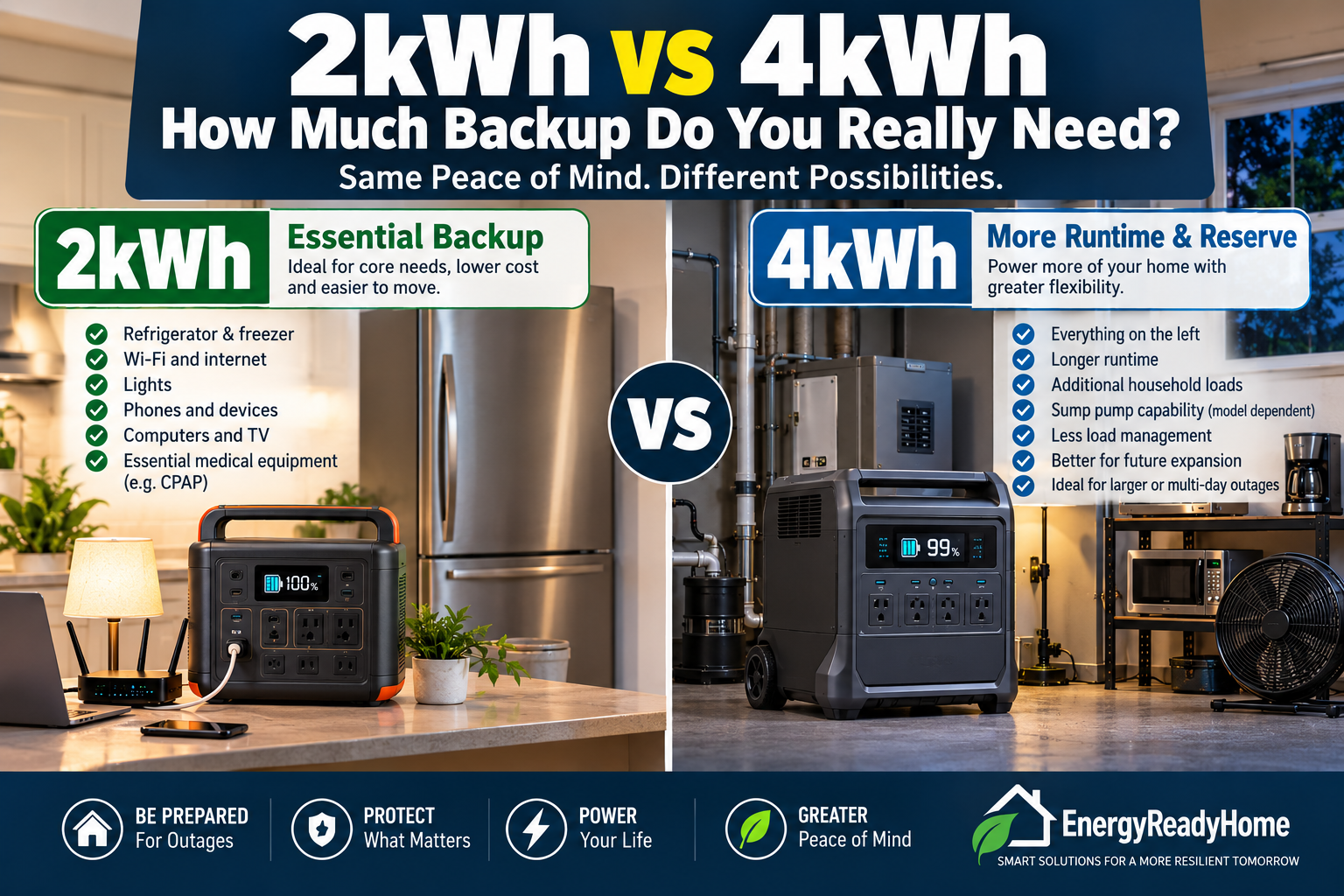
For many households, a 2kWh portable power station is the better starting point for essential outage backup. Moving to approximately 4kWh becomes worthwhile when you need substantially longer runtime, want to operate more equipment, prefer less aggressive load management, or are building toward a larger home-backup system.
The difference sounds simple: a 4kWh battery stores roughly twice as much energy as a 2kWh battery.
But the buying decision isn’t simply:
Do I want twice as much battery?
The better question is:
Will the additional 2kWh materially improve how my household gets through an outage?
Sometimes the answer is absolutely yes.
Other times, spending substantially more money for a larger, heavier system simply leaves you with battery capacity you rarely use.
That’s why EnergyReadyHome recommends deciding what the additional capacity accomplishes before deciding how much battery to buy.
Quick Answer: 2kWh vs 4kWh
| Backup Priority | 2kWh Class | 4kWh Class |
|---|---|---|
| Refrigerator and freezer | Good fit | More runtime reserve |
| Wi-Fi, phones and lights | Good fit | Usually more than necessary by themselves |
| Computers and electronics | Good fit | More flexibility |
| CPAP or compatible medical equipment | Potentially good fit | Greater reserve |
| Sump pump plus essentials | Possible, depending on usage | More comfortable reserve |
| Multiple household appliances | Requires more load management | Better fit |
| Longer outage without recharging | More limited | Stronger |
| Portability | Generally better | Generally worse |
| Home-backup expansion | Product dependent | Often stronger |
| Less aggressive energy management | More difficult | Easier |
The key word is reserve.
A 4kWh system doesn’t necessarily let you operate an appliance that a 2kWh system cannot operate.
That depends primarily on inverter output, surge capability and voltage.
Battery capacity primarily determines how much stored energy you have available to keep compatible loads operating.
First: What Does 2kWh or 4kWh Actually Mean?
A kilowatt-hour is a measure of stored energy.
2kWh = approximately 2,000 watt-hours
4kWh = approximately 4,000 watt-hours
In a simplified theoretical calculation:
Battery capacity ÷ average load = theoretical runtime
So:
A 2,000Wh battery supporting a constant 200W load would theoretically provide:
2,000Wh ÷ 200W = 10 hours
A 4,000Wh battery supporting that same load would theoretically provide:
4,000Wh ÷ 200W = 20 hours
But those are mathematical examples—not guaranteed real-world runtimes.
Actual usable runtime is affected by factors including:
- Inverter losses
- Battery-management overhead
- Standby consumption
- Temperature
- Appliance cycling
- Battery state of charge
- Operating conditions
That means you should never purchase a battery assuming every watt-hour printed on the specification sheet will reach your appliances.
Capacity and Output Are Not the Same Thing
This distinction is critical.
Imagine two portable power stations:
System A
- 2kWh battery
- 3,000W inverter
System B
- 4kWh battery
- 2,000W inverter
System B stores twice as much energy.
But System A can potentially support a larger simultaneous load because its inverter output is higher.
Think of it this way:
Battery capacity = how much energy you have
Inverter output = how quickly you can use that energy
Surge capability = whether the system can handle temporary startup demand
Voltage = which types of equipment the system can support
A bigger battery does not automatically mean a more powerful inverter.
The EnergyReadyHome 2kWh-to-4kWh Upgrade Test
Before spending more for a 4kWh-class system, ask whether moving up solves at least one meaningful problem.
1. Do You Need More Runtime Reserve?
This is the most obvious reason to move from 2kWh toward 4kWh.
Suppose your essential-load plan consumes approximately 1.5kWh over the outage period you’re trying to cover.
A nominal 2kWh battery doesn’t leave enormous breathing room once real-world losses and uncertainty are considered.
Moving toward 4kWh gives you considerably more reserve.
That reserve can matter when:
- The outage lasts longer than expected
- Refrigeration runs more frequently
- A sump pump cycles more often
- Someone uses an appliance you didn’t anticipate
- Recharging isn’t immediately available
- Solar conditions are poor
If your calculated energy requirement already consumes most of a 2kWh battery, 4kWh starts looking much more attractive.
2. Do You Want to Add More Essential Loads?
A 2kWh system can be a strong foundation for carefully prioritized essentials.
Your plan might include:
- Refrigerator
- Freezer
- Internet equipment
- Phones
- LED lighting
- Laptop
- Television
- Selected compatible medical or accessibility equipment
Now start adding:
- Sump pump
- Furnace controls
- More electronics
- Additional lighting
- Kitchen appliances
- More refrigeration
- Other household equipment
Your daily energy budget begins to grow.
At some point, you’re no longer asking whether a 2kWh system works.
You’re asking whether you want to spend an extended outage constantly deciding:
What do I need to turn off before I turn something else on?
That’s when additional capacity becomes valuable.
3. Do You Want Less Aggressive Load Management?
This is one of the most overlooked benefits of a larger battery.
A carefully managed 2kWh system may cover your most important equipment very effectively.
But careful management requires attention.
You may need to:
- Limit television use
- Reduce unnecessary lighting
- Avoid convenience appliances
- Monitor refrigeration consumption
- Watch battery percentage
- Schedule certain loads
- Recharge sooner
A 4kWh battery doesn’t eliminate the need for energy management.
It simply gives you more margin for mistakes, changing conditions and ordinary household behavior.
That can be particularly valuable when several people are using the backup system.
4. Are You Building Toward a Larger Backup System?
This is where the buying decision changes again.
If you only want a self-contained portable battery for essential loads, approximately 2kWh may be plenty.
If you’re moving toward:
- Selected-circuit backup
- Greater battery expansion
- Higher-output equipment
- 240V capability
- Solar-supported extended outages
- More substantial home integration
then starting around 4kWh—or buying an expandable platform—can make more sense.
That brings us to the most important alternative to choosing between fixed 2kWh and 4kWh systems.
Option Three: Start at 2kWh and Expand Later
You don’t necessarily have to predict your maximum future battery requirement today.
An expandable 2kWh platform can give you a third strategy:
Start around 2kWh → experience a real outage → add battery capacity if necessary
The Jackery Explorer 2000 Plus illustrates this approach particularly well.
It starts with 2,042.8Wh of battery capacity and 3,000W of continuous AC output. Jackery also supports compatible expansion batteries, allowing the system to grow substantially beyond its starting capacity.
According to Jackery’s official Explorer 2000 Plus specifications, the base unit provides 2,042.8Wh of capacity, 3,000W of total AC output and support for compatible expansion batteries.
For someone who isn’t sure whether 2kWh will ultimately be enough, this can be an attractive compromise.
You avoid automatically buying a much larger system today without permanently locking yourself into the original battery capacity.
Jackery Explorer 2000 Plus
Affiliate disclosure: EnergyReadyHome may earn a commission if you purchase through this link, at no additional cost to you.
When 2kWh Is Probably Enough
A 2kWh-class portable power station is especially attractive when your outage strategy is disciplined.
You’re primarily protecting:
food + communications + lighting + electronics + selected essential equipment
For example, BLUETTI currently specifies the Elite 200 V2 at 2,073.6Wh of capacity and 2,600W of standard AC output.
That combination demonstrates why today’s 2kWh category can provide serious emergency capability.
You have roughly 2kWh of stored energy combined with enough inverter output to support many combinations of ordinary household essentials—provided their actual running and startup requirements remain within the system’s limits.
A 2kWh-class system can therefore make sense when:
- Your outage energy budget is comfortably below its usable capacity
- You can recharge during longer outages
- You don’t need substantial 240V capability
- Portability matters
- You are comfortable managing loads
- Your critical equipment is relatively efficient
- You don’t need a large reserve margin
BLUETTI Elite 200 V2
Affiliate disclosure: EnergyReadyHome may earn a commission if you purchase through this link, at no additional cost to you.
When 4kWh Starts Making More Sense
Moving toward 4kWh changes the experience.
Instead of designing the system around the absolute minimum energy required to survive an outage, you’re buying more operating margin.
A 4kWh-class system becomes increasingly attractive when:
- Your expected consumption approaches or exceeds 2kWh
- Refrigeration demand is substantial
- You have multiple refrigerators or freezers
- A sump pump may operate frequently
- You need longer runtime between recharge opportunities
- Several people will use the system
- You want greater reserve for uncertainty
- You expect your backup requirements to grow
- You want a more substantial home-backup architecture
The EcoFlow DELTA Pro 3 is a good example of this category.
It provides 4,096Wh of rated capacity and 4,000W of continuous AC output, along with 120V/240V capability and an expandable architecture.
Notice what’s happening here.
You’re not merely doubling stored energy compared with a roughly 2kWh system.
You’re also moving into a different class of home-backup platform.
That additional capability may be valuable—but only if you’ll use it.
EcoFlow DELTA Pro 3
Affiliate disclosure: EnergyReadyHome may earn a commission if you purchase through this link, at no additional cost to you.
2kWh vs 4kWh: The Portability Tradeoff
Battery capacity has a physical cost.
Larger systems generally require more battery cells, larger enclosures and more substantial hardware.
For perspective, the BLUETTI Elite 200 V2 weighs approximately 53.4 pounds, while the EcoFlow DELTA Pro 3 weighs approximately 113.5 pounds.
That’s a significant difference.
The EcoFlow has wheels and a handle to help move it, but you’re still comparing two very different portability classes.
This matters if you expect to:
- Carry the unit between floors
- Load it into a vehicle
- Move it between home and RV
- Store it on shelving
- Frequently reposition it around the house
A 4kWh system may provide more resilience while simultaneously becoming less genuinely portable.
More battery is only better if the physical system still fits how you intend to use it.
What Does Doubling Capacity Actually Buy You?
Here’s a simplified illustration.
| Average Load | 2kWh Theoretical Runtime | 4kWh Theoretical Runtime |
|---|---|---|
| 100W | 20 hours | 40 hours |
| 200W | 10 hours | 20 hours |
| 300W | 6.7 hours | 13.3 hours |
| 500W | 4 hours | 8 hours |
| 750W | 2.7 hours | 5.3 hours |
| 1,000W | 2 hours | 4 hours |
These are theoretical mathematical comparisons, not promised appliance runtimes.
Real-world runtime will be lower.
But the table illustrates the fundamental value proposition:
Doubling battery capacity approximately doubles the stored energy available to the same load.
It does not automatically double inverter output.
It does not automatically add 240V.
It does not automatically make an incompatible appliance compatible.
It primarily buys you more time.
The Refrigerator-and-Freezer Test
For many households, refrigeration is the heart of the outage plan.
If your refrigerator, freezer and other essentials consume an amount of energy that fits comfortably inside your 2kWh-class system’s usable capacity for the period you’re trying to cover, moving to 4kWh may provide little immediate benefit.
But if refrigeration plus communications, lighting and other essential equipment already pushes you close to your available energy limit, the larger battery creates valuable reserve.
That’s why copying someone else’s battery recommendation can be misleading.
Two families can own identical refrigerators and still experience different outage consumption because of:
- Appliance age and efficiency
- Indoor temperature
- How frequently doors are opened
- Freezer temperature
- Household size
- Other connected loads
Your energy budget matters more than somebody else’s runtime claim.
What If You Have a Sump Pump?
A sump pump adds uncertainty.
It may consume little energy during dry conditions and become one of the most important loads in the house during a severe storm.
That’s precisely when the grid may fail.
A 2kWh battery might support your normal essential loads comfortably—until the sump pump begins cycling repeatedly.
A larger battery gives you more energy reserve for that uncertainty.
But remember the earlier distinction:
The battery must have enough capacity to sustain the pump over time, while the inverter must also have enough output and surge capability to start it.
Moving from 2kWh to 4kWh solves only the first problem unless the larger system also provides greater inverter capability.
Don’t Buy 4kWh Just Because the Outage Might Last Three Days
Outage duration matters, but battery capacity isn’t the only way to solve a longer outage.
Consider your recharging strategy.
A 2kWh system that can be reliably replenished may provide greater resilience than a 4kWh system that cannot.
Possible replenishment sources can include:
- Grid power when service intermittently returns
- Appropriately configured solar panels
- Compatible vehicle charging
- Other manufacturer-supported charging methods
Solar is particularly useful for resilience planning, but it should never be treated as guaranteed daily energy.
Clouds, shading, season, panel orientation and available daylight all affect production.
The better question isn’t simply:
“How many days will my battery last?”
It’s:
“How much energy will I consume between realistic opportunities to recharge?”
The Cost of Buying Too Small
Buying too little capacity can leave you:
- Constantly monitoring battery percentage
- Cutting loads earlier than expected
- Recharging more frequently
- Unable to maintain your desired reserve
- Purchasing additional equipment later
If your calculations already put you near the limit of a 2kWh system, buying exactly 2kWh leaves little margin for real-world uncertainty.
That’s a strong argument for moving up.
The Cost of Buying Too Large
Oversizing has costs too.
You may spend more money for:
- Battery capacity you rarely use
- A heavier system
- More storage space
- Reduced portability
- A more complex backup platform
If your actual outage plan consumes 700Wh before you can recharge, owning 4,000Wh doesn’t automatically make you better prepared than owning an appropriately designed 2,000Wh system.
Unused battery capacity provides reserve—but reserve has diminishing value once it greatly exceeds your realistic requirements.
ERH Decision: 2kWh or 4kWh?
Use the EnergyReadyHome 2kWh-to-4kWh Upgrade Test.
Stay Around 2kWh When:
Your essential-load energy requirement fits comfortably within the available capacity, portability matters, you have a realistic recharging plan and you’re willing to manage consumption.
Move Toward 4kWh When:
Your expected consumption is already approaching the limits of 2kWh, you need substantially more runtime reserve, you want to support additional essential loads, or you don’t want to manage energy as aggressively.
Start Around 2kWh and Expand Later When:
You’re unsure what you’ll ultimately need and can choose an expandable platform that allows you to add battery capacity without replacing the original system.
For many households, that third option may be the smartest compromise of all.
The goal isn’t to purchase the largest battery you can afford.
It’s to purchase enough stored energy to make your outage plan work—with enough reserve that the first unexpected load doesn’t ruin the plan.
How to Decide Without Guessing
If you’re still unsure whether 2kWh or 4kWh is right, don’t start with the battery.
Start with the energy you actually expect to consume between recharging opportunities.
A practical process is:
- List the equipment you consider essential.
- Estimate how much energy each load will consume during the period you’re planning to cover.
- Add those watt-hours together.
- Allow additional reserve for conversion losses, changing conditions and unexpected usage.
- Compare that requirement with the battery capacity you’re considering.
- Separately verify inverter output, startup surge and voltage requirements.
That last step matters because a 4kWh battery can still be the wrong system if its inverter cannot start an essential appliance.
Should You Buy 2kWh or 4kWh for Home Backup?
For most buyers, we would make the decision this way.
Choose approximately 2kWh if your primary goal is maintaining a disciplined group of essential 120V loads and you value lower weight, lower cost and easier portability.
Choose approximately 4kWh if your calculated consumption already puts meaningful pressure on a 2kWh battery, you want substantially more reserve, or you expect to operate a broader collection of household equipment.
Choose an expandable 2kWh platform if you’re genuinely uncertain. It can let you enter the market without immediately paying for all the battery capacity you might eventually need.
And if your backup plan includes significant 240V equipment or selected-circuit home integration, capacity alone should no longer drive the decision. Voltage, inverter output and system architecture become equally important.
Frequently Asked Questions
Is 2kWh enough for a power outage?
For many households, yes. Approximately 2kWh can provide meaningful backup for carefully prioritized essentials such as refrigeration, internet equipment, lights, phones, computers and other compatible equipment.
Whether it’s enough for your outage depends on how much energy those loads consume before you can recharge.
Is 4kWh twice as good as 2kWh?
Not necessarily.
A 4kWh battery stores roughly twice as much energy as a 2kWh battery, so the same load can theoretically operate for approximately twice as long.
But “twice the capacity” doesn’t mean twice the inverter output, twice the surge capability or twice the appliance compatibility.
The extra capacity is valuable only when you need the additional stored energy.
How long will a 2kWh portable power station last?
It depends on the load.
Ignoring real-world losses for a moment, a 2,000Wh battery would theoretically support:
- 100W for about 20 hours
- 200W for about 10 hours
- 500W for about 4 hours
- 1,000W for about 2 hours
Actual runtime will be lower because the full nominal battery capacity generally isn’t delivered to AC appliances.
How long will a 4kWh portable power station last?
Under the same simplified calculation, a 4,000Wh battery would theoretically support:
- 100W for about 40 hours
- 200W for about 20 hours
- 500W for about 8 hours
- 1,000W for about 4 hours
Again, those are mathematical illustrations rather than guaranteed runtimes.
Is 2kWh enough to run a refrigerator and freezer?
Potentially, yes.
But there isn’t a reliable universal runtime because refrigerators and freezers cycle rather than draw constant power. Their actual energy consumption varies with appliance efficiency, temperature, usage and other conditions.
The better approach is to estimate or measure the energy consumption of your actual appliances and include appropriate reserve.
Is 4kWh better for a sump pump?
It can be better for runtime, especially when a pump may cycle frequently during the same storm causing the outage.
But battery capacity is only part of the requirement.
You must also verify that the portable power station’s inverter can handle the pump’s running wattage and startup surge. A larger battery doesn’t automatically solve an insufficient inverter.
Should I buy 4kWh for a three-day outage?
Not automatically.
A three-day outage requires a resilience strategy, not simply a larger battery.
If you consume 2kWh every day, even a nominal 4kWh battery won’t independently cover 72 hours without significant load reduction or replenishment.
For longer outages, consider stored capacity together with your realistic ability to recharge.
Is an expandable 2kWh system better than buying 4kWh immediately?
For some buyers, yes.
An expandable system can let you start with approximately 2kWh, determine how the system performs with your actual household loads, and add compatible battery capacity later.
The tradeoff is that expansion batteries add cost and equipment. If you already know you’ll routinely need approximately 4kWh, purchasing a larger starting system may be more straightforward.
Should I buy more battery capacity than my calculation says I need?
Some reserve is prudent because real-world outages aren’t perfectly predictable.
The objective isn’t to massively oversize the system. It’s to avoid designing your backup plan around using essentially 100% of nominal battery capacity under ideal conditions.
Final Verdict: 2kWh vs 4kWh
For many households, 2kWh is the sweet spot for serious but carefully managed essential-load backup.
It can provide enough stored energy to make refrigeration, communications, lighting and selected electronics practical during an outage without moving into the size, weight and cost of a substantially larger system.
But 4kWh begins to justify itself when the household wants more runtime, more reserve, more loads and less aggressive energy management.
That’s the key distinction.
Don’t move from 2kWh to 4kWh simply because 4 is bigger than 2.
Move up because you’ve identified something the additional capacity accomplishes.
The EnergyReadyHome 2kWh-to-4kWh Upgrade Test therefore comes down to four questions:
Do I need substantially more runtime?
Do I need to support additional essential loads?
Do I want considerably more reserve and less load management?
Am I building toward a larger home-backup system?
If the answers are mostly no, approximately 2kWh may be the smarter purchase.
If several answers are yes, moving toward 4kWh becomes much easier to justify.
And if you don’t know yet, an expandable 2kWh-class platform can give you a valuable middle path.
The right amount of backup isn’t the biggest battery you can buy.
It’s the smallest system that comfortably meets your real outage requirements—with enough reserve to handle the unexpected.
Related Articles
- How Much Battery Capacity Do I Need for Backup Power?
- Best Portable Power Stations for a 24-Hour Power Outage
- Best Portable Power Stations for a 3-Day Power Outage
- Jackery Explorer 2000 Plus Review: Is It Worth It for Home Backup in 2026?
- EcoFlow DELTA Pro 3 Review: Is It Worth It for Home Backup in 2026?