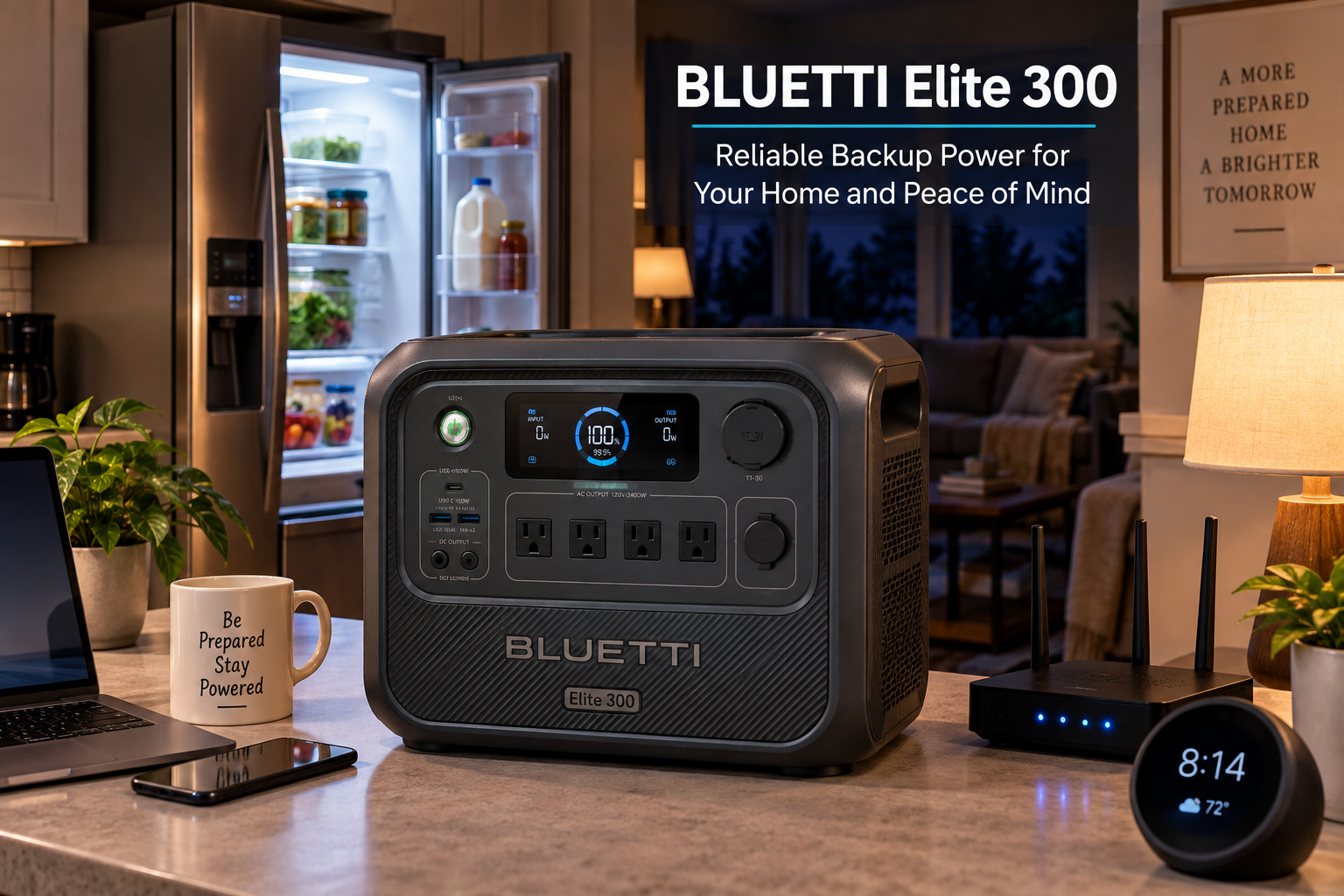
The BLUETTI Elite 300 occupies an interesting position in the portable power station market. With 3,014Wh of battery capacity and 2,400W of continuous AC output, it gives homeowners substantially more stored energy than a typical 2kWh portable power station without moving all the way into a large modular whole-home backup system.
That combination makes the Elite 300 particularly interesting for emergency home backup.
It can provide meaningful runtime for refrigerators, freezers, internet equipment, lights, televisions, computers and other compatible household essentials while remaining a self-contained portable power station. BLUETTI also equips it with a 10 ms UPS function, app-based monitoring and control, and a LiFePO₄ battery rated for more than 6,000 cycles.
But 3kWh is an unusual middle ground.
The Elite 300 costs more and weighs more than smaller portable power stations, while homeowners who need 240V capability or extensive battery expansion may be better served by a larger home-backup platform.
So is the BLUETTI Elite 300 actually the right size for home backup?
Quick Verdict
The BLUETTI Elite 300 is a strong choice for homeowners who want approximately 3kWh of portable backup capacity without moving into a larger modular home-backup system.
Its biggest advantage is straightforward: 3,014Wh gives you roughly 45% more stored energy than a typical 2kWh-class system, while its 2,400W continuous output is sufficient for many common 120V emergency loads.
We particularly like the Elite 300 for homeowners whose outage plan centers on keeping several essentials operating for longer rather than powering the largest possible appliances.
Best For
- Refrigerator and freezer backup
- Internet and communications equipment
- Lights and electronics
- CPAP and other compatible low-to-moderate-power equipment
- Television and computers
- Intermittent use of compatible kitchen appliances
- Homeowners who want more runtime than a 2kWh system
- Buyers who still want a movable, self-contained power station
Consider Another System If
- You specifically need 240V output
- You want to integrate backup power extensively with household electrical circuits
- You expect to build a much larger expandable battery system
- Your primary goal is running central air conditioning or other major 240V loads
- A smaller 1–2kWh system already provides enough runtime for your outage plan
BLUETTI Elite 300 Key Specifications
| Specification | BLUETTI Elite 300 |
|---|---|
| Battery Capacity | 3,014.4Wh |
| Battery Chemistry | LiFePO₄ |
| Continuous AC Output | 2,400W |
| Power Lifting Mode | Up to 4,800W for compatible resistive loads |
| Battery Cycle Life | 6,000+ cycles |
| UPS Switchover | 10 ms |
| App Control | Bluetooth and Wi-Fi |
| RV Output | TT-30 |
| Primary Home-Backup Role | Extended 120V essential-load backup |
Specifications should always be considered alongside the requirements of the individual appliances you intend to operate. Starting surges, simultaneous loads and appliance-specific power requirements can determine whether a particular device is suitable even when its normal running wattage appears to fit within the power station’s output.
What Makes the Elite 300 Different?
The most important feature of the Elite 300 isn’t simply its 2,400W inverter.
It’s the 3,014Wh battery.
Portable power stations around the 2kWh level have become a practical sweet spot for emergency household use. They can provide substantial refrigerator, communications and electronics backup without becoming enormous.
The Elite 300 takes a different approach: increase stored energy to approximately 3kWh while keeping the system relatively self-contained.
That additional kilowatt-hour can matter during an outage.
For example, two systems may both be capable of operating a refrigerator, but the system with greater battery capacity can potentially operate that refrigerator and other essential loads for longer before recharging becomes necessary.
That’s why homeowners should distinguish between power and energy.
Watts determine what you can run. Watt-hours help determine how long you can run it.
The Elite 300’s 2,400W output determines the amount of compatible equipment that can operate at a given time. Its 3,014Wh battery determines the pool of stored energy available to keep those devices operating.
For outage preparedness, both matter.
How Much Usable Backup Does 3,014Wh Provide?
A 3,014Wh battery does not mean you should assume that exactly 3,014Wh will reach your appliances.
Power stations consume energy through inverter operation, electronics and other conversion losses. Actual runtime also changes with load, temperature, battery state and the behavior of the appliance itself.
For planning purposes, we prefer to think in realistic ranges rather than theoretical maximums.
If a household could ultimately use roughly 85% of the Elite 300’s nominal capacity after allowing for system losses, approximately 2,562Wh would be available for AC loads.
That produces the following simplified planning examples:
| Average Load | Approximate Planning Runtime* |
|---|---|
| 50W | 51 hours |
| 100W | 25.6 hours |
| 200W | 12.8 hours |
| 300W | 8.5 hours |
| 500W | 5.1 hours |
| 1,000W | 2.6 hours |
These are EnergyReadyHome planning estimates, not guaranteed manufacturer runtimes. Actual results can vary significantly depending on appliance cycling, inverter efficiency, temperature and other operating conditions.
This table also demonstrates why the Elite 300 can be more valuable as an essential-load backup system than as a way to operate high-wattage equipment continuously.
A refrigerator that cycles on and off is fundamentally different from a 1,500W electric heater running continuously.
Where the Elite 300 Fits in a Home Backup Plan
Think of portable backup systems as a capacity ladder.
A 1kWh-class system can be excellent for short outages, communications equipment, electronics and selected essentials.
A 2kWh-class system provides substantially more flexibility and has become a strong option for refrigerator/freezer backup plus additional household essentials.
A 3kWh system such as the Elite 300 extends that runtime further without automatically requiring the homeowner to move into a large expandable home-backup architecture.
Above that, systems around 4kWh and larger increasingly begin competing with expandable platforms intended for more extensive home backup.
For homeowners still deciding between these capacity classes, our guide to 2kWh vs 4kWh portable power stations explains why simply buying the largest battery isn’t always the best answer.
The Elite 300 effectively creates another option between those two capacity levels.
Our Home-Backup Assessment
For EnergyReadyHome, the Elite 300’s strongest role is:
Extended-duration backup for important 120V household loads.
That’s different from calling it a whole-home backup system.
A homeowner could use the Elite 300 strategically during an outage to prioritize:
- Food preservation
- Internet connectivity
- Phones and communications
- Lighting
- Computers
- Television
- Medical or accessibility equipment whose electrical requirements have been verified
- Selected kitchen or household appliances used intermittently
That type of load management can stretch a 3kWh battery considerably further than trying to recreate normal grid-powered living.
It also fits an important principle we’ve emphasized throughout our outage-planning coverage:
The best backup system isn’t necessarily the one that can power everything. It’s the one that reliably powers what you have already decided matters most.
Affiliate Option: BLUETTI Elite 300
The Elite 300 is now directly monetizable through EnergyReadyHome’s verified BLUETTI affiliate route.
BLUETTI Elite 300
Check Current Price:https://energyreadyhome.com/go/bluetti-elite-300
EnergyReadyHome may earn a commission if you purchase through this link, at no additional cost to you.
Manufacturer Specification Source
For readers who want to verify the manufacturer’s current specifications, configurations and compatibility information, BLUETTI maintains the official Elite 300 product page here:
See the official BLUETTI Elite 300 specifications for current manufacturer specifications and configuration information.
Charging the BLUETTI Elite 300
A backup battery is only as useful as your ability to recharge it during an extended outage.
The Elite 300 provides several charging options, including AC wall charging, solar charging and vehicle-based charging with compatible equipment.
For normal household preparedness, AC charging will usually be the simplest method. You can keep the power station ready before severe weather and recharge it from grid power whenever electricity is available.
Solar becomes more important during a multi-day outage.
The Elite 300 supports up to 1,200W of DC input, giving homeowners the option of pairing the system with compatible solar panels. Actual solar production depends heavily on weather, panel orientation, season, shading and the solar array being used, so homeowners should not assume that a panel’s rated wattage will continuously reach the battery.
That distinction becomes especially important when planning for outages lasting several days.
If extended outages are your primary concern, our guide to preparing with larger portable systems provides additional context:
<p>See our <a href="https://energyreadyhome.com/best-portable-power-stations-3-day-outage/">Best Portable Power Stations for a 3-Day Power Outage</a> guide for a broader look at long-duration backup planning.</p>The Elite 300 can also accept combined AC and DC input of up to 2,400W, according to BLUETTI’s specifications. That can substantially reduce recharge time when appropriate charging sources are available.
Portability: Portable, but Not Lightweight
The word “portable” deserves some context with a 3kWh battery.
The Elite 300 weighs approximately 58 pounds.
That’s movable, but it isn’t something most people will casually carry around the house with one hand.
We consider it better described as relocatable backup power.
You can move it:
- From storage to the kitchen during an outage
- Between important household loads
- Into an RV or vehicle
- To another location before severe weather
- Between indoor and outdoor applications when appropriate
But if you expect to move your power station frequently, weight deserves serious consideration before buying.
This is one of the tradeoffs that comes with increasing battery capacity.
More stored energy usually means more battery cells, and more battery cells add weight.
The Elite 300 therefore makes the most sense for someone who values the additional runtime of a 3kWh battery enough to accept a roughly 58-pound unit.
Elite 300 vs a 2kWh Portable Power Station
This may be the most important buying decision for prospective Elite 300 owners.
Do you actually need 3kWh?
A good 2kWh portable power station can already provide substantial emergency capability. If you’re primarily protecting a refrigerator, internet equipment, phones and a few lights during relatively short outages, 2kWh may be enough.
The Elite 300 becomes more compelling when you want additional runtime or expect to operate several essential loads.
Consider the difference in nominal battery capacity between the Elite 300 and BLUETTI’s smaller Elite 200 V2:
- Elite 300: 3,014.4Wh
- Elite 200 V2: 2,073.6Wh
That’s approximately 941Wh of additional nominal storage in the Elite 300.
That extra energy could be valuable during an overnight outage or when grid power remains unavailable into the next day.
But it isn’t free capacity.
You’re accepting a larger battery, additional weight and potentially higher purchase cost in exchange for the extra runtime.
For homeowners deciding where their needs fall on this capacity spectrum, we’ve examined the broader decision here:
<p>Our <a href="https://energyreadyhome.com/2kwh-vs-4kwh-portable-power-station/">2kWh vs 4kWh Portable Power Station: How Much Backup Do You Really Need?</a> guide can help you determine whether moving beyond the 2kWh class makes sense for your outage plan.</p>Elite 300 vs BLUETTI Elite 200 V2
The Elite 200 V2 remains an important alternative because bigger isn’t automatically better.
The Elite 200 V2 offers 2,073.6Wh of battery capacity and 2,600W of continuous AC output. Interestingly, that means it actually has higher rated continuous AC output than the Elite 300 despite having substantially less stored energy.
That illustrates the difference between power and capacity particularly well.
Choose the Elite 200 V2 when you prioritize:
- Lower weight
- Approximately 2kWh of capacity
- Higher continuous AC output
- Shorter-duration essential-load backup
- A smaller system that’s easier to move
Choose the Elite 300 when you prioritize:
- Approximately 3kWh of stored energy
- Longer potential runtime
- More energy for multiple essential loads
- Longer outages
- RV-oriented connectivity such as the TT-30 output
We reviewed the smaller model separately here:
<p>Read our <a href="https://energyreadyhome.com/bluetti-elite-200-v2-review/">BLUETTI Elite 200 V2 Review: Is It Worth It for Home Backup in 2026?</a> for a closer look at the 2kWh-class alternative.</p>What About the BLUETTI Apex 300?
The BLUETTI Apex 300 represents a different step up.
Rather than simply providing more portable battery capacity, the Apex 300 moves toward a more expandable home-backup architecture, including 120V/240V capability and substantially greater expansion potential.
That’s an important distinction.
The Elite 300 is attractive because it’s relatively straightforward: one self-contained 3kWh-class portable power station.
The Apex 300 is better suited to homeowners thinking about a larger system that can grow over time.
We would therefore frame the choice this way:
Elite 300: Buy it because you want a self-contained 3kWh portable backup system.
Apex 300: Consider it when you’re beginning to think beyond portable backup toward a larger expandable home-energy system.
For buyers whose requirements are approaching that level, this review explains the difference in system philosophy:
<p>See our <a href="https://energyreadyhome.com/bluetti-apex-300-review/">BLUETTI Apex 300 Review: Is It Worth It for Home Backup in 2026?</a> before deciding whether a larger expandable platform better fits your needs.</p>What We Like About the BLUETTI Elite 300
The strongest feature is the capacity-to-size proposition.
A little over 3kWh is enough stored energy to provide meaningful emergency flexibility without immediately jumping into the size and complexity of a large home-battery system.
We also like:
- 3,014.4Wh LiFePO₄ battery
- 2,400W continuous AC output
- 10 ms UPS switchover
- Up to 1,200W DC input
- Wi-Fi and Bluetooth connectivity
- TT-30 RV output
- 12V/30A DC output
- Multiple USB charging options
- A self-contained design that does not require permanent installation
The Elite 300 also fits a useful niche that isn’t always well served by portable power stations: homeowners who believe 2kWh is a little too small but don’t need a 4–5kWh system.
What We Don’t Like
There are tradeoffs.
It’s Heavy
At approximately 58 pounds, the Elite 300 is portable in the technical sense, but it isn’t particularly light.
2,400W Output May Be the Limiting Factor
The 3,014Wh battery provides considerable energy storage, but continuous AC output remains 2,400W.
That means buyers shouldn’t look at the large battery and assume it can simultaneously operate every high-wattage appliance they own.
It Isn’t a 240V Home-Backup Platform
For buyers who specifically want 240V backup, this isn’t the product category we would target.
3kWh May Be More Than Some Homes Need
If your typical outages last only a few hours and you’re protecting only a refrigerator, router and basic electronics, you may get better value from a smaller system.
That’s why we would choose the Elite 300 based on a defined outage plan, not simply because its battery is larger.
Who Should Buy the BLUETTI Elite 300?
The Elite 300 makes the most sense if you:
- Want approximately 3kWh of portable battery capacity
- Expect outages that can extend overnight or longer
- Want substantial refrigerator/freezer backup
- Need to support several essential 120V loads
- Want UPS functionality for compatible equipment
- Want solar-recharging capability
- Want a TT-30 RV connection
- Prefer a self-contained system instead of a permanently installed battery
- Don’t need 240V output
- Are comfortable moving a roughly 58-pound power station
For that buyer, the Elite 300 occupies a particularly useful middle ground.
Who Should Skip It?
We would look elsewhere if you:
- Only need basic short-duration backup
- Strongly prioritize low weight
- Need 240V appliances
- Want extensive whole-home integration
- Want a highly expandable battery architecture
- Need substantially more than 3kWh of starting capacity
Those requirements point toward either a smaller portable power station or a larger expandable home-backup platform.
EnergyReadyHome Bottom Line
The BLUETTI Elite 300 makes the most sense as an extended-runtime 120V essential-load backup system.
Its 3,014.4Wh battery is the reason to buy it.
You’re getting significantly more stored energy than a typical 2kWh portable power station while avoiding the complexity of a large modular home-battery system.
For homeowners whose emergency plan is built around refrigeration, communications, lights, electronics, compatible medical equipment and intermittent appliance use, that’s a compelling combination.
We would not buy the Elite 300 simply because “more battery is better.”
We would buy it when a realistic outage plan shows that 2kWh isn’t quite enough, but a larger 240V or expandable home-backup platform would be more system than you actually need.
For that specific buyer, the Elite 300 hits a very useful sweet spot.
BLUETTI Elite 300
EnergyReadyHome may earn a commission if you purchase through this link, at no additional cost to you.
Frequently Asked Questions
How much battery capacity does the BLUETTI Elite 300 have?
The Elite 300 has 3,014.4Wh of nominal battery capacity using LiFePO₄ battery chemistry.
How much continuous AC power does the Elite 300 provide?
The U.S. Elite 300 is rated for up to 2,400W of continuous AC output.
Can the BLUETTI Elite 300 run a refrigerator?
It may run many compatible household refrigerators, but compatibility depends on the refrigerator’s running wattage and compressor startup requirements. Runtime also varies because refrigerators cycle rather than draw their rated power continuously.
Can the Elite 300 power an entire house?
We would not classify the Elite 300 as a whole-home backup system. Its stronger role is powering selected 120V essential loads during an outage.
Does the BLUETTI Elite 300 provide 240V output?
The U.S. Elite 300 specifications list 120V AC output, so buyers specifically needing 240V backup should consider a system designed for that requirement.
How much does the BLUETTI Elite 300 weigh?
BLUETTI lists the Elite 300 at approximately 57.98 pounds.
Does the Elite 300 support solar charging?
Yes. BLUETTI specifies up to 1,200W maximum DC input. Actual solar charging performance depends on the panels, sunlight, temperature, orientation and other conditions.
Does it work as a UPS?
BLUETTI specifies a 10 ms UPS switchover time. Buyers using sensitive or critical equipment should still verify the requirements of that specific equipment before relying on any backup-power device.
Is 3kWh enough for a power outage?
It can provide substantial essential-load backup, but the answer depends entirely on what you’re powering and for how long. A carefully managed 3kWh battery can last far longer powering refrigeration, internet and lights than it will powering continuous high-wattage heating or cooking equipment.
Is the BLUETTI Elite 300 worth it?
It is particularly well suited to buyers who want more runtime than a typical 2kWh portable power station without moving into a larger 240V or extensively expandable home-backup platform. Buyers with shorter outages or lighter loads may be better served by a smaller system.
Related Articles
- BLUETTI Elite 200 V2 Review: Is It Worth It for Home Backup in 2026?
- BLUETTI Apex 300 Review: Is It Worth It for Home Backup in 2026?
- 2kWh vs 4kWh Portable Power Station: How Much Backup Do You Really Need?
- Best Portable Power Stations for a 3-Day Power Outage
- Best Portable Power Stations for a 24-Hour Power Outage