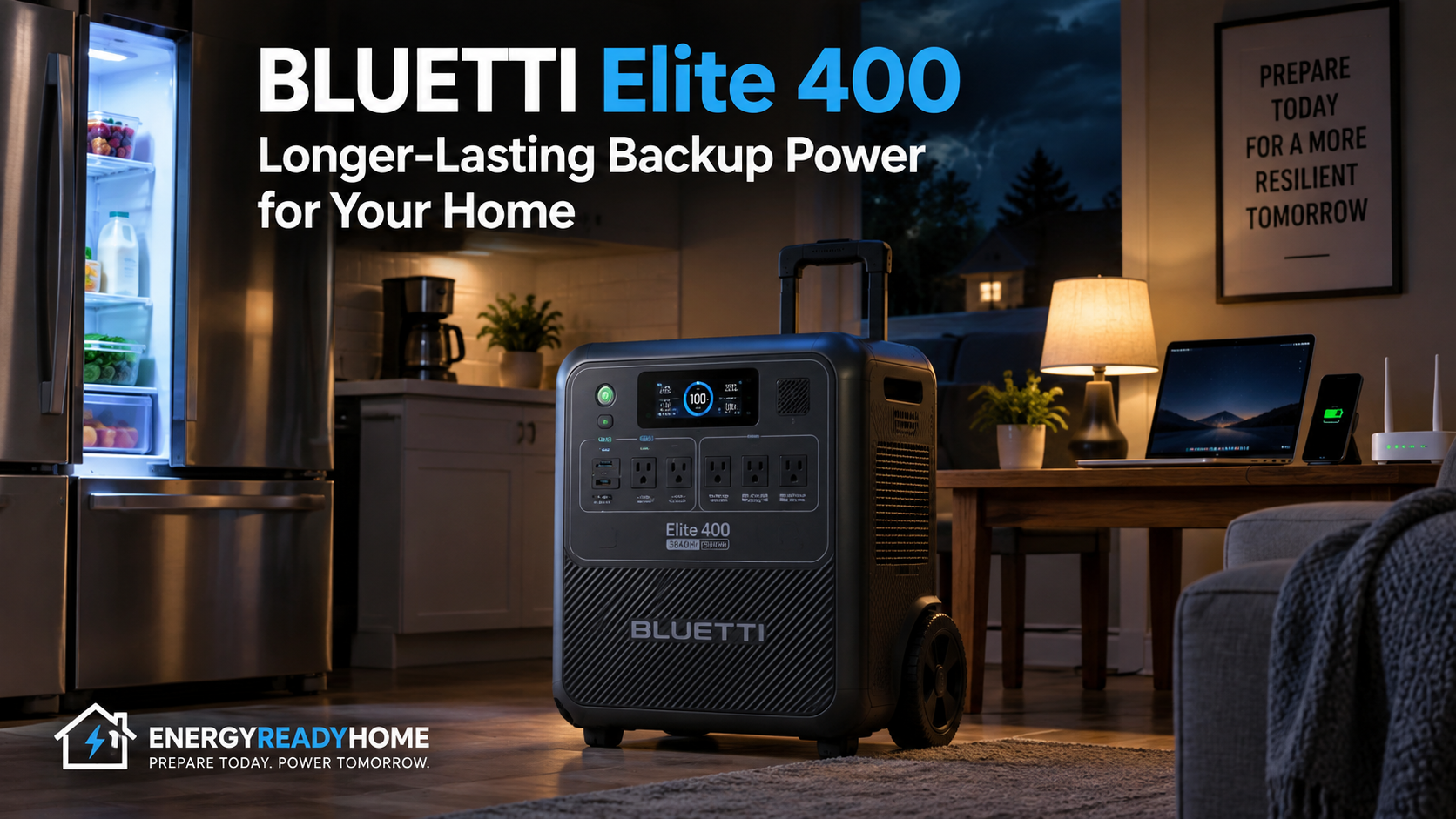
The BLUETTI Elite 400 sits in an interesting position between conventional portable power stations and much larger home-backup battery systems.
With 3,840Wh of battery capacity and 2,600W of continuous AC output, it provides substantially more stored energy than a typical 2kWh portable power station while remaining a self-contained system that can be rolled into position when an outage occurs.
That combination makes the Elite 400 particularly interesting for homeowners who want longer backup runtime without immediately moving into a large modular battery system.
Quick Verdict
The BLUETTI Elite 400 is a strong choice for homeowners who want nearly 4kWh of portable battery capacity primarily for essential 120V household loads.
Its biggest advantage is straightforward: runtime.
A 3,840Wh battery gives you considerably more energy to work with than the increasingly common 2kWh class. That can make a meaningful difference when an outage lasts overnight or extends into the next day.
The tradeoff is weight.
At approximately 86 pounds, the Elite 400 is not something most people will casually carry around the house. BLUETTI addresses that with integrated wheels and a telescoping handle, making it more appropriate to think of the Elite 400 as a rolling backup power station rather than a lightweight portable battery.
Best For
Homeowners who want:
- Nearly 4kWh of battery capacity in one unit
- Longer refrigerator, freezer, internet and electronics backup
- 2,600W of continuous AC output
- Fast AC and solar charging capability
- A movable system rather than a permanently installed battery
- Backup power without immediately building a large modular system
Think Twice If
The Elite 400 may not be the best fit if:
- You frequently need to carry your power station up or down stairs
- Approximately 2kWh already provides enough runtime for your outage plan
- You need extensive battery expansion
- You specifically need a 240V home-backup architecture
- You want direct integration with large household circuits rather than portable backup for selected loads
BLUETTI Elite 400 Specifications
| Specification | BLUETTI Elite 400 |
|---|---|
| Battery Capacity | 3,840Wh |
| Battery Chemistry | LiFePO₄ |
| Continuous AC Output | 2,600W |
| AC Voltage | 120V |
| AC Charging Input | Up to 1,800W |
| DC Input | Up to 1,000W |
| Combined AC + DC Input | Up to 2,800W |
| UPS Switchover | 15 ms |
| Weight | Approx. 86 lb |
| Dimensions | 16.8 × 11.3 × 19.3 in |
| Connectivity | Wi-Fi + Bluetooth |
These are manufacturer specifications. For additional technical details, operating limits, charging specifications and safety information, see the official BLUETTI Elite 400 user manual and specifications
How Much Backup Power Does 3,840Wh Really Provide?
Battery capacity is one of the most important numbers when choosing a portable power station for an outage.
The Elite 400 stores 3,840 watt-hours of energy.
That does not mean every one of those watt-hours should be assumed available to AC appliances. Conversion losses, inverter operation, temperature and other factors affect actual runtime.
For planning purposes, EnergyReadyHome uses an illustrative 85% usable-energy assumption when estimating AC runtime.
That gives the Elite 400 approximately:
3,840Wh × 85% = 3,264Wh of estimated usable AC energy
This is an EnergyReadyHome planning model, not a manufacturer runtime guarantee.
Estimated BLUETTI Elite 400 Runtime
| Average Load | Estimated Runtime* |
|---|---|
| 50W | 65.3 hours |
| 100W | 32.6 hours |
| 200W | 16.3 hours |
| 300W | 10.9 hours |
| 500W | 6.5 hours |
| 1,000W | 3.3 hours |
EnergyReadyHome estimates based on 85% of rated battery capacity. Actual runtime varies according to appliance behavior, inverter losses, temperature, battery condition and other operating factors.
The table demonstrates why the Elite 400 is more interesting for home backup than its 2,600W output rating alone might suggest.
Its real strength isn’t simply running a high-wattage appliance.
It’s having almost 4kWh of stored energy available for longer outages.
What Could the Elite 400 Keep Running During an Outage?
A realistic outage plan rarely involves operating every appliance in the house simultaneously.
Instead, most homeowners prioritize essential loads such as:
- Refrigerator
- Freezer
- Internet modem and router
- Phones and tablets
- LED lighting
- Television
- Laptop computers
- CPAP or other compatible equipment
- Selected small kitchen appliances
- Fans
- Other essential 120V devices
The Elite 400’s 2,600W continuous output provides enough power for many combinations of these loads, provided their combined operating and startup requirements remain within the system’s capabilities.
But the larger battery is what separates it from smaller portable power stations.
A household averaging only 150W of continuous essential loads, for example, could theoretically get roughly 21.8 hours from our 85% planning model.
At an average 250W load, the estimate falls to approximately 13.1 hours.
Those numbers illustrate an important home-backup principle:
Reducing your average load can extend outage runtime just as effectively as buying more battery capacity.
Why 4kWh Is an Important Step Up From 2kWh
A 2kWh-class portable power station can be an excellent emergency-power solution.
But doubling battery capacity changes how the system can be used.
Instead of constantly deciding which essential device gets power next, a larger battery gives you more flexibility to operate multiple modest loads over longer periods.
For example, a homeowner might want to keep a refrigerator cycling normally while continuously powering internet equipment, several lights and electronics.
That workload may not require enormous instantaneous wattage.
It requires energy over time.
That distinction between watts and watt-hours is critical.
Watts determine what the power station can run.
Watt-hours help determine how long it can run it.
With 2,600W of output and 3,840Wh of capacity, the Elite 400 emphasizes the second half of that equation more heavily than many smaller portable systems.
Is the BLUETTI Elite 400 Actually Portable?
Technically, yes.
Practically, it depends on what you mean by portable.
At approximately 86 pounds, the Elite 400 is far too heavy to treat like a compact camping battery.
BLUETTI instead equips it with wheels and a telescoping handle. The company’s own product positioning describes it as a rolling power station.
That design makes sense.
Rolling an 86-pound battery from a storage location to a kitchen, office or utility area is very different from lifting the same battery and carrying it through the house.
For a single-level home, garage or basement with accessible flooring, the design could make deployment relatively straightforward.
Stairs are another matter.
If your backup plan requires routinely moving the battery between floors, weight deserves serious consideration before buying.
For homeowners who prioritize easier physical portability, a smaller system may be the better choice even if it provides less runtime.
How Fast Can the BLUETTI Elite 400 Recharge?
Battery capacity matters during an outage, but recharge speed determines how quickly you can put that capacity back to work.
The Elite 400 supports up to 1,800W of AC charging, up to 1,000W of DC input, and up to 2,800W of combined AC and DC input. That gives homeowners several ways to recharge depending on whether grid power has returned or another compatible charging source is available.
For outage planning, this is particularly useful because a large battery does not necessarily need to sit idle for an extended period while recharging. You can use stored energy overnight, recharge when power or adequate solar input becomes available, and then return the system to backup duty.
Actual charging time will vary with battery state, charging conditions, input power and environmental factors.
Is 3,840Wh Enough for Home Backup?
For many households, 3,840Wh is enough to provide meaningful backup for essential loads, but it should not be confused with whole-home battery capacity.
The Elite 400 makes the most sense when you prioritize selected devices rather than attempting to run everything in the house simultaneously.
A practical outage plan might prioritize:
- Refrigerator and freezer
- Internet modem and router
- Phones and other communications equipment
- LED lighting
- Laptop computers
- Television
- CPAP or other compatible low-to-moderate-power equipment
- Fans and selected small appliances
The advantage of moving toward the 4kWh class is that you have considerably more stored energy to allocate among those loads.
Our guide to 2kWh vs 4kWh portable power stations explains this capacity decision in greater detail.
BLUETTI Elite 400 vs Elite 300
The Elite 300 and Elite 400 occupy adjacent positions in BLUETTI’s lineup, but the capacity difference is meaningful for home backup.
| Feature | Elite 400 | Elite 300 |
|---|---|---|
| Battery Capacity | 3,840Wh | 3,014.4Wh |
| Continuous AC Output | 2,600W | 2,400W |
| Primary Advantage | Longer backup runtime | Lower weight and easier mobility |
| Best Fit | Longer essential-load backup | Moderate-duration home backup |
The Elite 400 provides about 826Wh more nominal battery capacity than the Elite 300. That is roughly 27% more stored energy, which can translate into additional runtime when both systems are supporting similar loads.
The tradeoff is portability. The Elite 400 is substantially heavier and is better thought of as a rolling backup power station than something you will routinely carry.
If you do not need nearly 4kWh of capacity, our BLUETTI Elite 300 review examines the smaller alternative.
BLUETTI Elite 400 vs BLUETTI Apex 300
The Elite 400 and Apex 300 represent two different approaches to backup power.
The Elite 400 is attractive when you want a large-capacity, self-contained 120V portable power station. Its appeal is straightforward: substantial battery capacity, strong AC output and relatively simple deployment.
The Apex 300 is more appropriate for homeowners interested in a more expandable system architecture and a path toward more advanced home-backup configurations, including 120V/240V applications when configured with compatible equipment.
That distinction matters.
If your objective is primarily to keep essential 120V devices operating for as long as practical, the Elite 400’s larger integrated battery can be compelling. If your longer-term objective includes broader home integration or 240V capability, the Apex platform deserves closer consideration.
Our BLUETTI Apex 300 review examines that system in detail.
What We Like About the BLUETTI Elite 400
The strongest argument for the Elite 400 is its combination of 3,840Wh of storage and 2,600W of continuous AC output.
For outage use, we particularly like the larger energy reserve. Many portable power stations have enough inverter output to start or operate common household devices, but their batteries can become the limiting factor during a long outage. The Elite 400 shifts that balance toward runtime.
The wheeled design also makes sense at this weight. An approximately 86-pound power station is not something most people will want to carry around the house, but wheels and a telescoping handle make repositioning it considerably more practical on suitable surfaces.
The LiFePO₄ battery chemistry, UPS capability, Wi-Fi and Bluetooth connectivity, and multiple charging options further strengthen its usefulness as a dedicated home-backup unit.
Where the Elite 400 Has Limitations
The biggest limitation is weight.
At approximately 86 pounds, this is not a highly portable power station in the conventional sense. Stairs, vehicle loading and storage locations should be considered before buying it.
It is also fundamentally a 120V backup solution. Homeowners specifically looking to operate 240V household loads or build a more integrated whole-home backup system should compare it with platforms designed around those requirements.
Finally, 3,840Wh is substantial for a portable power station, but it is still finite. High-wattage heating appliances, cooking equipment and other heavy loads can consume stored energy rapidly.
For extended outages, load management remains important regardless of battery size. Our guide to the best portable power stations for a 3-day power outage explains how larger systems fit into longer-duration outage planning.
Who Should Buy the BLUETTI Elite 400?
The Elite 400 is particularly well suited to homeowners who want more runtime than a typical 2kWh-class portable power station provides without moving immediately into a permanently installed home-battery system.
It makes the most sense if your priorities include refrigerators and freezers, communications equipment, lighting, electronics, CPAP equipment and other compatible 120V essentials.
It is also a good fit for someone who expects the unit to remain primarily at home. The wheels help with movement, but the Elite 400’s weight makes it less attractive for frequent lifting or highly mobile use.
Who Should Skip It?
A smaller power station may be a better choice if your backup requirements are modest or portability is a major priority.
Likewise, homeowners whose primary objective is operating 240V loads, integrating backup directly with more of the home’s electrical system, or building a substantially larger expandable battery system should evaluate a platform designed around those requirements.
The goal is not to buy the largest battery possible. It is to buy enough capacity and output for the loads you actually intend to protect.
BLUETTI Elite 400 — Check Current Price
For readers who have determined that the Elite 400 fits their backup requirements, EnergyReadyHome has a verified direct BLUETTI purchasing route.
EnergyReadyHome may earn a commission if you purchase through this link, at no additional cost to you.
Final Verdict: Is the BLUETTI Elite 400 Worth It?
For the right household, yes—the BLUETTI Elite 400 is a strong home-backup option when runtime is more important than lightweight portability.
Its 3,840Wh battery gives it enough stored energy to occupy a useful middle ground: considerably more endurance than smaller portable power stations without requiring the commitment of a permanently installed home battery.
The 2,600W continuous AC output should accommodate many common essential-load combinations, while the larger battery gives you more flexibility to keep those loads operating through an extended outage.
Its biggest compromises are equally clear: it is heavy, it remains a finite battery system, and homeowners needing 240V or more extensive home integration should consider other architectures.
For homeowners who primarily want long-duration backup for essential 120V loads in a self-contained system, the Elite 400 makes a compelling case.
Frequently Asked Questions
How much battery capacity does the BLUETTI Elite 400 have?
The BLUETTI Elite 400 has 3,840Wh of nominal battery capacity. EnergyReadyHome’s runtime estimates use a lower illustrative usable-energy figure to account for conversion losses rather than assuming every rated watt-hour reaches AC-powered devices.
How much power can the BLUETTI Elite 400 output?
The Elite 400 is rated for 2,600W of continuous AC output. Actual appliance compatibility also depends on startup requirements and the characteristics of the connected load.
Can the BLUETTI Elite 400 run a refrigerator?
A typical refrigerator is well within the Elite 400’s continuous-output range, although actual runtime depends on the refrigerator’s energy consumption, compressor cycling and whatever other devices are connected.
Can the Elite 400 power a house?
The Elite 400 can provide meaningful backup for selected household essentials, but it should not be treated as an unrestricted whole-home power system. High-demand loads can substantially shorten runtime, and 240V requirements call for a different system architecture.
Is the BLUETTI Elite 400 good for a multi-day outage?
It can be a strong component of a multi-day outage plan, particularly when loads are carefully prioritized and the battery can be recharged during the outage. A 3,840Wh battery does not by itself guarantee several days of operation; total energy consumption determines runtime.
Is the Elite 400 better than the Elite 300?
It depends on the priority. The Elite 400 provides more battery capacity and somewhat higher continuous AC output, making it better suited to longer backup periods. The Elite 300 is lighter and may be the better fit when roughly 3kWh of capacity is sufficient.
Related Articles
- BLUETTI Elite 300 Review: Is It Worth It for Home Backup in 2026?
- BLUETTI Elite 200 V2 Review: Is It Worth It for Home Backup in 2026?
- BLUETTI Apex 300 Review: Is It Worth It for Home Backup in 2026?
- 2kWh vs 4kWh Portable Power Station: How Much Backup Do You Really Need?
- Best Portable Power Stations for a 3-Day Power Outage