Introduction
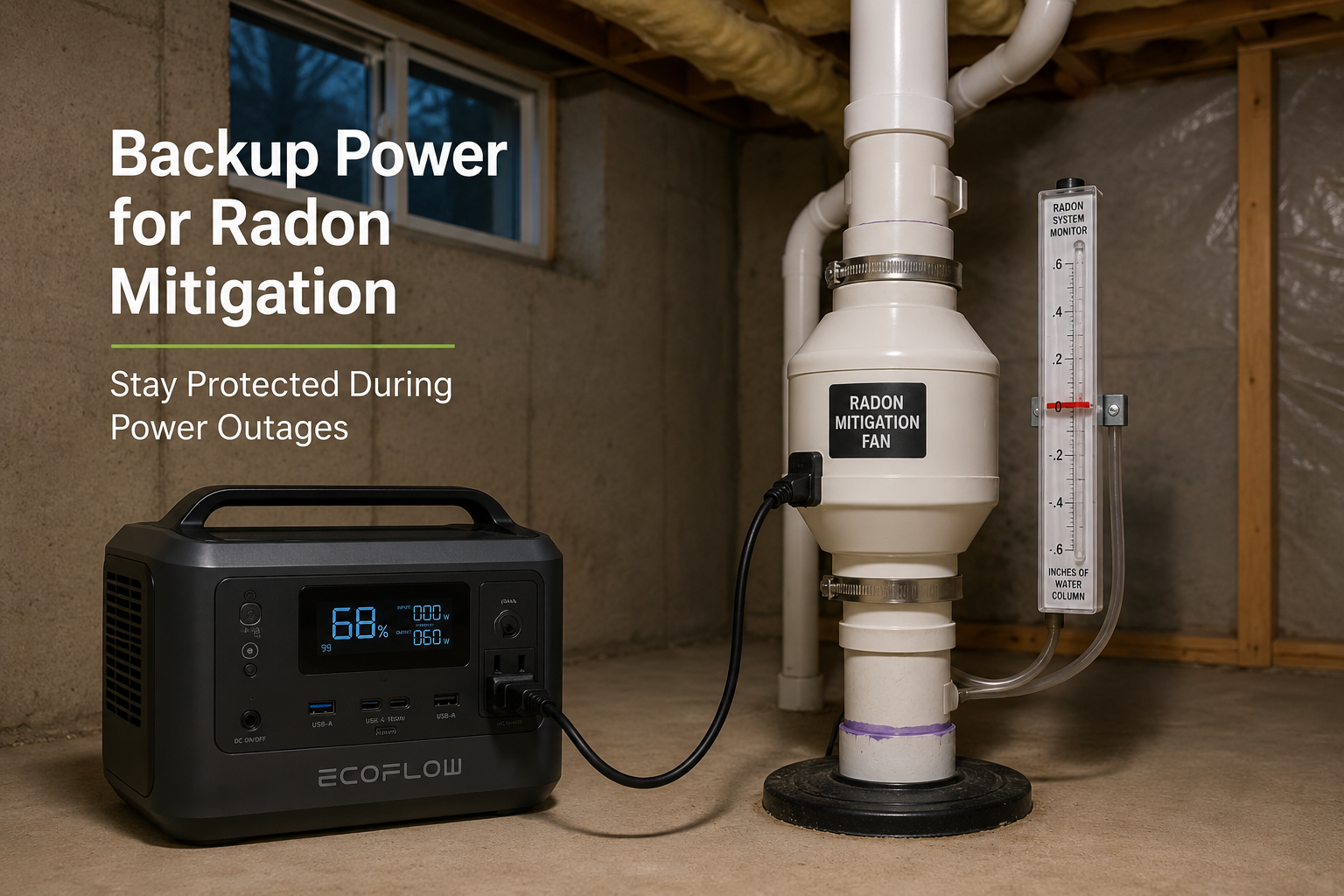
Yes, most portable power stations can run a typical residential radon mitigation system for many hours or even several days, depending on the battery capacity and the fan’s power consumption.
If your home relies on an active radon mitigation system, maintaining continuous operation during a power outage is more important than many homeowners realize. While short interruptions are generally not a serious concern, prolonged outages allow radon gas to accumulate beneath your home’s foundation, potentially increasing indoor radon levels until power is restored.
Fortunately, radon mitigation fans consume very little electricity compared to many other household appliances, making them excellent candidates for backup power from a portable power station.
In this guide, you’ll learn:
- Whether a portable power station can run a radon mitigation system
- How much electricity radon fans typically use
- How long various battery sizes will keep the system operating
- The best portable power station sizes for different homes
- Important safety considerations during outages
At a Glance
| Category | Information |
|---|---|
| Best For | Homeowners with active radon mitigation systems |
| Estimated Reading Time | 10 minutes |
| Last Updated | July 2026 |
| Who Should Read This | Homeowners concerned about radon protection during power outages |
| What You’ll Learn | Battery sizing, runtime estimates, and backup power recommendations |
Can a Portable Power Station Run a Radon Mitigation System?
In most cases, yes.
Most residential radon mitigation fans require only:
- 40–120 watts while operating
- Continuous operation
- Standard 120-volt household power
Because of their relatively low electrical demand, they are among the easiest essential home systems to power during an outage.
Unlike refrigerators, well pumps, or furnaces, radon fans:
- Have low startup power requirements
- Use consistent electricity
- Operate efficiently on quality portable power stations
For many homeowners, even a mid-sized portable power station can provide backup power for an extended period.
How Does a Radon Mitigation System Work?
A typical active radon mitigation system includes:
- PVC vent piping
- An inline radon mitigation fan
- Roof vent exhaust
- Foundation suction point
- Monitoring gauge
The fan continuously pulls radon gas from beneath the home’s slab or crawlspace before it can enter the living area.
This creates slight negative pressure under the foundation while safely venting the gas above the roofline.
When electrical power is lost:
- The fan stops.
- The pressure difference disappears.
- Radon gas can begin accumulating beneath the foundation.
- Indoor radon levels may gradually increase if the outage lasts long enough.
How Much Power Does a Radon Mitigation Fan Use?
Most residential systems use surprisingly little electricity. The U.S. Environmental Protection Agency provides additional guidance on radon, testing, mitigation systems, and maintaining safe indoor air quality.
| Fan Size | Typical Running Watts |
|---|---|
| Small | 40–60 watts |
| Medium | 60–90 watts |
| Large | 90–120 watts |
Many homeowners are surprised to learn that a radon fan often uses less electricity than a standard incandescent light bulb.
Because the load remains steady throughout operation, runtime estimates are much easier to calculate than for appliances with compressors or heating elements.
Typical Runtime Estimates
Actual runtime depends on:
- Battery capacity
- Fan efficiency
- Power station inverter efficiency
- Ambient temperature
- Battery age
Approximate runtimes for a 60-watt radon fan:
| Portable Power Station | Approximate Runtime |
|---|---|
| 300Wh | 4–5 hours |
| 500Wh | 7–8 hours |
| 700Wh | 10–11 hours |
| 1000Wh | 14–16 hours |
| 1500Wh | 22–24 hours |
| 2000Wh | 30–33 hours |
For larger fans drawing around 100 watts, runtimes will be proportionally shorter.
Choosing the Right Portable Power Station
The best choice depends on how long you want your radon mitigation system to remain operational.
Short Outages (Under 8 Hours)
A compact power station in the 500Wh range is often sufficient for brief utility interruptions.
Ideal if your area experiences:
- Occasional thunderstorms
- Brief grid interruptions
- Utility maintenance outages
Overnight Outages
If outages commonly last overnight, a 1000Wh model offers significantly more runtime while remaining portable.
It can often keep a typical radon fan operating until electricity is restored the next morning.
Multi-Day Outages
For severe weather events or extended outages, larger units in the 1500Wh–2000Wh range provide greater peace of mind and may also power other essential household devices.
Can You Power Other Devices at the Same Time?
Yes—but the total power draw of all connected devices must stay within the portable power station’s continuous output rating.
For example, if your radon mitigation fan uses 60 watts and your portable power station can continuously supply 1,000 watts, you still have approximately 940 watts available for other essential devices.
Some common combinations include:
| Device | Typical Running Watts |
|---|---|
| Radon mitigation fan | 40–120 watts |
| Wi-Fi router | 10–20 watts |
| LED lamp | 8–15 watts |
| Laptop | 45–90 watts |
| Phone charger | 10–20 watts |
This makes a portable power station an excellent solution for keeping several low-power essentials operating during an outage.
Is It Safe to Power a Radon Mitigation Fan with a Portable Power Station?
Yes, provided you follow the manufacturer’s operating instructions.
Portable power stations produce clean, regulated AC power that is generally suitable for continuously running electric motors found in residential radon mitigation systems.
To operate safely:
- Place the power station indoors in a dry, well-ventilated area.
- Use only the supplied AC outlet.
- Keep ventilation openings unobstructed.
- Avoid using damaged extension cords.
- Recharge the battery before it becomes completely depleted whenever practical.
Unlike gasoline generators, portable power stations produce no exhaust fumes and are safe for indoor use.
When Should You Consider a Larger Battery?
A larger portable power station may be worthwhile if you:
- Frequently experience outages lasting more than one day.
- Live in an area prone to hurricanes, ice storms, or severe winter weather.
- Want to power additional critical devices during outages.
- Prefer longer runtimes without recharging.
Many homeowners eventually choose a larger model because it provides flexibility for powering refrigerators, communications equipment, lighting, medical devices, and a radon mitigation system simultaneously.
Can Solar Panels Extend Runtime?
Yes.
Many modern portable power stations accept compatible portable solar panels.
During extended outages, solar charging can replenish the battery during daylight hours, allowing the radon mitigation fan to continue operating much longer than battery power alone would allow.
Actual charging performance depends on:
- Available sunlight
- Panel size
- Weather conditions
- Season
- Battery capacity
Solar charging can be especially valuable during multi-day outages when grid power remains unavailable.
Common Mistakes to Avoid
Avoid these common errors:
- Assuming every radon fan uses the same amount of electricity.
- Purchasing a battery based only on watt output instead of battery capacity (Wh).
- Forgetting to account for additional devices you may also want to power.
- Allowing the battery to remain uncharged before storm season.
- Blocking airflow around the portable power station while operating.
Choosing the correct battery size before an emergency helps ensure reliable performance when you need it most.
Frequently Asked Questions
Can a small portable power station run a radon mitigation system?
Yes. Many systems drawing between 40 and 60 watts can operate for several hours on even a compact portable power station.
Will a power outage immediately create dangerous radon levels?
Generally, no. Radon levels usually rise gradually during an extended outage rather than immediately. However, restoring the mitigation system as soon as practical helps minimize long-term exposure.
Does a radon fan require surge power to start?
Most residential radon mitigation fans have relatively modest startup requirements compared to appliances with compressors, making them well-suited for quality portable power stations.
Should I leave the portable power station plugged into the fan all the time?
Many homeowners instead keep the power station fully charged and connect it when an outage occurs. Some higher-end models offer UPS (Uninterruptible Power Supply) functionality, but you should verify whether your chosen model supports this feature and whether it meets your needs.
Key Takeaways
- Most residential radon mitigation systems require only 40–120 watts.
- Portable power stations are well-suited for powering radon mitigation fans during outages.
- Battery capacity (Wh) determines how long the system can operate.
- Larger power stations can support both the radon mitigation system and additional household essentials.
- Solar charging can significantly extend runtime during prolonged power outages.
Conclusion
A portable power station is one of the simplest and most practical ways to keep a residential radon mitigation system operating during a power outage.
Because these systems typically consume very little electricity, homeowners often achieve impressive runtimes even with mid-sized batteries. Selecting a portable power station with adequate battery capacity—and keeping it charged—helps maintain continuous radon mitigation while also providing backup power for other essential household devices.
Investing in reliable backup power not only improves emergency preparedness but also helps ensure your home’s radon reduction system continues protecting your indoor air quality when utility power is unavailable.
Related Articles
- Can a Portable Power Station Run a Sump Pump?
- Can a Portable Power Station Run a Security System?
- Can a Portable Power Station Run a Wi-Fi Router?
- Can a Portable Power Station Run a Refrigerator?
- How to Choose the Right Size Portable Power Station
- Best Ways to Extend Portable Power Station Runtime During an Outage