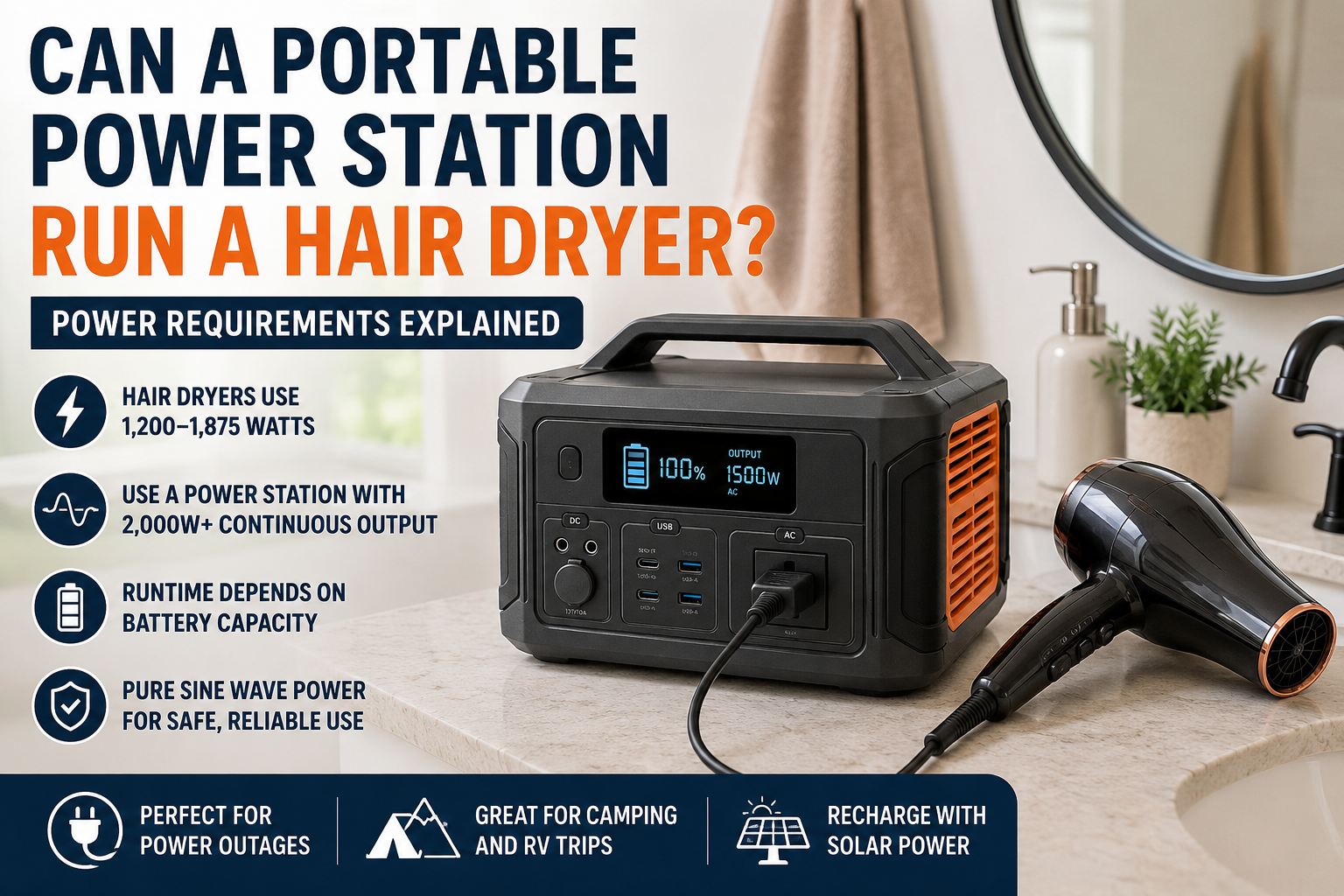
If you’re preparing for a power outage or planning to use portable power while camping or traveling, you may wonder: Can a portable power station run a hair dryer?
The short answer is yes—but not every portable power station can. Hair dryers are among the highest-wattage household appliances, often requiring more power than coffee makers, televisions, laptops, or even many microwave ovens. Choosing a portable power station that can safely handle a hair dryer requires understanding both the dryer’s wattage and the power station’s continuous output.
This guide explains how much electricity hair dryers use, what size portable power station you’ll need, and how to avoid common mistakes when selecting a backup power solution.
Can a Portable Power Station Run a Hair Dryer?
Yes, a portable power station can run a hair dryer if it produces enough continuous output power.
Most residential hair dryers require:
- Low heat: 600–900 watts
- Medium heat: 900–1,200 watts
- High heat: 1,200–1,875 watts
Many entry-level portable power stations are designed for electronics and small appliances and cannot safely operate high-wattage devices like hair dryers.
Larger portable power stations with continuous output ratings of 2,000 watts or more are generally much better suited for this application.
Why Hair Dryers Use So Much Power
Hair dryers generate heat by passing electricity through heating elements while simultaneously powering an electric fan.
Unlike refrigerators or well pumps, hair dryers typically do not have large startup surges. Instead, they draw a high continuous electrical load for as long as they are operating.
Because of this constant demand, the portable power station must be capable of supplying the required wattage continuously without exceeding its rated output.
Understanding Hair Dryer Wattage
Most hair dryers display their power rating on a label near the handle or plug.
Typical examples include:
| Hair Dryer Type | Typical Wattage |
|---|---|
| Compact Travel Hair Dryer | 800–1,200 W |
| Standard Household Hair Dryer | 1,200–1,600 W |
| Professional Salon Hair Dryer | 1,600–1,875 W |
Always use the wattage listed on your specific appliance rather than relying on average values. The U.S. Department of Energy’s energy-saving guidance provides additional information about household electricity use and improving energy efficiency.
Choosing the Right Portable Power Station
When selecting a portable power station for a hair dryer, pay attention to these specifications.
Continuous Output
The continuous output rating must exceed the hair dryer’s wattage.
For example:
- 1,200-watt hair dryer → at least a 1,500-watt power station is recommended.
- 1,875-watt hair dryer → a 2,000-watt or larger power station provides a better safety margin.
Avoid operating a power station continuously at its maximum rated output.
Battery Capacity
Battery capacity determines how long the hair dryer can operate.
For example:
- 1,024 Wh battery
- Hair dryer uses 1,500 watts
Continuous runtime would be relatively short because hair dryers consume energy very quickly.
Fortunately, most people use a hair dryer for only a few minutes at a time, making battery runtime less of a concern than continuous output.
Pure Sine Wave Inverter
A quality portable power station should provide pure sine wave AC power.
This ensures compatibility with modern household appliances and helps protect sensitive electronic controls that may be present in some premium hair dryers.
Can You Use Other Appliances at the Same Time?
Possibly—but only if the combined electrical load remains below the portable power station’s continuous output rating.
For example:
- Hair dryer: 1,500 watts
- LED light: 10 watts
- Phone charger: 20 watts
Total load:
1,530 watts
Always add the wattage of every connected device before operating multiple appliances simultaneously.
Portable Power Station vs. Generator
Both can operate a hair dryer if they provide sufficient power, but they have different advantages.
Portable Power Station
Advantages include:
- Quiet operation
- Safe for indoor use
- No gasoline required
- Minimal maintenance
- Instant startup
Portable Generator
Advantages include:
- Longer runtime with refueling
- Higher power output
- Better suited for operating multiple large appliances simultaneously
For occasional use during power outages, many homeowners prefer the convenience and quiet operation of a portable power station.
Common Mistakes to Avoid
Many buyers focus only on battery size when comparing portable power stations.
Instead, always verify:
- Continuous output rating
- Battery capacity
- Pure sine wave inverter
- Number of AC outlets
- Overall appliance compatibility
Selecting a power station based solely on battery capacity may result in a unit that stores plenty of energy but cannot safely operate a high-wattage appliance like a hair dryer.
How Long Can a Portable Power Station Run a Hair Dryer?
Hair dryers use a significant amount of electricity, so runtime depends on two primary factors:
- The battery capacity of the portable power station.
- The wattage setting of the hair dryer.
Although every portable power station is different, higher heat settings will drain the battery much faster than lower settings.
For most people, this isn’t a major concern because a hair dryer is typically used for only a few minutes each day.
Example Runtime Estimates
The table below provides approximate runtimes for a 1,500-watt hair dryer using portable power stations of different battery capacities.
| Battery Capacity | Approximate Runtime* |
|---|---|
| 1,000 Wh | 30–40 minutes |
| 2,000 Wh | 60–80 minutes |
| 3,000 Wh | 90–120 minutes |
*Actual runtime varies depending on inverter efficiency, battery age, ambient temperature, and the selected heat setting.
Tips for Maximizing Battery Runtime
If you’re relying on a portable power station during a power outage, these simple steps can help extend battery life.
Use the Lowest Effective Heat Setting
Many hair dryers consume significantly less electricity when operating on low or medium heat.
Lower settings may slightly increase drying time but can noticeably reduce battery consumption.
Dry Your Hair with a Towel First
Removing excess moisture before using the hair dryer reduces the amount of time the appliance needs to run.
This simple step conserves battery power without affecting results.
Turn Off Other High-Wattage Appliances
Avoid operating multiple large appliances at the same time.
For example:
- Space heaters
- Microwave ovens
- Electric kettles
- Coffee makers
- Toaster ovens
Keeping the total electrical load below the portable power station’s continuous output rating helps prevent overload shutdowns.
Recharge Whenever Possible
If utility power is unavailable for an extended period, recharge your portable power station using:
- Solar panels
- Vehicle charging
- AC wall charging (when available)
Maintaining battery capacity ensures the power station is ready when needed.
Is a Hair Dryer a Good Appliance for Emergency Backup Power?
For many homeowners, the answer is yes.
Unlike refrigerators or medical equipment, a hair dryer is not considered an essential emergency appliance. However, during prolonged outages it can provide added comfort and convenience.
Because it is used for only a short period each day, a properly sized portable power station can usually support occasional hair dryer use while still reserving capacity for more important devices such as:
- Refrigerators
- Internet equipment
- LED lighting
- Phone chargers
- CPAP machines
- Medical devices
Planning your power usage helps maximize battery life during extended outages.
Frequently Asked Questions
Can a 1,000-watt portable power station run a hair dryer?
Usually not.
Most household hair dryers require between 1,200 and 1,875 watts, which exceeds the continuous output of many 1,000-watt portable power stations.
Will a hair dryer damage a portable power station?
No, provided the hair dryer’s wattage does not exceed the portable power station’s continuous output rating and the unit is used according to the manufacturer’s recommendations.
Can I use a travel hair dryer with a smaller portable power station?
Often yes.
Travel hair dryers typically consume less power than full-size household models, making them more compatible with smaller portable power stations.
Always verify the appliance’s wattage before connecting it.
Is a solar generator better for running a hair dryer?
A solar generator is essentially a portable power station paired with solar charging capability.
If it provides sufficient continuous output, it can operate a hair dryer just as effectively while allowing the battery to be recharged from solar panels during extended outages.
Conclusion
So, can a portable power station run a hair dryer? In many cases, the answer is yes—provided the power station has enough continuous output to match the hair dryer’s electrical requirements.
Because hair dryers are among the highest-wattage household appliances, it’s important to look beyond battery capacity and verify the unit’s continuous output rating before purchasing. Choosing a properly sized portable power station ensures safe, reliable operation during power outages, camping trips, RV travel, and other situations where portable backup power is valuable.
With the right equipment, a portable power station can provide both convenience and peace of mind when traditional power isn’t available.
Related Articles
- Can a Portable Power Station Run a Blender? (Power Requirements Explained)
- Can a Portable Power Station Run a Coffee Maker? (Power Requirements Explained)
- Can a Portable Power Station Run a Space Heater? (Important Safety & Power Guide)
- Can a Portable Power Station Run an Electric Blanket? (Power & Runtime Guide)
- Can a Portable Power Station Run a Window AC Unit? (Important Power Considerations)
- Can a Portable Power Station Run a Microwave? (Power Requirements Explained)