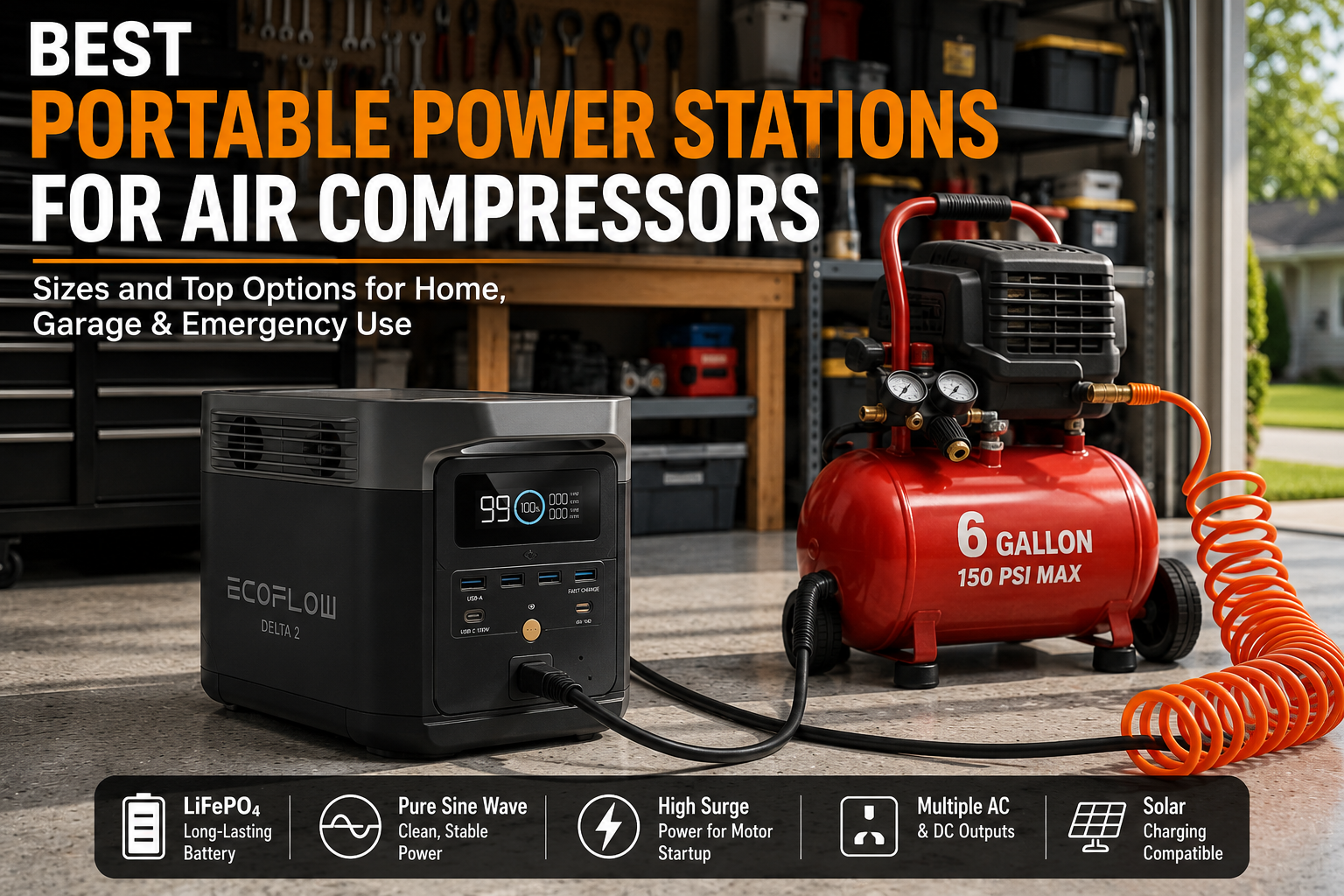
Air compressors are among the most challenging portable tools to power during an outage because they require a large burst of electricity when the motor starts. Many homeowners discover that while a compressor’s running wattage appears reasonable, its startup surge can be two to three times higher—enough to overload an undersized portable power station.
Whether you need to inflate vehicle tires after a storm, power pneumatic nailers for emergency repairs, or operate a small compressor in your garage or workshop, choosing the right portable power station is essential.
The good news is that today’s higher-capacity portable power stations can safely run many small and medium-sized air compressors. However, success depends on matching the compressor’s power requirements with a power station that provides enough continuous output, sufficient surge capacity, and adequate battery storage.
In this guide, you’ll learn how much power different air compressors require, what size portable power station you need, and which models offer the best performance and value for homeowners and DIY users.
Can a Portable Power Station Run an Air Compressor?
Yes—but not every portable power station can.
Air compressors place a unique demand on battery-powered systems because electric motors require significantly more power during startup than while running.
For example:
- A compressor that normally runs at 700 watts may briefly require 1,400–2,100 watts during startup.
- Larger compressors may exceed 3,000 watts for a fraction of a second.
If the portable power station cannot handle this surge, it will typically shut down to protect itself.
Fortunately, many modern portable power stations designed for home backup include pure sine wave inverters with generous surge ratings, making them suitable for many consumer-grade air compressors.
How Much Power Does an Air Compressor Use?
Power requirements vary considerably based on compressor size, tank capacity, and motor horsepower.
| Air Compressor | Running Watts | Startup Surge |
|---|---|---|
| 1 Gallon Pancake | 300–500W | 600–900W |
| 2–6 Gallon Portable | 500–900W | 1,000–1,800W |
| 8–20 Gallon Workshop | 900–1,500W | 1,800–3,000W |
| Large Shop Compressors | 1,500W+ | 3,000W+ |
Keep in mind that manufacturer specifications may list horsepower rather than wattage. When in doubt, consult the compressor’s data plate or owner’s manual to determine its electrical requirements.
Understanding Startup Surge
Startup surge is the most important factor when selecting a portable power station for an air compressor.
When the compressor motor first starts, it must overcome internal pressure and inertia before reaching normal operating speed. During those first few seconds, electrical demand increases dramatically.
National Electrical Manufacturers Association (NEMA) electric motor resources.
Choosing a power station based only on running watts is one of the most common mistakes homeowners make.
A properly sized inverter should comfortably exceed the compressor’s maximum surge requirement to ensure reliable operation.
What Size Portable Power Station Do You Need?
Small Portable Power Stations (300–600Wh)
These compact units are suitable only for:
- Mini inflators
- Small cordless tool battery chargers
- Very small hobby compressors
Most are not recommended for standard household air compressors because their inverter capacity is too limited.
Medium Portable Power Stations (700–1,200Wh)
This size works well for many homeowners.
Typical benefits include:
- Enough inverter power for many portable compressors
- Good balance of portability and battery capacity
- Power for additional emergency devices
- Ideal for garage and workshop use
Many compressors in the 2- to 6-gallon range can be powered successfully by a quality unit in this category, provided the inverter’s surge rating is adequate.
Large Portable Power Stations (1,500Wh and Above)
If you own a larger air compressor or plan to power multiple tools during an outage, consider a higher-capacity model.
These units typically offer:
- Higher continuous output
- Greater startup surge capability
- Longer runtime
- Expandable battery options
- Better overall emergency preparedness
They can also support refrigerators, lighting, communication equipment, and other essential household appliances during extended outages.
Features to Look For
Choosing the right portable power station involves more than selecting the largest battery.
High Continuous Output
Select a unit whose continuous output exceeds your compressor’s normal operating wattage with room to spare.
Additional capacity improves efficiency and allows you to power other devices simultaneously.
Strong Surge Rating
For air compressors, surge capability is often more important than battery size.
Look for a power station whose surge rating comfortably exceeds your compressor’s startup requirements.
This reduces nuisance shutdowns and helps ensure reliable operation.
Pure Sine Wave Inverter
Most modern compressors use electric motors that perform best with clean, stable power.
A pure sine wave inverter closely replicates household electricity, helping protect the motor while improving startup performance.
LiFePO₄ Battery Technology
Portable power stations equipped with lithium iron phosphate (LiFePO₄) batteries offer several long-term advantages:
- Longer battery life
- Thousands of charge cycles
- Improved thermal stability
- Lower maintenance
- Better long-term value
For homeowners investing in emergency backup equipment, LiFePO₄ technology is generally the preferred choice.
Best Portable Power Stations for Air Compressors
Choosing the right portable power station depends on your air compressor’s startup surge, running wattage, and how you plan to use it. Whether you’re inflating vehicle tires after a storm, powering pneumatic tools during emergency repairs, or operating a larger workshop compressor, selecting the right category is more important than simply buying the largest battery.
Best Overall Choice
Important: Before purchasing a portable power station, verify both your air compressor’s running wattage and startup surge. Air compressors often require two to three times their normal operating power during startup, so choosing a power station with adequate surge capacity is essential for reliable operation.
The EcoFlow DELTA 2 is our top overall recommendation because it delivers an outstanding balance of inverter power, battery capacity, portability, and expandability. Its 1,800W continuous output and 2,700W surge capability make it an excellent choice for powering many popular homeowner air compressors.
Disclosure: As an Amazon Associate, EnergyReadyHome may earn from qualifying purchases. This comes at no additional cost to you.
Why We Recommend It
- Excellent balance of performance and portability
- 1,800W continuous output
- 2,700W surge capability
- Reliable pure sine wave inverter
- Long-lasting LiFePO₄ battery
- Expandable battery system
- Ultra-fast AC charging
The EcoFlow DELTA 2 is an excellent choice for homeowners who want dependable emergency backup power for portable air compressors while also supporting battery chargers, work lights, and other essential equipment. Before purchasing, verify your compressor’s startup surge requirements to ensure compatibility.
Best Budget Option
Important: Budget-friendly portable power stations can offer excellent value, but inverter output and surge capability are often more important than battery size alone. Always verify both specifications before making your purchase.
The Jackery Explorer 1000 provides an excellent combination of affordability, portability, and inverter performance for homeowners who want dependable emergency backup power without investing in a premium system.
Disclosure: As an Amazon Associate, EnergyReadyHome may earn from qualifying purchases. This comes at no additional cost to you.
Why We Recommend It
- Excellent value for most homeowners
- 2,000W continuous output
- 4,000W surge capability
- Durable LiFePO₄ battery technology
- Solar charging compatible
- Lightweight and portable
The Jackery Explorer 1000 Plus is ideal for homeowners who occasionally use portable air compressors for tire inflation, emergency repairs, and general home maintenance. Verify your compressor’s startup surge before purchasing to ensure reliable performance.
Best for Larger Compressors
Important: Larger workshop compressors often require significantly higher startup surge than smaller portable models. Before selecting a portable power station, confirm both the running wattage and the maximum startup surge listed on your compressor’s specification label or owner’s manual.
The BLUETTI AC200L is our top recommendation for larger portable air compressors thanks to its higher continuous output, exceptional surge capability, expandable battery system, and long-lasting LiFePO₄ battery technology.
Disclosure: As an Amazon Associate, EnergyReadyHome may earn from qualifying purchases. This comes at no additional cost to you.
Why We Recommend It
- 2,200W continuous output
- 4,800W surge capability
- Large 2,048Wh battery
- Expandable battery capacity
- Pure sine wave inverter
- Excellent for demanding workshop applications
The BLUETTI AC200L is an excellent choice for homeowners and DIY enthusiasts who operate larger portable air compressors or expect longer emergency runtimes. Its higher inverter capacity makes it better suited for compressors that smaller portable power stations may struggle to start reliably.
Estimated Runtime
Actual runtime depends on how often the compressor cycles.
Unlike a refrigerator, an air compressor does not run continuously. It typically fills the tank, shuts off, then restarts as pressure drops.
Approximate operating time:
| Portable Power Station | Small Compressor | Medium Compressor |
|---|---|---|
| EcoFlow DELTA 2 | 2–4 hours intermittent use | 1–2 hours |
| Jackery Explorer 1000 Plus | 2–5 hours intermittent use | 1–3 hours |
| Bluetti AC200MAX | 4–8 hours intermittent use | 3–5 hours |
Actual runtime will vary depending on:
- Tank size
- Air pressure
- Duty cycle
- Ambient temperature
- Battery state of charge
Tips for Running an Air Compressor on Battery Power
To maximize runtime and improve performance:
- Fully charge the power station before use.
- Allow the compressor tank to fill completely before beginning work.
- Reduce unnecessary compressor cycling by repairing air leaks.
- Use the shortest practical extension cord.
- Avoid running multiple high-wattage appliances simultaneously.
- Store the power station indoors during extremely cold or hot weather.
These simple steps can significantly extend battery life during emergency situations.
Frequently Asked Questions
Can a portable power station start an air compressor?
Yes. The power station must provide sufficient startup surge in addition to enough continuous output.
Can I run a 20-gallon air compressor?
Many 20-gallon compressors require over 2,000 watts of running power and substantially higher startup surge.
You’ll generally need a high-capacity portable power station with a large inverter. Some larger compressors may still exceed what battery-powered systems can safely provide.
Does battery size matter?
Yes.
A larger battery does not improve startup performance, but it allows the compressor to operate for longer periods before recharging.
Inverter size determines whether the compressor can start successfully.
Is a generator better for large compressors?
For very large stationary shop compressors used continuously throughout the day, a traditional generator may be the better solution.
Portable power stations excel for:
- Short emergency repairs
- Mobile work
- Tire inflation
- Quiet indoor operation
- Situations where fuel storage is undesirable
Final Thoughts
A portable power station can be an excellent backup power solution for many air compressors—as long as it’s properly matched to the compressor’s electrical requirements.
For most homeowners, models such as the EcoFlow DELTA 2, Jackery Explorer 1000 Plus, and Bluetti AC200MAX provide the combination of inverter power, battery capacity, and reliability needed for emergency repairs and everyday projects.
Before purchasing, always verify both the compressor’s running wattage and startup surge. Selecting a power station with adequate continuous output, generous surge capability, and a high-quality LiFePO₄ battery will help ensure dependable performance whenever the power goes out.
Related Articles
- Can a Portable Power Station Run an Air Compressor? Power Requirements Explained
- Can a Portable Power Station Run a Garage Door Opener?
- Can a Portable Power Station Run a Space Heater? (Important Safety & Power Guide)
- How to Choose the Right Size Portable Power Station for Your Home
- Best Ways to Extend Portable Power Station Runtime During an Outage
- What Happens If a Portable Power Station Runs Out of Battery?