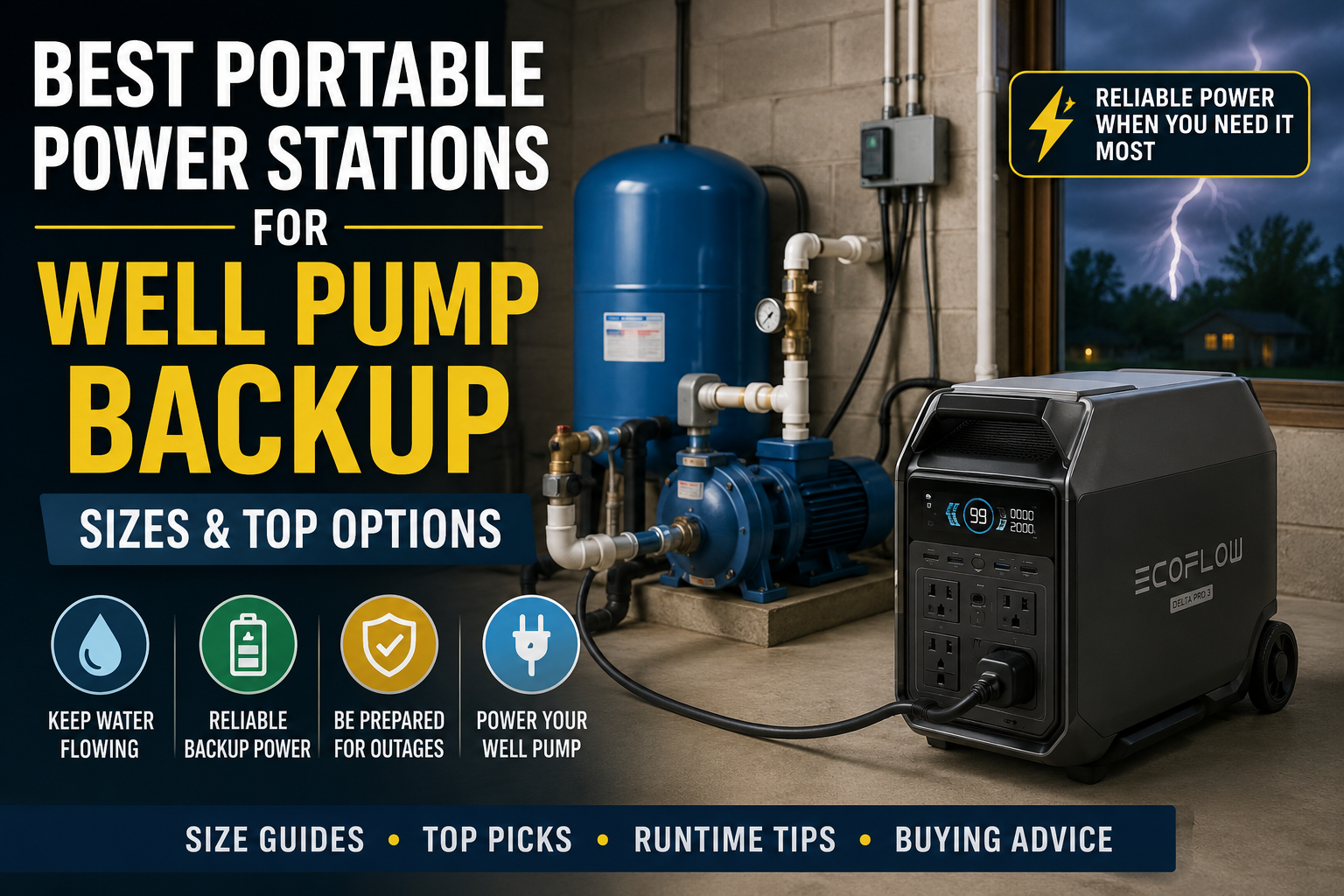
A power outage can leave your home without one of its most essential systems—running water. If your home relies on a private well, losing electricity means your well pump stops working, making it impossible to flush toilets, shower, cook, or access drinking water until power is restored.
Fortunately, many homeowners can keep their well pump operating during an outage with a properly sized portable power station. However, not every portable power station is capable of starting or running a well pump. These motors often require significantly more power when they first start than they do while running, making surge capacity just as important as battery capacity.
In this guide, you’ll learn how well pumps use electricity, how to determine your power requirements, how to calculate runtime, and which portable power stations are best suited for different types of residential well pumps.
Why Well Pumps Are Challenging to Power
Unlike many household electronics, well pumps use electric motors that create a large startup surge when they first turn on.
For many residential well pumps:
- Running power ranges from 500 to 2,000 watts
- Startup surge can reach 2 to 4 times the running wattage
- Startup usually lasts only a few seconds but requires a power station capable of handling the load
U.S. Department of Energy guidance on selecting energy-efficient water pumps
For example:
| Well Pump | Running Watts | Typical Starting Surge |
|---|---|---|
| 1/3 HP | 700W | 1,400–2,100W |
| 1/2 HP | 1,000W | 2,000–3,000W |
| 3/4 HP | 1,400W | 2,800–4,200W |
| 1 HP | 2,000W | 4,000–6,000W |
Because of this startup surge, a portable power station that appears large enough based only on running wattage may still fail to start the pump.
What Size Portable Power Station Do You Need?
Selecting the right portable power station depends on four key specifications:
Continuous Output
This is the amount of power the inverter can provide continuously while your well pump is operating.
Always choose a power station with a continuous output greater than your pump’s running wattage.
Surge Capacity
Surge capacity determines whether the power station can start the pump motor.
This is often the deciding factor for well pump compatibility.
Many premium portable power stations advertise surge ratings between 2,700 and 7,200 watts, making them suitable for many residential well pumps.
Battery Capacity
Battery capacity, measured in watt-hours (Wh), determines how long the pump can operate before recharging.
Larger batteries provide longer runtime but also increase cost and weight.
Expandability
If your home experiences frequent extended outages, consider an expandable system that allows additional battery modules.
Expandable systems can dramatically increase available runtime without replacing the original power station.
Best Portable Power Stations for Well Pump Backup
Before purchasing any portable power station, verify both your well pump’s running wattage and startup surge by checking the owner’s manual or pump specification label. If these values are unavailable, consult the manufacturer or have an electrician measure the startup current. Choosing a unit with sufficient surge capacity is critical for reliable operation.
Best Overall Choice
The EcoFlow DELTA Pro 3 is our top recommendation for most homeowners because it combines high inverter output, excellent surge capability, expandable battery capacity, and fast recharging. It is well suited for many residential well pumps while also powering refrigerators, freezers, lighting, and other essential household devices during an outage.
Before purchasing any portable power station for a well pump, verify your pump’s running wattage, startup surge requirements, and operating voltage. Selecting a unit with sufficient surge capacity is essential for reliable startup.
Disclosure: As an Amazon Associate, EnergyReadyHome earns from qualifying purchases. This comes at no additional cost to you.
Before purchasing, verify current pricing, specifications, available accessories, and compatibility with your well pump and emergency backup requirements.
Why We Recommend It
- High continuous inverter output
- Excellent startup surge capability
- Expandable battery system
- Fast AC and solar charging
- Long-life LiFePO₄ battery chemistry
- Suitable for whole-home emergency preparedness
The EcoFlow DELTA Pro 3 offers one of the best combinations of performance and flexibility for homeowners who want dependable emergency backup power for both their well pump and other essential appliances.
Before purchasing any portable power station for a well pump, verify your pump’s running wattage, startup surge requirements, and operating voltage. Selecting a unit with sufficient surge capacity is essential for reliable startup.
Best Budget Choice
The Jackery Explorer 2000 provides strong inverter performance at a more approachable price point while offering battery expansion options for homeowners planning future upgrades.
Disclosure: As an Amazon Associate, EnergyReadyHome earns from qualifying purchases. This comes at no additional cost to you.
Why We Recommend It
- Excellent value
- Strong surge capability
- Expandable battery platform
- Reliable LiFePO₄ battery
- User-friendly operation
- Good portability for its capacity
The Jackery Explorer 2000 Plus is an excellent solution for homeowners with smaller or medium-sized well pumps who want dependable backup power without purchasing a premium whole-home system.
Best for Large Well Pumps
Important: Homes with 3/4 HP or 1 HP well pumps often require substantially higher startup surge than smaller systems. Before purchasing a portable power station, verify both the pump’s continuous running wattage and its startup surge. If your pump uses a 240-volt circuit, confirm that the portable power station supports 240V output or the appropriate manufacturer-approved connection method.
The BLUETTI Elite 200 V2 is an excellent choice for homeowners with larger well pumps that require higher inverter output and additional surge capacity. Its powerful inverter, long-lasting LiFePO₄ battery, and expandable energy storage make it well suited for extended emergency use.
Disclosure: EnergyReadyHome may earn a commission from qualifying purchases made through links on this page, at no additional cost to you.
Why We Recommend It
- High continuous inverter output
- Excellent surge capacity for demanding motor loads
- Large battery capacity
- Expandable battery options
- Pure sine wave output
- Durable LiFePO₄ battery chemistry
The BLUETTI Elite 200 V2 is an excellent option for homeowners with larger residential well pumps who want reliable backup power while also supporting other essential household loads during an outage.
Before purchasing any portable power station for a well pump, verify your pump’s running wattage, startup surge requirements, and operating voltage. Selecting a unit with sufficient surge capacity is essential for reliable startup.
Estimated Runtime
Runtime depends on three primary factors:
- Battery capacity
- Pump size
- How frequently the pump cycles
Unlike appliances that run continuously, a well pump typically runs only when water is being used. This means most homeowners can operate a well pump for much longer than expected because the pump may only run a few minutes each hour.
The following estimates assume typical residential usage.
| Battery Capacity | Approximate Pump Runtime* |
|---|---|
| 1,000 Wh | Several hours of intermittent household use |
| 2,000 Wh | Approximately one full day for average household water usage |
| 3,500 Wh | One to two days depending on demand |
| Expandable systems | Multiple days with conservative water use |
*Actual runtime varies based on pump horsepower, household water consumption, battery condition, inverter efficiency, and environmental conditions.
How to Estimate Your Runtime
You can estimate runtime using this simple formula:
Battery Watt-Hours ÷ Pump Running Watts = Approximate Continuous Runtime (Hours)
For example:
- Battery capacity: 2,048 Wh
- Pump running power: 1,000 W
2,048 ÷ 1,000 = approximately 2 hours of continuous operation
Because well pumps cycle on and off instead of running continuously, real-world operation is often significantly longer than this calculation suggests.
Tips to Maximize Runtime
During a prolonged outage, conserving battery power helps extend your available water supply.
Consider these best practices:
- Fill containers with water while power is available.
- Reduce unnecessary water usage.
- Repair dripping faucets before storm season.
- Avoid running multiple high-power appliances simultaneously.
- Recharge using solar panels whenever practical.
- Monitor battery state of charge regularly.
Small reductions in water usage can significantly increase available backup time.
Common Mistakes to Avoid
Many homeowners purchase a portable power station based only on battery size.
Avoid these common mistakes:
- Ignoring startup surge requirements
- Buying based only on watt-hours
- Forgetting to verify voltage compatibility
- Assuming every portable power station can run motor-driven equipment
- Waiting until after an emergency to test the system
- Overloading the inverter with multiple large appliances at the same time
Testing your emergency power setup before storm season provides confidence that everything will work when needed.
Frequently Asked Questions
Can a portable power station start a deep well pump?
Many can, provided the inverter offers sufficient continuous output and startup surge capacity. Always verify your specific pump’s electrical requirements before purchasing.
Can I run other appliances while powering my well pump?
Yes, provided the combined electrical load remains below the portable power station’s continuous output rating. Prioritize essential appliances such as refrigerators, freezers, lighting, and communications equipment.
Can I recharge the battery with solar panels?
Most modern portable power stations support solar charging using compatible portable solar panels, making them an excellent option for extended outages.
Are portable power stations safe for well pumps?
Yes. High-quality portable power stations produce clean pure sine wave electricity that is appropriate for most residential well pump motors. Follow the manufacturer’s operating instructions and avoid exceeding rated capacities.
Final Thoughts
A properly sized portable power station can provide reliable backup power for many residential well pumps, helping your household maintain access to running water during power outages.
The key to success is selecting a model with enough continuous inverter output, startup surge capacity, and battery storage for your specific well pump. While battery capacity determines how long the system can operate, surge capability often determines whether the pump will start at all.
Investing in the right portable power station before severe weather strikes can provide peace of mind and help keep one of your home’s most essential systems operating when the electrical grid goes down.
Related Articles
To build a complete home backup power strategy, explore these related EnergyReadyHome guides:
- Can a Portable Power Station Run a Well Pump? Power Requirements Explained
- What Size Portable Power Station Do I Need?
- Best Portable Power Stations for Home Backup (2026 Guide)
- Portable Power Station Maintenance Checklist: Keep Your Battery Ready for the Next Emergency
- How to Create a Home Backup Power Plan
- How to Choose the Right Size Portable Power Station for Your Home