Jackery HomePower 3600 Plus vs Explorer 5000 Plus: The Bottom Line
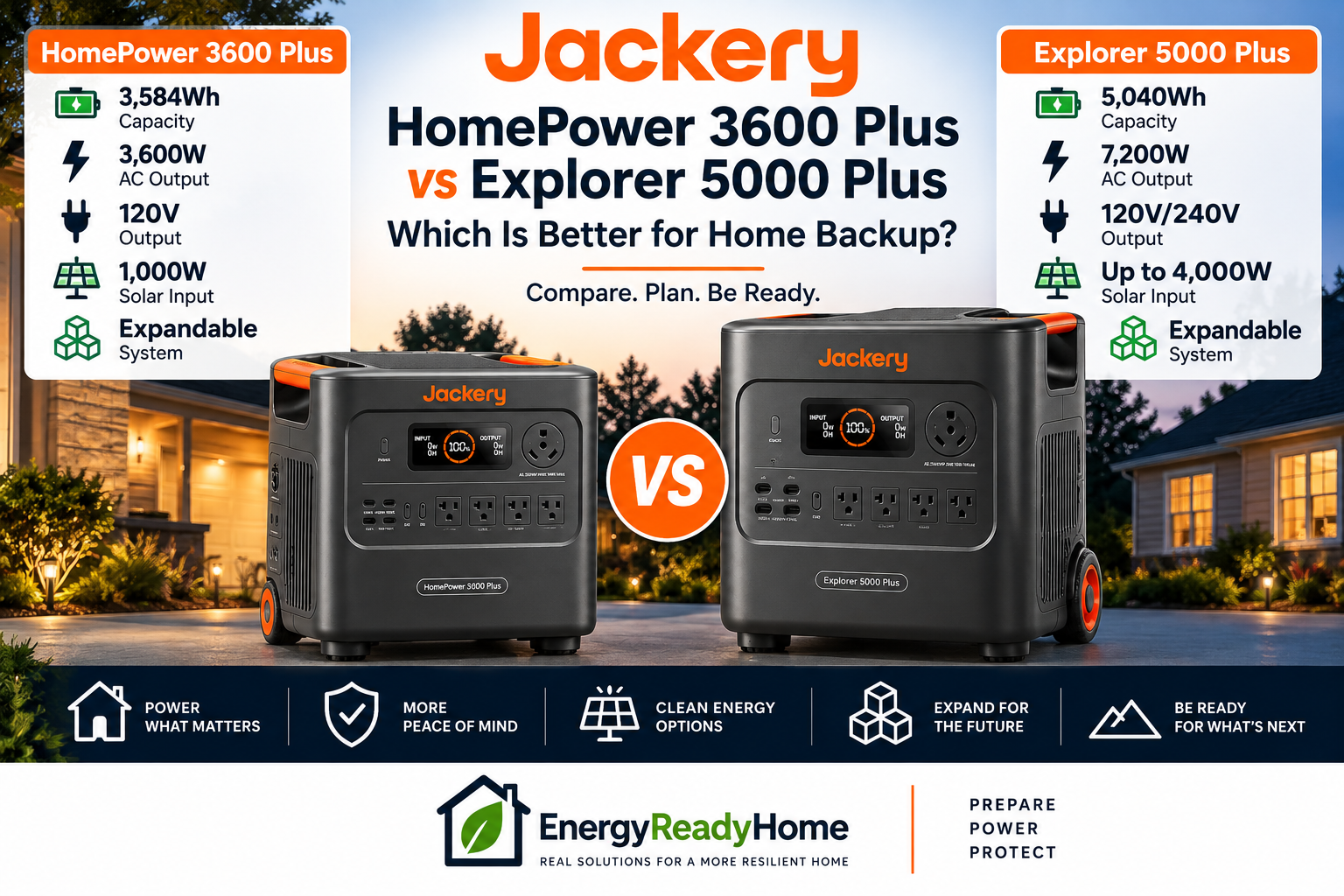
The Jackery HomePower 3600 Plus and Jackery Explorer 5000 Plus are both expandable LiFePO4 backup systems, but they target noticeably different levels of home-backup capability.
The HomePower 3600 Plus starts with 3,584Wh of battery capacity and 3,600W of continuous AC output. The Explorer 5000 Plus increases those figures to 5,040Wh and 7,200W while providing direct 120V/240V output.
Our take: The HomePower 3600 Plus is the more approachable option for homeowners primarily interested in essential 120V loads, easier mobility and a system they can expand over time. The Explorer 5000 Plus is the more capable platform for heavier household loads, 240V equipment and deeper integration into a home-backup system.
The decision therefore isn’t simply about buying the bigger battery. It comes down to how much energy you need, which appliances you need to power and how far you intend to take your home-backup system.
HomePower 3600 Plus vs Explorer 5000 Plus Specifications
| Specification | HomePower 3600 Plus | Explorer 5000 Plus |
|---|---|---|
| Battery Capacity | 3,584Wh | 5,040Wh |
| Battery Chemistry | LiFePO4 | LiFePO4 |
| Rated AC Output | 3,600W | 7,200W |
| Surge Output | 7,200W | 14,400W |
| Standard AC Voltage | 120V | 120V/240V |
| Battery Cycle Life | 6,000 cycles to 70%+ capacity | 4,000 cycles to 70%+ capacity |
| Maximum Solar/DC Input | 1,000W | Up to 4,000W high-voltage PV input |
| Weight | About 77.2 lb | About 134.5 lb |
| Dimensions | 15.2 × 12.2 × 19.3 in. | 16.5 × 15.5 × 25 in. |
| Expandable | Yes | Yes |
Jackery’s current Explorer 5000 Plus specifications confirm its 5,040Wh capacity, 7,200W output, 120V/240V capability and LiFePO4 battery architecture.
Capacity: 5,040Wh vs 3,584Wh
The Explorer 5000 Plus begins with 1,456Wh more battery capacity than the HomePower 3600 Plus.
That works out to approximately 41% more nominal stored energy in the Explorer 5000 Plus base unit.
For home backup, that difference can be meaningful. More stored energy means more flexibility for refrigeration, internet equipment, lighting, medical equipment and other essential loads before the system needs to be recharged.
But nominal capacity doesn’t translate directly into AC runtime because energy is lost through the inverter and other system components.
ERH Runtime Comparison
For consistent planning comparisons, EnergyReadyHome uses an 85% usable AC-energy assumption. This is our planning model rather than a Jackery runtime guarantee.
Using that assumption:
- HomePower 3600 Plus: approximately 3,046Wh usable AC energy
- Explorer 5000 Plus: approximately 4,284Wh usable AC energy
| Average Load | HomePower 3600 Plus | Explorer 5000 Plus |
|---|---|---|
| 50W | About 60.9 hours | About 85.7 hours |
| 100W | About 30.5 hours | About 42.8 hours |
| 200W | About 15.2 hours | About 21.4 hours |
| 300W | About 10.2 hours | About 14.3 hours |
| 500W | About 6.1 hours | About 8.6 hours |
| 1,000W | About 3.0 hours | About 4.3 hours |
| 2,000W | About 1.5 hours | About 2.1 hours |
Real-world results will vary with appliance cycling, inverter efficiency, startup loads, temperature and other operating conditions. The important comparison is that the Explorer 5000 Plus provides roughly 41% more base-unit energy, so under otherwise identical conditions its runtime advantage should be similar.
Output Power: This Is the Bigger Difference
Battery capacity isn’t the biggest distinction between these two Jackery systems. Output capability is.
The HomePower 3600 Plus supplies 3,600W of rated AC output with a 7,200W surge peak. That is substantial power for a portable battery and enough for many common 120V household appliances.
The Explorer 5000 Plus doubles rated output to 7,200W and increases surge capability to 14,400W.
That difference gives the Explorer 5000 Plus considerably more headroom when multiple high-demand appliances are operating simultaneously.
120V vs 240V: A Critical Home-Backup Difference
This is where the two products separate most clearly.
A standalone HomePower 3600 Plus provides normal 120V AC output. Jackery does provide an expansion architecture for more advanced configurations, but buyers should not assume one standalone HomePower 3600 Plus operates conventional 240V household appliances.
The Explorer 5000 Plus, by contrast, provides 120V/240V output and includes connections designed for substantially heavier home-backup applications.
That can matter for equipment such as certain central air-conditioning systems, well pumps, electric water heaters and other 240V household loads.
Whether a specific appliance can be powered still depends on its actual voltage, continuous wattage, startup demand and the way the backup system is connected. But for homeowners who know that 240V capability is part of their backup plan, the Explorer 5000 Plus is architecturally much closer to that requirement.
Solar Recharging: 1,000W vs Up to 4,000W
The HomePower 3600 Plus supports up to 1,000W of DC input.
The Explorer 5000 Plus supports a much more aggressive solar architecture, including a high-voltage PV input rated up to 4,000W as well as low-voltage solar input options.
That difference becomes increasingly important during extended outages.
A larger battery is useful, but the ability to replenish significant amounts of energy during daylight can be just as important for multi-day resilience. Under appropriate conditions and with a compatible solar array, the Explorer 5000 Plus provides substantially greater solar-recharging potential.
Actual solar production will depend on panel configuration, weather, season, shading, orientation and available sunlight, so maximum input ratings should not be treated as guaranteed real-world generation.
Portability: HomePower 3600 Plus Has a Major Advantage
The HomePower 3600 Plus weighs approximately 77.2 pounds, while the Explorer 5000 Plus weighs approximately 134.5 pounds.
Neither is a lightweight power station, and both are designed with mobility features rather than expecting users to routinely carry them.
But a roughly 57-pound difference is significant.
The HomePower 3600 Plus is therefore easier to position as a movable backup system that can serve different locations around a property. The Explorer 5000 Plus is better thought of as a heavy-duty mobile home-backup platform that will usually spend much more time in one location.
The ERH Standalone vs Home-System Test
| Priority | HomePower 3600 Plus | Explorer 5000 Plus |
|---|---|---|
| Essential 120V Loads | Strong fit | Strong fit |
| Base Battery Capacity | 3,584Wh | 5,040Wh |
| Heavy Simultaneous Loads | Good | Much greater output headroom |
| Standalone 240V Capability | No | Yes |
| Maximum Solar Input | 1,000W DC | Up to 4,000W high-voltage PV |
| Mobility | Easier | Heavier system |
| Home-System Integration | Expandable platform | Designed for deeper home-backup integration |
Which Is Better for a Typical Power Outage?
For a typical outage focused on refrigerators, freezers, internet equipment, lights, electronics and other essential 120V loads, both systems provide substantial capability.
The HomePower 3600 Plus has enough output for most essential-load strategies while keeping the system smaller and easier to move. Its 3,584Wh battery also provides significantly more storage than the common 1–2kWh portable-power category.
The Explorer 5000 Plus becomes more compelling as the number and size of the loads increase. Its 5,040Wh battery provides more base runtime, while 7,200W of output gives it considerably more room for operating multiple demanding appliances simultaneously.
Refrigerator, Freezer and Essential-Load Backup
If your main objective is keeping refrigeration, communications, lighting and other essentials operating, the HomePower 3600 Plus may provide all the capability you actually need.
That matters because buying more output does not automatically provide better value if your household will never use it.
The Explorer 5000 Plus adds approximately 41% more base battery capacity, however, so households with several essential loads or higher daily energy consumption gain additional runtime before recharging becomes necessary.
Which Is Better for Multi-Day Outages?
Multi-day backup depends on more than the size of the battery on day one. Load management, expansion capacity and the ability to replenish energy become increasingly important as an outage continues.
Both systems can be expanded, but the Explorer 5000 Plus begins with more stored energy and supports substantially higher solar input. That combination gives it a stronger foundation for extended-outage planning.
The HomePower 3600 Plus can still be a strong multi-day option when paired with expansion batteries, solar charging and disciplined energy use. Its lower starting capacity simply makes energy management more important.
Which Is Better for 240V Appliances?
If operating 240V equipment is an important part of your backup plan, the distinction is significant.
The standalone HomePower 3600 Plus is primarily a 120V system. Jackery supports more advanced configurations using compatible equipment, but buyers should evaluate the complete required configuration rather than assuming a single base unit provides ordinary 240V appliance power.
The Explorer 5000 Plus provides direct 120V/240V capability and is designed around substantially heavier home-backup requirements.
That makes it the more appropriate architecture to evaluate for households planning around compatible 240V loads such as certain well pumps, HVAC equipment and other high-demand appliances.
Which Is Easier to Move?
The HomePower 3600 Plus has the clear practical advantage when mobility matters.
At roughly 77 pounds, it is still heavy, but its wheels and retractable handle make relocation manageable for many users.
The Explorer 5000 Plus weighs roughly 134.5 pounds. Its mobility features help, but this is a much larger system that is better suited to being positioned near its primary backup location.
If you expect to move your power station between the house, garage, RV or other locations, the HomePower 3600 Plus is the more manageable of the two.
Buyer A: Essential Backup and Flexibility
Buyer A wants to keep a refrigerator, freezer, internet equipment, lights, electronics and other essential 120V loads operating during an outage.
They value battery expansion but do not currently need extensive 240V capability or 7,200W of continuous output.
For this buyer, the HomePower 3600 Plus offers a strong balance of capacity, output, expandability and mobility without stepping immediately into the larger Explorer 5000 Plus platform.
Buyer B: Heavy-Duty Home Backup
Buyer B wants more than essential-load backup. They are planning around higher simultaneous loads, greater base battery capacity, 240V equipment or deeper home electrical integration.
They may also want substantially greater solar-input capability for extended outages.
For this buyer, the Explorer 5000 Plus is the more capable architecture. Its larger battery, 7,200W continuous output and 120V/240V capability make it better suited to demanding home-backup configurations.
Which Offers Better Value?
Value depends on how much of the additional capability you will actually use.
The HomePower 3600 Plus can offer better practical value when your backup plan revolves around essential 120V loads. Paying for substantially more output and 240V capability provides limited benefit if those features are not part of your outage strategy.
The Explorer 5000 Plus can justify its larger system when those capabilities are important. Its additional battery capacity, much higher continuous output, 240V support and greater solar-input potential represent meaningful functional upgrades rather than simply a larger specification sheet.
The better approach is therefore to size the system around your actual loads rather than automatically choosing the larger power station.
Who Should Choose the HomePower 3600 Plus?
- Households primarily backing up essential 120V loads
- Buyers who want a 3.6kWh-class battery with expansion capability
- Users who value easier mobility
- Households that do not currently require standalone 240V output
- Buyers who want to start with a substantial base system and expand later
If that describes your backup plan, you can check the current Jackery HomePower 3600 Plus price on Amazon.
Who Should Choose the Explorer 5000 Plus?
- Households that want 5,040Wh of base battery capacity
- Users expecting heavier simultaneous loads
- Buyers who need 120V/240V capability
- Households planning deeper home-backup integration
- Users who want substantially greater solar-input capability
If those capabilities match your requirements, you can check the current Jackery Explorer 5000 Plus price on Amazon.
As an Amazon Associate, EnergyReadyHome earns from qualifying purchases.
Final Verdict
The Jackery HomePower 3600 Plus and Explorer 5000 Plus solve different levels of the home-backup problem.
For essential 120V backup, easier mobility and expandable storage without immediately moving into a much larger system, the HomePower 3600 Plus is a strong fit.
For greater base runtime, much higher output, direct 120V/240V capability and a platform designed for heavier home-backup demands, the Explorer 5000 Plus provides the additional capability.
The deciding question is not simply which power station is larger. It is whether your outage plan requires the Explorer 5000 Plus’s additional output and 240V architecture. If it does not, the HomePower 3600 Plus may provide the more practical level of backup. If it does, the Explorer 5000 Plus offers capabilities the smaller standalone system cannot match.
Frequently Asked Questions
Which has more battery capacity: HomePower 3600 Plus or Explorer 5000 Plus?
The Explorer 5000 Plus has 5,040Wh of base capacity compared with 3,584Wh for the HomePower 3600 Plus. That is approximately 41% more nominal battery capacity.
Which has more output power?
The Explorer 5000 Plus provides 7,200W of continuous output, while the HomePower 3600 Plus provides 3,600W. The difference becomes important when operating multiple high-demand appliances simultaneously.
Can both systems run a refrigerator?
Yes. Both have ample output capability for typical household refrigerators. Runtime depends on the refrigerator’s actual energy consumption, compressor cycling and other loads connected to the power station.
Which Jackery is better if I need 240V power?
The Explorer 5000 Plus provides direct 120V/240V capability. A standalone HomePower 3600 Plus should not be treated as a conventional 240V appliance power source.
Which is easier to move?
The HomePower 3600 Plus is considerably lighter at approximately 77 pounds compared with roughly 134.5 pounds for the Explorer 5000 Plus. Both include mobility features, but the HomePower 3600 Plus is easier to relocate.
Which is better for a multi-day outage?
The Explorer 5000 Plus begins with more stored energy and supports greater solar-input capability, giving it a stronger starting point for extended outages. Either system can provide longer-duration backup when properly expanded and recharged.
Do I need the Explorer 5000 Plus for basic outage backup?
Not necessarily. If your goal is primarily refrigeration, internet equipment, lights, electronics and other essential 120V loads, the HomePower 3600 Plus may provide sufficient output and capacity. The Explorer 5000 Plus becomes more compelling when your requirements include heavier loads, more base runtime or 240V equipment.