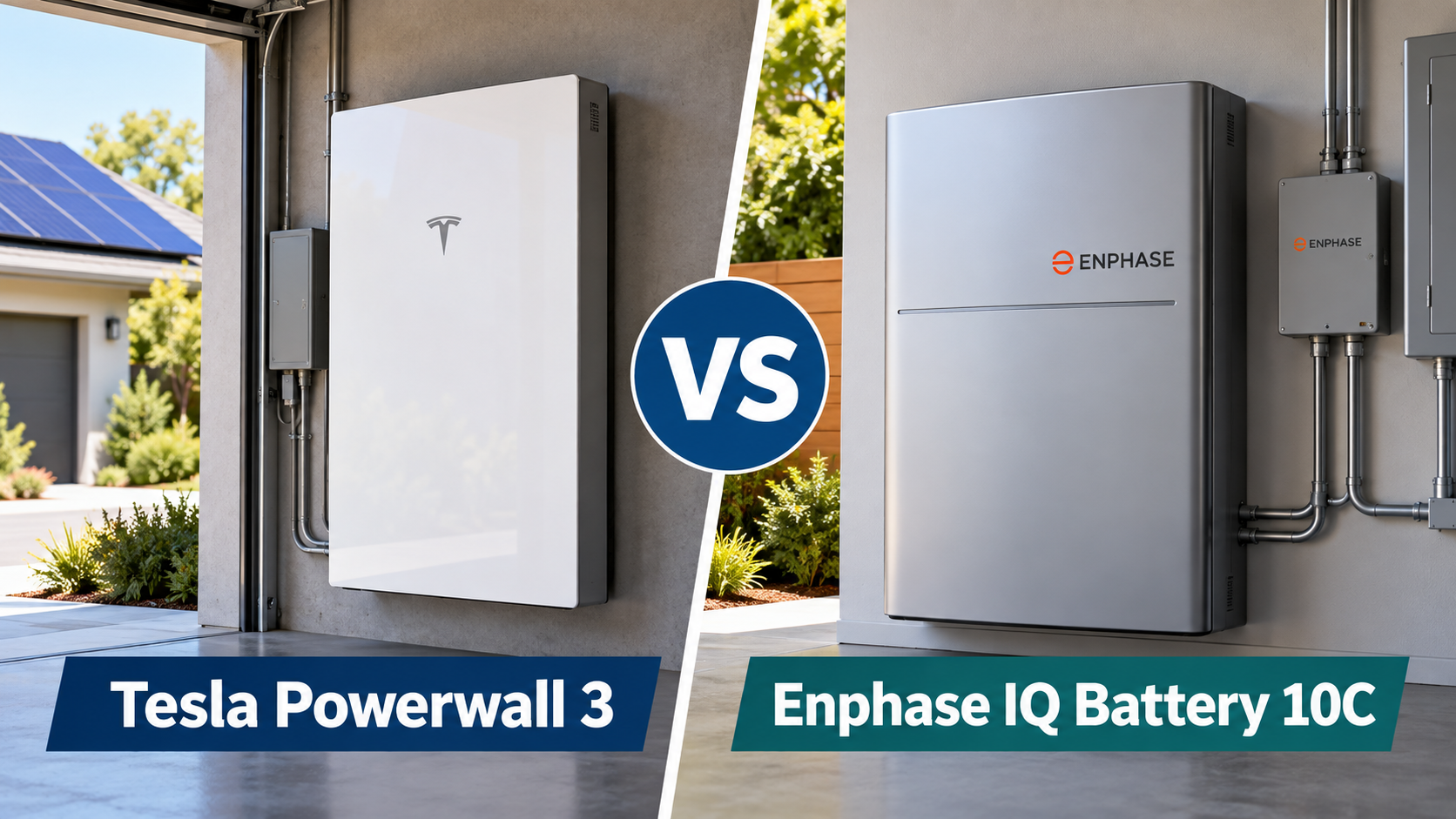
If you’re comparing the Tesla Powerwall 3 vs Enphase IQ Battery 10C for home backup, the biggest difference isn’t simply battery capacity. These are two capable home-energy systems with different strengths in power output, solar integration, expansion, installation architecture, and compatibility with an existing solar system.
The Tesla Powerwall 3 provides 13.5 kWh of nominal battery energy and can provide up to 11.5 kW of continuous AC output, giving a single unit substantial capability for larger household loads.
The Enphase IQ Battery 10C provides 10 kWh of usable energy and 7.08 kW of continuous power. Its modular AC-coupled architecture is particularly interesting for homeowners who value the Enphase ecosystem or want to add battery backup to an existing solar installation.
For 2026, that second use case has become especially important. Enphase now supports adding the IQ Battery 10C and whole-home backup to qualifying homes with existing third-party solar systems without requiring homeowners to replace the solar equipment already on their roof.
Tesla Powerwall 3 vs Enphase IQ Battery 10C: Quick Comparison
| Feature | Tesla Powerwall 3 | Enphase IQ Battery 10C |
|---|---|---|
| Battery Energy | 13.5 kWh nominal | 10 kWh usable |
| Continuous Power | Up to 11.5 kW | 7.08 kW |
| Electrical System | 120/240V split phase | 120/240V AC-coupled architecture |
| Solar Architecture | Integrated solar inverter | AC-coupled |
| Existing Third-Party Solar | Configuration dependent | Supported in qualifying 10C configurations |
| Expansion | Powerwall 3 and Powerwall 3 Expansion architecture | Modular multiple-battery architecture |
| Warranty | 10 years | 15-year limited warranty / 6,000 cycles |
| Best Fit | Higher single-unit output and Tesla solar/storage integration | Modular storage and existing-solar retrofit flexibility |
EnergyReadyHome Quick Answer
The Tesla Powerwall 3 is particularly compelling when higher single-unit power output, larger per-unit energy capacity, and tightly integrated solar-plus-storage are priorities. Its 13.5 kWh battery and up-to-11.5 kW continuous output provide considerably more capacity and power from one battery than a single IQ Battery 10C.
The Enphase IQ Battery 10C is particularly compelling when modularity, AC-coupled storage, Enphase ecosystem integration, or adding backup to an existing solar installation are priorities. Enphase’s expanded support for qualifying third-party solar systems makes the 10C especially relevant to homeowners who already have rooftop solar but haven’t yet added battery backup.
Neither specification tells you by itself which system is right for your house. Whole-home battery design also depends on peak electrical loads, daily energy consumption, air-conditioning requirements, outage duration, solar production, electrical-panel configuration, utility requirements, and how much of the home you actually want to operate during an outage.
Battery Capacity: Powerwall 3 Has More Energy Per Unit
The Powerwall 3 stores 13.5 kWh of nominal battery energy, compared with 10 kWh of usable energy for the IQ Battery 10C.
Those manufacturer specifications aren’t expressed on precisely the same basis—Tesla publishes nominal battery energy while Enphase publishes usable energy—so they shouldn’t be treated as a perfectly equivalent laboratory comparison.
But the practical point remains important: a single Powerwall 3 represents a larger battery unit.
Capacity affects how long a home can operate during an outage, but runtime depends entirely on what you’re powering.
A household limiting backup consumption to refrigerators, lights, internet equipment, selected outlets, and other essential loads can stretch stored energy much further than a household attempting to operate central air conditioning, electric cooking, laundry equipment, pumps, and other large loads normally.
Solar can change the calculation again because a properly designed solar-plus-storage system may recharge batteries during daylight hours while the grid remains unavailable.
Power Output: Powerwall 3 Has the Higher Single-Unit Rating
Battery capacity tells you how much energy is stored. Power output tells you how much electrical demand the system can support at one time.
This is one of the clearest differences between these systems.
According to Tesla’s official Powerwall 3 technical specifications, Powerwall 3 can provide up to 11.5 kW of continuous AC output. Enphase specifies the IQ Battery 10C at 7.08 kW of continuous power.
That difference can matter when operating high-demand equipment such as central air conditioning, well pumps, electric cooking equipment, or several substantial household loads simultaneously.
It doesn’t mean an Enphase system cannot support a high-demand home. Multiple batteries and proper system design can increase overall capability. It means that homeowners should compare the complete proposed system, rather than comparing only the nameplate capacity of one battery.
Solar Integration: Two Different Approaches
The Powerwall 3 and IQ Battery 10C take fundamentally different approaches to solar integration.
Powerwall 3 includes an integrated solar inverter. For homeowners designing a new Tesla solar-plus-storage system, that can create a more tightly integrated architecture in which solar generation, battery storage, backup power, and energy management operate within the same Tesla ecosystem.
The IQ Battery 10C is an AC-coupled battery. That architecture can be particularly useful when adding storage to a home that already has solar equipment installed.
Enphase has expanded that flexibility by supporting IQ Battery 10C whole-home backup configurations with qualifying existing third-party solar systems. That means some homeowners can add Enphase storage and backup without replacing the rooftop solar equipment they already own.
For a homeowner starting from scratch with a new solar-plus-storage project, Powerwall 3’s integrated architecture may be attractive. For a homeowner trying to preserve an existing solar investment, the IQ Battery 10C deserves particularly close consideration.
Which Is Better for an Existing Solar System?
The IQ Battery 10C has a particularly strong case for existing-solar retrofits.
That’s important because replacing functioning solar equipment simply to add battery storage can add complexity and potentially unnecessary expense to a project.
Enphase’s support for qualifying third-party solar installations gives homeowners another path: keep compatible existing solar equipment and add the battery, system controller, and other components required for the desired backup configuration.
Powerwall 3 can also be used in different solar and storage configurations, but compatibility and system architecture need to be evaluated for the specific installation.
If you already have solar, don’t choose either battery solely from an online specification table. Ask prospective installers to explain exactly how the proposed battery will integrate with your existing inverter, solar array, electrical panel, metering equipment, and backup architecture.
Which Is Better for Whole-Home Backup?
Both systems can be used in whole-home backup designs, but the phrase whole-home backup can be misleading if it isn’t defined carefully.
A battery system may be electrically configured to back up an entire house without having enough stored energy to operate every appliance normally for an extended outage.
For example, central air conditioning, electric resistance heating, electric water heaters, clothes dryers, ranges, well pumps, pool equipment, and EV charging can dramatically increase household power and energy requirements.
Powerwall 3’s higher single-unit continuous output can be advantageous when substantial loads must operate simultaneously.
Enphase can approach the problem modularly by combining battery capacity as part of a properly engineered system.
The right comparison therefore isn’t simply:
Can this battery back up my whole house?
A better question is:
Which loads can the proposed system operate simultaneously, and for approximately how long under realistic outage conditions?
That distinction is central to choosing a home battery. Our How to Choose a Home Battery Backup System guide explains the broader sizing process in more detail.
What About Central Air Conditioning?
Central air conditioning is one of the most important loads to discuss with an installer before buying either system.
An air conditioner doesn’t just consume energy over time. Its compressor may also create a substantial starting load, while other household equipment may be operating simultaneously.
Powerwall 3’s higher single-unit continuous output gives it a meaningful advantage on paper for high-demand households.
But equipment specifications alone don’t establish whether a particular HVAC system will operate successfully. Air-conditioner size, compressor characteristics, starting requirements, other simultaneous loads, electrical configuration, and the number of installed batteries can all affect system design.
If keeping central air conditioning operational during an outage is a requirement rather than a preference, make that requirement explicit when requesting installation proposals.
Expansion: Think Beyond the First Battery
Both platforms provide ways to build beyond a basic single-battery installation.
That’s useful because homeowners don’t always know their ultimate storage requirements when purchasing their first system. Future EV ownership, heat-pump conversion, additional household loads, longer desired outage protection, or increased solar generation can change the amount of storage that makes sense.
Tesla supports expansion within the Powerwall 3 architecture, including Powerwall 3 Expansion units in supported configurations.
Enphase takes a modular approach that allows multiple compatible IQ Batteries to be incorporated into appropriately designed systems.
Before purchasing either platform, ask not only whether the system is expandable but also:
- How much additional battery capacity can be added?
- Does adding batteries increase available system power?
- What additional equipment would expansion require?
- Can batteries be added several years later?
- Would future expansion require additional electrical work?
Those questions can matter more than the theoretical maximum number of batteries a manufacturer supports.
Warranty: Enphase Offers the Longer Published Term
Tesla publishes a 10-year limited warranty for Powerwall 3.
Enphase publishes a 15-year limited warranty for the IQ Battery 10C, with warranty terms that also incorporate cycle and energy-throughput provisions.
That gives Enphase the longer headline warranty period, but battery warranties should never be compared by years alone.
Homeowners should review retained-capacity provisions, cycle or throughput limits, operating requirements, exclusions, labor coverage, transferability, and the process for obtaining warranty service.
A home battery is long-term electrical infrastructure. The installer and service network behind the equipment can therefore be nearly as important as the written warranty itself.
What Does Each System Cost?
Installed home-battery pricing varies substantially by location and project.
The final price can include the battery, energy-management equipment, backup gateway or system controller, electrical-panel modifications, wiring, permits, labor, solar integration, and additional equipment required by the home’s electrical system.
A one-battery proposal also shouldn’t be compared directly with a multi-battery proposal simply because both installers describe their design as “whole-home backup.”
Compare proposals based on the complete installed system and what that system is designed to accomplish.
Our How Much Does a Home Battery Backup System Cost in 2026? guide explains the major cost drivers and why advertised battery prices don’t necessarily represent the final installed price.
Who Should Choose Tesla Powerwall 3?
Powerwall 3 deserves particularly close consideration if you:
- Want higher power output from a single battery unit.
- Are designing a new solar-plus-storage installation.
- Want tight integration within Tesla’s home-energy ecosystem.
- Expect to operate substantial household loads during an outage.
- Want 13.5 kWh of nominal battery energy from the primary battery unit.
- May expand the system within Tesla’s Powerwall architecture.
Who Should Choose Enphase IQ Battery 10C?
The IQ Battery 10C deserves particularly close consideration if you:
- Already use Enphase solar equipment.
- Want a modular AC-coupled battery architecture.
- Already have a qualifying third-party solar system you hope to retain.
- Prefer the flexibility of building storage capacity with multiple battery units.
- Value Enphase’s published 15-year limited battery warranty.
- Want solar, storage, backup, and energy management within the broader Enphase ecosystem.
Tesla Powerwall 3 vs Enphase IQ Battery 10C: Bottom Line
The Tesla Powerwall 3 stands out for its higher single-unit power output, larger per-unit energy capacity, and integrated approach to solar-plus-storage.
The Enphase IQ Battery 10C stands out for its modular AC-coupled architecture, longer published warranty term, Enphase ecosystem integration, and increasingly strong compatibility story for homeowners adding storage to existing solar.
The best choice depends on the house rather than the specification sheet alone.
Before selecting either system, determine which circuits and appliances you need during an outage, how long you want them to operate, whether central air conditioning or other major loads must remain available, whether you already have solar, and how much future expansion you want.
Then ask qualified installers to design both proposals around those same requirements. That gives you a much more meaningful comparison of system capability and installed cost.
Frequently Asked Questions
Is Tesla Powerwall 3 more powerful than one Enphase IQ Battery 10C?
Based on manufacturer continuous-power ratings, yes. Powerwall 3 can provide up to 11.5 kW of continuous AC output, while one IQ Battery 10C is rated at 7.08 kW continuous power. A multi-battery Enphase system changes the overall system comparison.
Which battery has more capacity?
Tesla publishes 13.5 kWh of nominal battery energy for Powerwall 3. Enphase publishes 10 kWh of usable energy for the IQ Battery 10C. Because the manufacturers express these specifications differently, the figures aren’t a perfectly equivalent usable-capacity comparison.
Can Enphase IQ Battery 10C work with existing non-Enphase solar?
Yes, in supported configurations. Enphase has expanded IQ Battery 10C whole-home backup support to qualifying existing third-party solar installations. Equipment compatibility and installation requirements still need to be verified for the individual home.
Can either system run central air conditioning?
Properly designed systems may be able to operate central air conditioning, but the answer depends on the HVAC equipment, starting and running requirements, other simultaneous loads, battery configuration, and electrical design. Have the installer size the system specifically for your air conditioner if HVAC backup is required.
Do you need solar panels to use these batteries?
Not necessarily. Home batteries can provide grid-charged backup in supported configurations. Solar becomes particularly valuable during longer outages because a properly designed system may use available solar production to recharge the batteries while grid power remains unavailable.
Which has the longer warranty?
Enphase publishes a 15-year limited warranty for the IQ Battery 10C, while Tesla publishes a 10-year limited warranty for Powerwall 3. Review the complete warranty conditions rather than comparing the number of years alone.
Related Articles
- How to Choose a Home Battery Backup System
- Best Home Battery Backup Systems for Power Outages (2026 Guide)
- How Much Does a Home Battery Backup System Cost in 2026?
- Whole-Home Battery Backup vs Generator: Which Should You Buy?
- Tesla Powerwall 3 vs FranklinWH aPower 2: Which Is Better?
- Whole-Home vs Partial-Home Battery Backup: Which Do You Need?