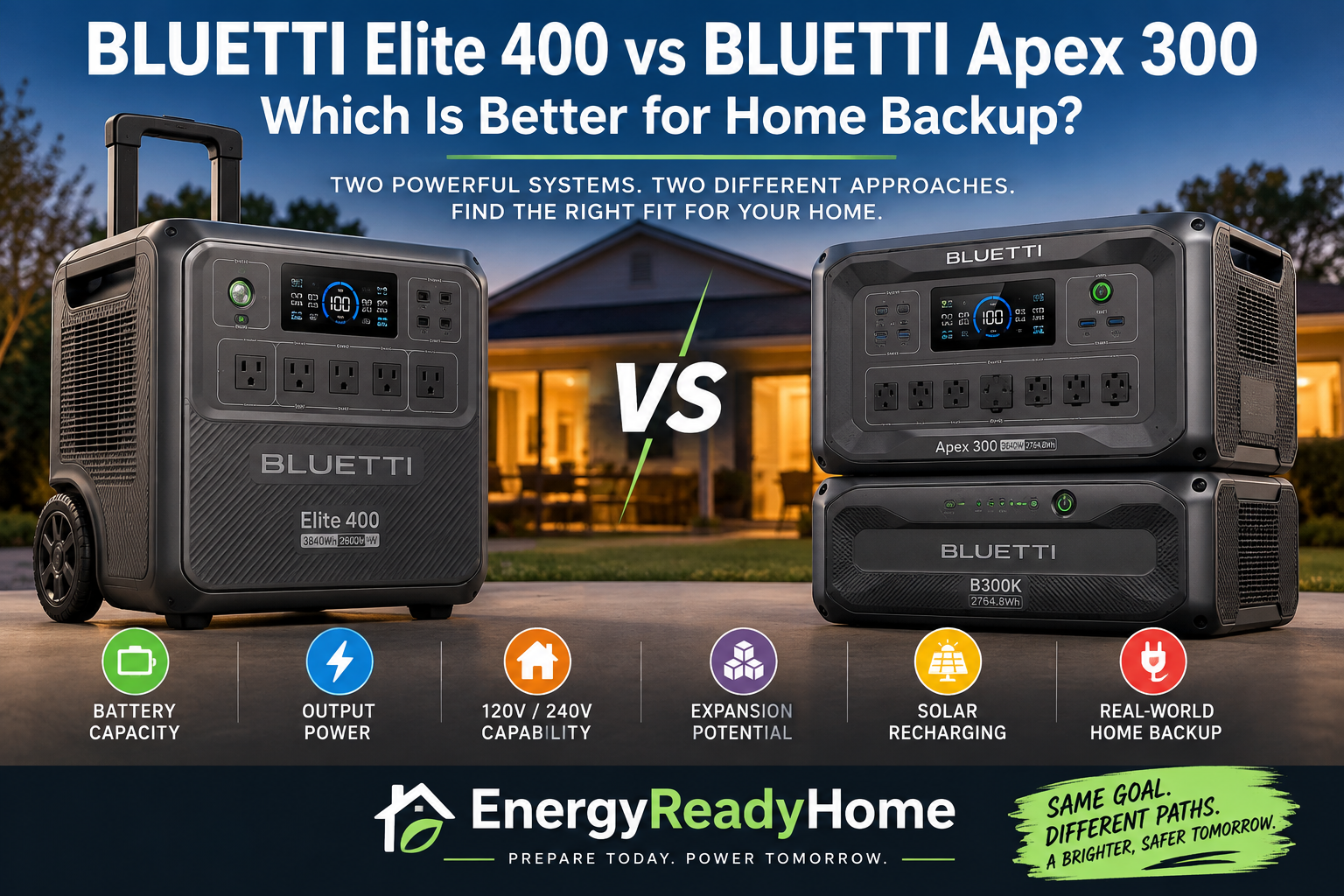
The BLUETTI Elite 400 and BLUETTI Apex 300 are both serious home-backup power systems, but they approach the job in very different ways.
The Elite 400 starts with the larger battery: 3,840Wh compared with 2,764.8Wh for the base Apex 300. That gives the Elite 400 more stored energy right out of the box.
The Apex 300, however, is the more ambitious home-backup platform. It provides 3,840W of output, supports 120V/240V operation, and can be expanded into a much larger backup system.
The Elite 400 provides 2,600W of continuous 120V AC output and is designed more like a large rolling portable power station: nearly 4kWh of battery capacity in a self-contained unit that can still be moved when necessary.
That creates the real buying decision:
Do you want more battery capacity in a simpler standalone power station, or a more powerful 120V/240V platform designed to grow with your home-backup needs?
Quick Verdict: Elite 400 vs Apex 300
Choose the BLUETTI Elite 400 if you want:
- 3,840Wh of battery capacity in the base unit
- A simpler all-in-one portable backup system
- Long refrigerator, freezer and electronics runtime
- 2,600W of continuous 120V AC output
- A rolling design with integrated wheels and telescoping handle
- Fast AC and DC charging capability
- Backup for selected household loads without building a larger modular system
Choose the BLUETTI Apex 300 if you want:
- 3,840W of output
- 120V and 240V capability
- More headroom for larger household loads
- A deeply expandable battery platform
- Home-integration potential
- 0 ms UPS functionality
- A system that can grow far beyond the capacity of a single portable power station
EnergyReadyHome Quick Take
The Elite 400 is the simpler choice when you want substantial battery capacity in one self-contained unit.
The Apex 300 is the stronger choice when you want a true expandable home-backup platform with 240V capability.
The Elite 400 actually starts with more battery capacity, but the Apex 300 provides substantially more system flexibility.
That distinction is more important than simply comparing their watt-hour ratings.
BLUETTI Elite 400 vs Apex 300: Key Specifications
| Specification | BLUETTI Elite 400 | BLUETTI Apex 300 |
|---|---|---|
| Base Battery Capacity | 3,840Wh | 2,764.8Wh |
| Battery Chemistry | LiFePO₄ | LiFePO₄ |
| AC Output | 2,600W continuous | 3,840W |
| AC Voltage | 120V | 120V/240V |
| AC Charging Input | Up to 1,800W | Configuration dependent |
| DC Input | Up to 1,000W | Higher solar configurations available |
| Combined AC + DC Input | Up to 2,800W | Configuration dependent |
| UPS | 15 ms | 0 ms |
| Expandable | Limited compared with Apex platform | Yes |
| Maximum System Capacity | Not designed around deep modular expansion | Up to 58kWh in expanded configurations |
| Base Weight | Approx. 86 lb | Larger/heavier system |
| Best Fit | High-capacity standalone 120V backup | Expandable 120V/240V home backup |
For primary-source verification, BLUETTI provides the Elite 400’s technical specifications, charging information, operating limits and safety instructions in its official BLUETTI Elite 400 User Manual.
Battery Capacity: Elite 400 Starts With the Advantage
If you compare only the base units, the Elite 400 has a significant capacity advantage.
Elite 400: 3,840Wh
Apex 300: 2,764.8Wh
That’s a difference of 1,075.2Wh.
In percentage terms, the Elite 400 starts with approximately 39% more nominal battery capacity than a single Apex 300 base unit.
For a homeowner who simply wants to roll a power station into position, plug in essential equipment and maximize runtime without adding expansion batteries or other system components, that’s an important advantage.
The Elite 400’s larger base battery can provide more runtime for compatible sustained loads such as:
- Refrigerators
- Freezers
- Internet equipment
- Lighting
- Televisions
- Computers
- CPAP equipment
- Fans
- Phone and tablet charging
But the base-unit comparison tells only part of the story.
The Apex 300 is designed around expansion. Its smaller starting battery is therefore better understood as the entry point into a much larger backup architecture rather than the system’s practical capacity ceiling.
ERH Runtime Model: Base Unit vs Base Unit
To illustrate the battery-capacity difference, EnergyReadyHome uses an 85% usable-energy assumption when estimating AC runtime.
This is an ERH planning model—not a manufacturer runtime guarantee. Actual runtime varies with inverter losses, battery-management overhead, temperature, appliance cycling and changing loads.
Estimated usable energy:
Elite 400:
3,840Wh × 85% ≈ 3,264Wh
Apex 300 base unit:
2,764.8Wh × 85% ≈ 2,350Wh
| Average Load | Elite 400 | Apex 300 Base Unit |
|---|---|---|
| 50W | ~65.3 hours | ~47.0 hours |
| 100W | ~32.6 hours | ~23.5 hours |
| 200W | ~16.3 hours | ~11.8 hours |
| 300W | ~10.9 hours | ~7.8 hours |
| 500W | ~6.5 hours | ~4.7 hours |
| 1,000W | ~3.3 hours | ~2.4 hours |
On a base-unit-to-base-unit comparison, the Elite 400 provides the longer theoretical runtime.
But this is also where the two products begin to diverge.
The Elite 400’s strength is having nearly 4kWh available immediately in one self-contained system.
The Apex 300’s strength is that you don’t have to remain at 2,764.8Wh. Its architecture is designed to add substantial battery capacity as your backup requirements grow.
AC Output: Apex 300 Has Considerably More Power
Battery capacity determines how much energy is stored. Inverter output helps determine how much AC power the system can provide at one time.
Here, the Apex 300 has the advantage.
Elite 400: 2,600W continuous AC output
Apex 300: 3,840W output
That’s a difference of 1,240W.
For ordinary critical loads such as refrigerators, freezers, internet equipment and electronics, the Elite 400’s 2,600W continuous output may already be more than enough.
The Apex 300’s higher output becomes more important as you move toward larger household loads, more simultaneous equipment or a more integrated backup strategy.
120V vs 240V: This Is the Biggest Architectural Difference
The Elite 400 is fundamentally a 120V portable power station.
The Apex 300 platform supports 120V and 240V operation.
For many homeowners, that difference matters more than the Elite 400’s larger base battery.
A 120V portable power station can be excellent for backing up selected essentials. But homes also contain larger loads and circuits that may require 240V.
The Apex 300 is designed to move further into that home-backup territory.
That does not mean every Apex 300 configuration automatically powers every 240V appliance or an entire house. System configuration, appliance requirements, circuit loads, connection equipment and installation all matter.
But if 240V capability is part of your long-term backup plan, the Apex 300 offers an architectural path the Elite 400 does not.
Expansion: Apex 300 Is in a Different Class
This is where comparing the two systems strictly by their base battery capacities becomes misleading.
The Elite 400 is primarily designed to give you substantial stored energy in one movable unit.
The Apex 300 is designed as a modular platform.
BLUETTI states that expanded Apex 300 configurations can scale to approximately 58kWh of battery capacity and up to 11.52kW of output in supported configurations.
Those figures should not be interpreted as the capability of one base Apex 300. They describe the potential of a larger configured system using compatible components.
For someone who wants a straightforward backup battery today, that scalability may be unnecessary.
For someone who wants to start with portable backup and potentially build toward a much larger home-energy system, it can be the deciding factor.
Which Is Better for a Typical Power Outage?
For many homeowners, the answer depends less on maximum system capability and more on how they actually plan to use backup power.
If your outage strategy is to keep a refrigerator, freezer, internet equipment, lights, electronics and other selected 120V essentials operating, the Elite 400’s 3,840Wh integrated battery is compelling.
You get substantial stored energy without building a modular system.
The Apex 300 becomes more attractive when your objective goes beyond selected portable loads and toward 240V capability, higher output, battery expansion or deeper home integration.
Short Outages: Elite 400 May Be the Simpler Choice
During a short outage, many households don’t need an elaborate backup architecture.
They need enough power for essentials such as:
- Refrigerator and freezer
- Internet modem and router
- Phones and communications equipment
- LED lighting
- Computers
- Television
- CPAP or other compatible equipment
- Fans and selected small appliances
For this type of backup plan, the Elite 400 offers an attractive combination of capacity and simplicity.
Its 3,840Wh battery is already larger than the Apex 300’s 2,764.8Wh base battery, so you don’t necessarily need expansion equipment simply to obtain substantial runtime.
Longer Outages: The Decision Changes
As an outage extends from hours into days, stored battery capacity is only one part of the equation.
You also need to consider:
- How much energy your household consumes each day
- How quickly the system can recharge
- Whether solar charging is practical
- Whether additional batteries may be needed
- Whether you want to support larger 120V or 240V loads
The Elite 400 gives you more energy in the base unit.
The Apex 300 gives you a much larger path for expansion.
That means the Elite 400 can be especially attractive for a homeowner who wants a high-capacity standalone system, while the Apex 300 makes more sense when the goal is to build a larger outage-resilience platform over time.
Elite 400 vs Apex 300 for Refrigerator and Freezer Backup
Both systems have more than enough inverter output for many conventional refrigerators and freezers, assuming the specific appliance’s operating and startup requirements fall within the power station’s limits.
For refrigerator and freezer backup, battery capacity often matters more than maximum inverter output.
That gives the Elite 400 an advantage when comparing only the two base units.
Using the EnergyReadyHome 85% planning model, the Elite 400 provides approximately 3,264Wh of estimated usable AC energy compared with approximately 2,350Wh for the base Apex 300.
Real refrigerators and freezers do not draw a constant amount of power. Compressors cycle on and off, ambient temperature matters, door openings matter and startup demand can differ significantly by appliance.
So runtime should always be treated as an estimate rather than a guarantee.
Elite 400 vs Apex 300 for CPAP and Overnight Backup
Both systems can provide substantial overnight energy for compatible CPAP equipment and other relatively low-power devices.
The Elite 400’s larger integrated battery again gives it the base-unit runtime advantage.
But CPAP power consumption varies considerably depending on the machine, pressure settings, heated humidifier, heated tubing and other features.
If medical equipment is part of your outage plan, determine its actual power requirements and maintain whatever manufacturer-recommended backup procedures apply to that equipment.
Which Is Better for Solar Recharging?
The Elite 400 supports up to 1,000W of DC input, giving it meaningful solar-recharging capability for a portable system.
The Apex 300 platform can support substantially larger solar configurations. With compatible BLUETTI system components, configurations can reach up to 4,000W of solar input per Apex setup.
That difference becomes increasingly important during multi-day outages.
A large battery is valuable, but once its stored energy is consumed, your resilience depends on how effectively you can replenish it.
Actual solar production can be substantially lower than panel ratings because of weather, season, shading, panel orientation, temperature and other installation conditions.
UPS Capability: Apex 300 Has the Advantage
The Elite 400 provides a specified 15 ms UPS switchover.
The Apex 300 provides specified 0 ms UPS functionality.
For many ordinary household appliances, the Elite 400’s UPS capability may be sufficient.
The Apex 300’s 0 ms capability is more compelling when uninterrupted operation of compatible sensitive equipment is a priority.
Potential applications can include computers, networking equipment, communications systems and home-office electronics.
Portability: Neither Is Lightweight, but Elite 400 Is More Self-Contained
At approximately 86 pounds, the Elite 400 is not a lightweight portable power station.
BLUETTI addresses that with integrated wheels and a telescoping handle.
That makes the Elite 400 better understood as a rolling backup power station: something you can reposition around a home on suitable surfaces without treating it like a battery you routinely carry.
The Apex 300 is oriented more toward a modular backup system. As batteries and other components are added, portability naturally becomes less important than system capability and integration.
If your priority is having one large-capacity unit that can still be moved when necessary, the Elite 400 has the simpler architecture.
The EnergyReadyHome Standalone vs Expandable Test
The most useful way to choose between these products is to ask one question:
Am I buying a large portable power station, or am I starting a home-backup system?
Buyer A — Wants a Large Standalone Power Station
This buyer wants:
- Nearly 4kWh of battery capacity immediately
- Strong refrigerator and freezer runtime
- Internet and electronics backup
- 120V appliance support
- Solar charging
- Simple deployment
- A system that can still be moved around the home
- No immediate need for 240V capability
For this buyer, the BLUETTI Elite 400 is likely the better fit.
BLUETTI Elite 400
EnergyReadyHome may earn a commission if you purchase through this link, at no additional cost to you.
Buyer B — Wants a Platform That Can Grow
This buyer wants:
- Higher AC output
- 120V and 240V capability
- Battery expansion
- Higher solar-input potential
- Home-integration options
- 0 ms UPS functionality
- Support for larger loads
- A path toward substantially more stored energy
For this buyer, the BLUETTI Apex 300 is the stronger platform.
BLUETTI Apex 300
EnergyReadyHome may earn a commission if you purchase through this link, at no additional cost to you.
Which Is the Better Value?
Value depends on what capability you actually intend to use.
The Elite 400 can provide excellent value for someone who wants a large amount of battery capacity in a relatively straightforward self-contained package.
Paying for a more expandable architecture may provide little benefit if your entire backup plan consists of selected 120V essential loads.
The Apex 300 can provide greater long-term value for a homeowner who expects backup requirements to grow.
If you eventually need additional batteries, 240V capability, more output, higher solar-input potential or deeper home integration, buying into the expandable platform may avoid reaching the limits of a simpler system.
The key is not buying the system with the most impressive maximum specification.
It’s buying the architecture that matches your actual outage plan.
Who Should Buy the BLUETTI Elite 400?
Choose the Elite 400 if you:
- Want 3,840Wh of capacity in one unit
- Primarily need 120V backup
- Want longer runtime for selected essential loads
- Prefer a self-contained system
- Want integrated wheels and a telescoping handle
- Need up to 2,600W of continuous AC output
- Want substantial backup without immediately building a modular system
The Elite 400 is particularly attractive when runtime and simplicity matter more than 240V capability and deep expansion.
Who Should Buy the BLUETTI Apex 300?
Choose the Apex 300 if you:
- Need 3,840W of output
- Want 120V/240V capability
- Expect your backup requirements to grow
- Want substantial battery expansion potential
- Are considering deeper home integration
- Want higher solar-input potential with compatible equipment
- Value 0 ms UPS functionality
- Want a platform that can scale far beyond a conventional portable power station
The Apex 300 is particularly attractive when system capability and future expansion matter more than having the largest battery in the initial base unit.
Final Verdict: BLUETTI Elite 400 vs Apex 300
The BLUETTI Elite 400 and Apex 300 solve two different versions of the home-backup problem.
The Elite 400 gives you more battery capacity immediately: 3,840Wh in a self-contained rolling 120V power station. For refrigerators, freezers, internet equipment, electronics and other selected essential loads, that combination of capacity and simplicity is appealing.
The Apex 300 starts with less battery capacity, but provides substantially more output, 120V/240V capability and a much deeper expansion path.
Want maximum base-unit runtime with simpler deployment? → BLUETTI Elite 400
Want 240V capability, expansion and a path toward deeper home backup? → BLUETTI Apex 300
For many households that primarily want extended backup for selected 120V essentials, the Elite 400 may be all the system they need.
For homeowners who see portable backup as the beginning of a larger home-energy system, the Apex 300 provides the more capable foundation.
Frequently Asked Questions
Which has more battery capacity, the BLUETTI Elite 400 or Apex 300?
The Elite 400 has more battery capacity when comparing the base units. It provides 3,840Wh versus 2,764.8Wh for one Apex 300, a difference of 1,075.2Wh.
Which has more AC output?
The Apex 300 provides 3,840W of output compared with 2,600W of continuous AC output from the Elite 400.
Which should run a refrigerator longer?
When comparing only the base units under similar conditions, the Elite 400’s larger battery gives it more stored energy and therefore greater theoretical runtime. Actual refrigerator runtime depends on compressor cycling, startup demand, temperature, door openings and other factors.
Can the Elite 400 provide 240V home backup?
The Elite 400 is a 120V power station. The Apex 300 platform supports 120V/240V operation with appropriate compatible configurations.
Which is better for a multi-day outage?
The Elite 400 provides more stored energy in the base unit, while the Apex 300 offers substantially greater expansion and solar-input potential. For multi-day resilience, the better choice depends on whether you want a self-contained battery or a larger expandable system with a recharging strategy.
Is the Apex 300 worth choosing even though its base battery is smaller?
It can be if you need capabilities the Elite 400 does not provide, particularly 240V support, higher AC output, deep battery expansion and broader home-backup integration. If those features are unnecessary, the Elite 400’s larger integrated battery may be the simpler solution.