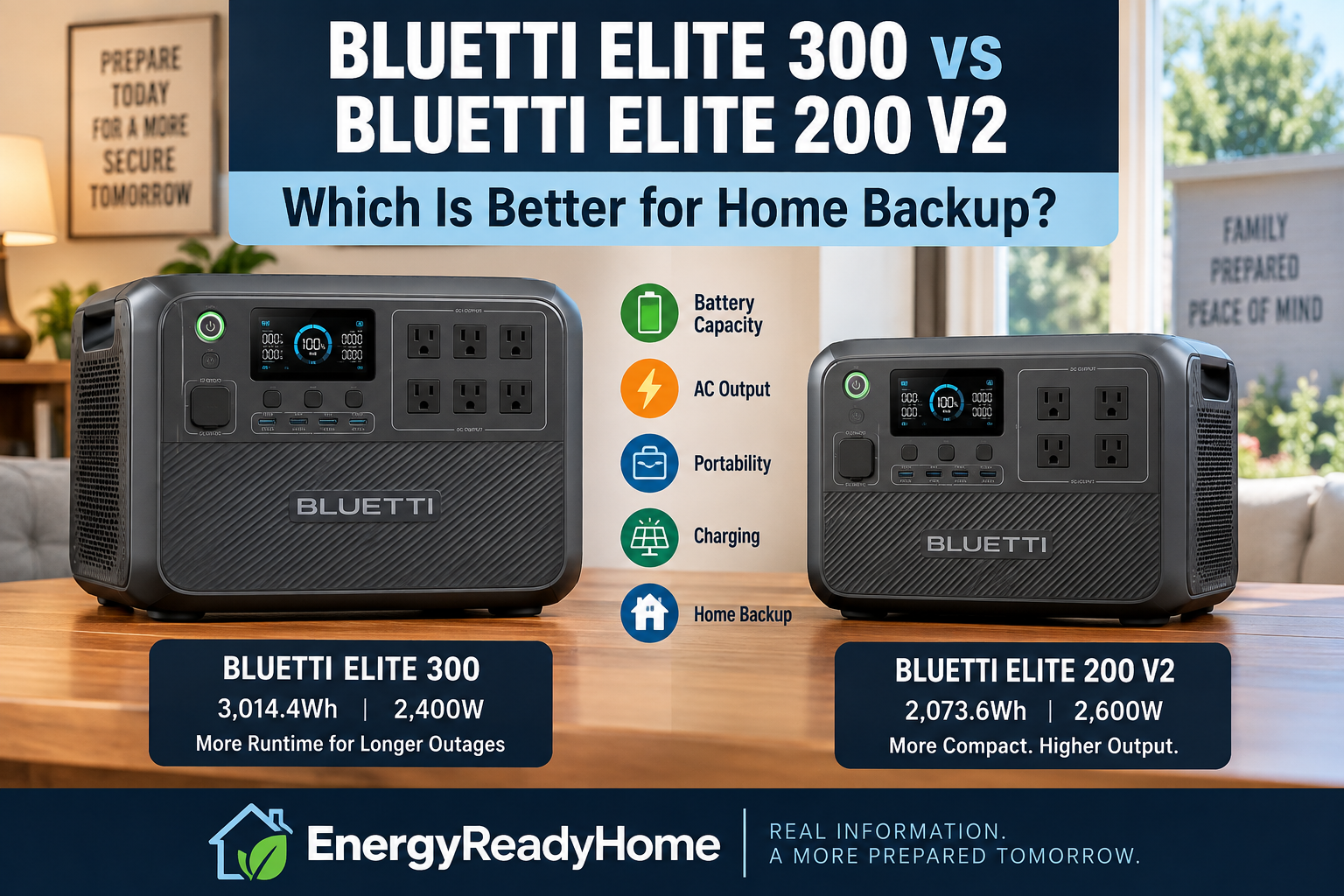
The BLUETTI Elite 300 and BLUETTI Elite 200 V2 are close enough in size and purpose to create a surprisingly difficult buying decision.
The Elite 300 gives you 3,014.4Wh of battery capacity, while the Elite 200 V2 provides 2,073.6Wh. That means the Elite 300 stores about 45% more energy—a meaningful advantage when the goal is keeping refrigerators, freezers, internet equipment, lights and other essentials running longer during an outage.
But the Elite 200 V2 has advantages of its own. It is lighter, more compact and actually provides slightly higher continuous AC output: 2,600W versus 2,400W for the Elite 300.
That creates the real buying decision:
Do you want more battery runtime, or would you rather have a smaller and lighter power station with slightly more AC output?
For most buyers, that question matters more than simply choosing the model with the larger number in its name.
Quick Verdict: Elite 300 vs Elite 200 V2
Choose the BLUETTI Elite 300 if you want:
- Approximately 3kWh of battery capacity
- Longer outage runtime
- More energy for refrigerators, freezers and other sustained loads
- Up to 1,200W of DC input
- A larger energy reserve without moving to a much heavier home-backup platform
- A system primarily intended to stay at home during outages
Choose the BLUETTI Elite 200 V2 if you want:
- Approximately 2kWh of battery capacity
- A lighter and more compact power station
- 2,600W of continuous AC output
- Easier movement around the house
- Strong backup capability for shorter outages
- A better balance between portability and power
EnergyReadyHome Quick Take
The Elite 300 is the stronger choice when runtime is the priority.
The Elite 200 V2 makes more sense when portability and compact size matter more than having an additional 940.8Wh of battery capacity.
Neither is automatically the better power station. They solve slightly different versions of the same home-backup problem.
BLUETTI Elite 300 vs Elite 200 V2: Key Specifications
| Specification | BLUETTI Elite 300 | BLUETTI Elite 200 V2 |
|---|---|---|
| Battery Capacity | 3,014.4Wh | 2,073.6Wh |
| Battery Chemistry | LiFePO₄ | LiFePO₄ |
| Continuous AC Output | 2,400W | 2,600W |
| AC Voltage — U.S. | 120V | 120V |
| Maximum AC Charging | 1,800W | 1,800W |
| Maximum DC Input | 1,200W | 1,000W |
| Maximum AC + DC Input | 2,400W | 2,400W |
| UPS Switchover | 10 ms | ≤15 ms |
| Weight | Approx. 57.98 lb | Approx. 53.35 lb |
| Dimensions | 14.41 × 12.01 × 11.71 in | 13.78 × 9.84 × 12.74 in |
| Best Fit | Longer-runtime 120V home backup | Compact 120V home backup |
For primary-source verification, BLUETTI provides the Elite 300’s specifications, charging limits, operating instructions and UPS information in its official BLUETTI Elite 300 User Manual.
Battery Capacity: Elite 300 Has the Big Advantage
The largest difference between these two systems is battery capacity.
Elite 300: 3,014.4Wh
Elite 200 V2: 2,073.6Wh
The Elite 300 therefore provides 940.8Wh more nominal battery capacity, or about 45% more stored energy.
For home backup, that is substantial.
More capacity doesn’t necessarily let you operate a more powerful appliance—that depends heavily on inverter output and appliance requirements. Instead, additional battery capacity generally means you can operate compatible loads for longer.
That’s particularly valuable for sustained outage loads such as:
- Refrigerators
- Freezers
- Internet equipment
- CPAP equipment
- Lighting
- Televisions
- Computers
- Fans
- Phone and tablet charging
ERH Runtime Model: What Does the Extra 940.8Wh Actually Buy You?
To make the capacity difference easier to understand, EnergyReadyHome uses an illustrative 85% usable-energy assumption for AC-powered loads.
This is an ERH planning model—not a manufacturer runtime guarantee. Actual results vary with inverter losses, temperature, appliance cycling, battery-management overhead and changing loads.
Estimated usable energy:
Elite 300:
3,014.4Wh × 85% ≈ 2,562Wh
Elite 200 V2:
2,073.6Wh × 85% ≈ 1,763Wh
That produces the following simplified comparison:
| Average Load | Elite 300 | Elite 200 V2 |
|---|---|---|
| 50W | ~51.2 hours | ~35.3 hours |
| 100W | ~25.6 hours | ~17.6 hours |
| 200W | ~12.8 hours | ~8.8 hours |
| 300W | ~8.5 hours | ~5.9 hours |
| 500W | ~5.1 hours | ~3.5 hours |
| 1,000W | ~2.6 hours | ~1.8 hours |
The important point isn’t the exact number of minutes. It’s the pattern.
At the same sustained load, the Elite 300’s larger battery provides roughly 45% more theoretical runtime under the same efficiency assumption.
For a short outage, that difference may not matter very much.
For an overnight or extended outage, it can matter considerably.
AC Output: Elite 200 V2 Actually Wins
This is where simply assuming the Elite 300 is the more powerful system can be misleading.
The Elite 200 V2 provides 2,600W of continuous AC output.
The U.S. Elite 300 provides 2,400W.
So despite having the smaller battery, the Elite 200 V2 can support a slightly larger continuous AC load.
That distinction illustrates an important home-backup concept:
Battery capacity determines how much energy you have.
Inverter output helps determine how much power you can deliver at one time.
For most critical-load backup plans, both 2,400W and 2,600W provide substantial capability. But buyers expecting to operate several higher-wattage compatible appliances simultaneously should not assume the Elite 300 has the higher output simply because it has the larger battery.
Portability: The Elite 200 V2 Is Easier to Move
Neither system is lightweight.
But the Elite 200 V2 has the advantage.
The Elite 200 V2 weighs approximately 53.35 pounds, compared with approximately 57.98 pounds for the Elite 300.
The Elite 200 V2 is also narrower and more compact.
A difference of roughly 4.6 pounds may not sound dramatic, but portability involves more than weight. Shape, dimensions, storage location and how often you expect to move the system all matter.
If the power station will normally remain in one location waiting for an outage, the Elite 300’s extra weight is unlikely to be the deciding factor.
If you expect to move the battery between rooms, vehicles, a garage, an RV or other locations, the Elite 200 V2’s more compact design becomes more attractive.
Charging: Very Similar, With an Elite 300 Solar/DC Advantage
Both units support up to 1,800W AC charging and up to 2,400W combined AC + DC input.
The difference appears on the DC side.
The Elite 300 supports up to 1,200W DC input, while the Elite 200 V2 supports up to 1,000W.
That extra input headroom can be useful when solar charging is an important part of an extended-outage strategy.
It doesn’t guarantee faster real-world solar charging. Actual solar production depends on compatible panels, available sunlight, shading, temperature, panel orientation and other conditions.
But for a homeowner building around multi-day resilience, the Elite 300 provides the higher DC-input ceiling.
UPS Capability
Both products can serve in UPS-style backup applications for compatible equipment.
BLUETTI specifies a 10 ms switchover time for the Elite 300 and 15 ms or less for the Elite 200 V2.
That can be useful for equipment such as computers, networking equipment and other electronics where maintaining power during a grid interruption is desirable.
For sensitive or critical equipment, however, always confirm the equipment manufacturer’s power and UPS requirements rather than assuming any portable power station is automatically appropriate.
Which Is Better for a Typical Power Outage?
For many homeowners, the Elite 300 versus Elite 200 V2 decision comes down to how long you need backup power rather than how much instantaneous power you need.
Both systems provide enough continuous AC output for many common 120V emergency loads. The more meaningful difference is that the Elite 300 starts with nearly 1kWh of additional battery capacity.
If your outage plan centers on essentials such as:
- Refrigerator
- Freezer
- Internet equipment
- Phones and tablets
- Lights
- Television
- Computers
- CPAP equipment
- Fans
either unit can provide meaningful emergency backup. The question becomes how long you expect those loads to remain powered before grid power returns or you can recharge the battery.
Short Outages: Elite 200 V2 May Be All You Need
For outages lasting only a few hours, the Elite 200 V2’s 2,073.6Wh battery may provide enough stored energy for many households.
Its combination of substantial battery capacity, 2,600W continuous AC output and a more compact enclosure makes it particularly attractive when you want serious emergency capability without moving into a larger power station.
It also makes sense if you expect to move the unit frequently rather than leaving it in one backup location.
For this use case, paying for additional battery capacity may provide limited practical benefit if your typical outage ends long before the Elite 200 V2 approaches depletion.
Overnight Outages: Elite 300 Becomes More Attractive
An overnight outage changes the equation because battery capacity becomes increasingly important.
A refrigerator and freezer may cycle throughout the night. Internet equipment can operate continuously. Add lights, television, device charging or medical equipment, and energy consumption gradually accumulates.
The Elite 300’s additional 940.8Wh of nominal capacity provides a larger buffer against that cumulative consumption.
That doesn’t guarantee the Elite 300 will last through every overnight outage. Actual runtime depends on the connected equipment and how frequently cycling appliances operate.
But when the same loads are connected to both systems, the Elite 300 begins with substantially more stored energy available to support them.
Extended Outages: Elite 300 Has the Clear Runtime Advantage
As an outage extends beyond one night, the Elite 300’s capacity advantage becomes increasingly useful.
This is especially true if your strategy involves conserving battery power for essential loads rather than trying to operate the house normally.
A disciplined outage plan might prioritize:
- Food refrigeration
- Internet and communications
- Essential lighting
- Medical equipment
- Phone charging
- Limited entertainment
Under that type of strategy, approximately 45% more nominal battery capacity can translate into meaningful additional backup time.
The Elite 300 also supports up to 1,200W of DC input, giving it a modest advantage if compatible solar charging will be part of your extended-outage plan.
What Can These Power Stations Actually Run?
Both units can operate many common 120V household devices as long as the connected loads remain within the power station’s operating limits and individual appliance startup requirements are compatible.
Potential uses include refrigerators, freezers, televisions, internet equipment, computers, fans, lights and many small kitchen appliances used selectively.
However, neither battery should be viewed as unlimited whole-home backup.
High-wattage appliances can consume stored energy quickly even when their power requirements fall within the inverter’s output capability.
For example, a 1,500W appliance may be technically compatible with the continuous output of either power station, but sustained operation at that level would drain a 2kWh or 3kWh battery relatively quickly.
That is why successful battery backup is as much about load management as battery size.
Elite 300 vs Elite 200 V2 for Refrigerator Backup
Refrigerators are one of the most important loads homeowners want to protect during a power outage.
Both BLUETTI models provide far more continuous AC output than a typical household refrigerator normally requires, although compressor startup behavior and actual consumption vary by refrigerator.
The Elite 300’s advantage is therefore not primarily its inverter output. It is the additional stored energy available to keep the refrigerator cycling for longer.
If refrigeration is your primary emergency load and outages in your area are generally brief, the Elite 200 V2 may be sufficient.
If you want additional runtime for a refrigerator plus a freezer, internet equipment, lights and other essentials, the Elite 300’s larger battery becomes considerably more useful.
Elite 300 vs Elite 200 V2 for CPAP Backup
Either system may provide substantial backup time for compatible CPAP equipment because CPAP machines generally consume far less power than large household appliances.
Actual consumption can vary significantly depending on the machine, pressure settings, humidifier use and heated tubing.
The Elite 200 V2 may therefore already provide considerably more capacity than many buyers need for short CPAP backup situations.
The Elite 300 becomes more attractive when the same battery must support CPAP equipment plus refrigeration, communications, lighting and other household essentials during an extended outage.
Which Is Better for Solar Recharging?
The Elite 300 has the specification advantage here.
It supports up to 1,200W of DC input compared with up to 1,000W for the Elite 200 V2.
That difference does not mean you’ll automatically receive 1,200W or 1,000W from solar panels. Real-world production depends on the compatible solar array, sunlight, panel orientation, temperature, shading and other environmental conditions.
But if your emergency plan includes substantial solar recharging during a prolonged outage, the Elite 300 provides the higher DC-input ceiling.
Which Is the Better Value?
Value depends on whether you will actually use the Elite 300’s additional capacity.
If approximately 2kWh already covers your expected outage loads and duration, the Elite 200 V2 gives you strong continuous output in a smaller and lighter package.
If your priority is stretching essential-load backup farther into an overnight or extended outage, the Elite 300’s additional 940.8Wh becomes much easier to justify.
Rather than buying solely according to battery size, estimate the devices you genuinely expect to operate and how many hours you need them.
Buying unused battery capacity adds cost and weight. Buying too little capacity can leave you without power before the outage ends.
Who Should Buy the BLUETTI Elite 300?
Choose the Elite 300 if you:
- Want approximately 3kWh of starting battery capacity
- Expect overnight or longer outages
- Want longer refrigerator and freezer runtime
- Plan to operate several essential loads together
- Want the higher DC-input ceiling for compatible solar charging
- Don’t mind approximately 58 pounds of weight
- Prioritize runtime over maximum portability
For this buyer, the Elite 300 provides a useful middle ground between conventional 2kWh portable power stations and substantially larger home-backup systems.
BLUETTI Elite 300
EnergyReadyHome may earn a commission if you purchase through this link, at no additional cost to you.
Who Should Buy the BLUETTI Elite 200 V2?
Choose the Elite 200 V2 if you:
- Want approximately 2kWh of backup capacity
- Primarily need backup for shorter outages
- Value a smaller and lighter design
- Want 2,600W of continuous AC output
- Expect to move the power station regularly
- Want strong essential-load backup without buying capacity you may not use
For this buyer, the Elite 200 V2 offers an excellent balance of capacity, output and portability.
BLUETTI Elite 200 V2
EnergyReadyHome may earn a commission if you purchase through this link, at no additional cost to you.
Final Verdict: BLUETTI Elite 300 vs Elite 200 V2
The BLUETTI Elite 300 and Elite 200 V2 are not separated by a simple bigger-is-better hierarchy.
The Elite 300 is our preferred choice for longer-runtime home backup. Its 3,014.4Wh battery provides approximately 45% more nominal capacity than the Elite 200 V2, giving homeowners considerably more energy to work with during overnight and extended outages.
The Elite 200 V2 is our preferred choice for more compact portable backup. It weighs less, takes up less space and still provides 2,600W of continuous AC output—slightly more than the Elite 300.
The decision can therefore be simplified:
Want more runtime? → BLUETTI Elite 300
Want greater portability with strong output? → BLUETTI Elite 200 V2
For homeowners building primarily around longer refrigerator, freezer and essential-load backup, we would choose the Elite 300.
For homeowners who expect shorter outages and place greater value on size, weight and portability, we would choose the Elite 200 V2.
Frequently Asked Questions
Which has more battery capacity?
The BLUETTI Elite 300. It provides 3,014.4Wh compared with 2,073.6Wh for the Elite 200 V2, giving the Elite 300 940.8Wh more nominal capacity.
Which has more AC output?
The Elite 200 V2 has the slightly higher continuous AC rating at 2,600W compared with 2,400W for the U.S. Elite 300.
Which will run a refrigerator longer?
Under comparable loads and conditions, the Elite 300 should provide longer runtime because it has approximately 45% more nominal battery capacity. Actual refrigerator runtime varies with energy consumption, compressor cycling, temperature and other connected loads.
Which is easier to move?
The Elite 200 V2. It weighs approximately 53.35 pounds compared with approximately 57.98 pounds for the Elite 300 and has a more compact form factor.
Can either power station provide 240V backup?
The U.S. specifications used for this comparison are based on 120V AC output. Buyers specifically requiring 240V backup should use a system designed for that requirement rather than assuming either of these units provides standalone 240V service.
Is the Elite 300 worth buying instead of the Elite 200 V2?
It can be if longer runtime is important. The Elite 300 provides nearly 1kWh of additional nominal battery capacity. If approximately 2kWh already meets your expected outage duration, however, the smaller Elite 200 V2 may be sufficient.
Related Articles
- BLUETTI Elite 300 Review: Is It Worth It for Home Backup in 2026?
- BLUETTI Elite 200 V2 Review: Is It Worth It for Home Backup in 2026?
- BLUETTI Apex 300 Review: Is It Worth It for Home Backup in 2026?
- 2kWh vs 4kWh Portable Power Station: How Much Backup Do You Really Need?
- Best Portable Power Stations for a 3-Day Power Outage