Category: Portable Power Stations

  • Best Portable Power Stations for CPAP Backup: Safe Overnight Options and Buying Guide

    Best Portable Power Stations for CPAP Backup: Safe Overnight Options and Buying Guide

    Portable power stations can provide dependable overnight backup for many CPAP machines during a power outage, helping users continue essential sleep therapy when the electrical grid goes down. However, not every portable power station is a good choice. Battery capacity, inverter quality, DC compatibility, and runtime all play a major role in determining whether your CPAP will operate safely through the night.

    This guide explains how to choose the best portable power station for CPAP backup, compares top models, and highlights the features that matter most before you buy.


    Why Choosing the Right Portable Power Station Matters

    Unlike many household appliances, CPAP machines require consistent, clean power throughout the night. A backup battery that is too small may shut down before morning, while an undersized inverter can fail to start or operate certain machines correctly.

    Selecting the proper portable power station helps ensure:

    • Continuous overnight therapy
    • Stable, pure sine wave power
    • Longer battery life
    • Quiet operation
    • Safe indoor use
    • Expandability for extended outages

    For many households, a portable power station is also useful for powering phones, lights, internet equipment, and other essentials during an outage.


    Key Features to Look For

    Battery Capacity

    Battery capacity is measured in watt-hours (Wh).

    General recommendations:

    Typical NeedRecommended Capacity
    One night500–800 Wh
    Two nights1,000–1,500 Wh
    Multi-day outages2,000+ Wh

    Actual runtime depends on:

    • CPAP model
    • Pressure settings
    • Humidifier use
    • Heated hose use
    • DC vs. AC operation

    Pure Sine Wave Inverter

    Always choose a portable power station with a pure sine wave inverter.

    Benefits include:

    • Cleaner electrical output
    • Better compatibility with medical devices
    • Reduced risk of operational issues
    • More efficient performance

    Avoid inexpensive modified sine wave inverters whenever possible.


    DC Output Compatibility

    Many CPAP manufacturers offer optional DC power cables.

    Using DC power instead of AC often:

    • Extends runtime
    • Improves efficiency
    • Eliminates inverter losses
    • Reduces overall battery consumption

    Before purchasing a portable power station, verify that a compatible DC cable is available for your CPAP model.


    Best Overall

    EcoFlow DELTA Pro 3

    Best for: Most CPAP users seeking maximum flexibility and long-term value.

    Why it stands out

    • Large battery capacity
    • Excellent overnight runtime
    • Expandable battery system
    • Fast charging
    • Pure sine wave inverter
    • Excellent mobile app
    • Solar charging support

    Pros

    • Multiple nights of backup
    • Very reliable
    • Easy expansion
    • Excellent warranty
    • Can power other household essentials

    Cons

    • Higher purchase price
    • Larger than necessary for occasional travel

    Best for

    Homeowners preparing for extended outages who also want backup power for refrigerators, internet equipment, lighting, and medical devices.


    Best Value

    Jackery Explorer 1000 Plus

    The Jackery Explorer 1000 Plus offers an excellent balance of price, portability, and runtime.

    Highlights include:

    • LiFePO₄ battery
    • Pure sine wave inverter
    • Expandable battery options
    • Lightweight design
    • Reliable overnight CPAP operation

    Ideal for:

    • One to two nights of backup
    • Emergency preparedness
    • Weekend travel
    • Smaller households

    Best for Maximum Runtime

    BLUETTI AC200L

    For users who want the longest possible runtime between charges, the BLUETTI AC200L is an outstanding option.

    Advantages include:

    • Large battery capacity
    • Expandable system
    • Long cycle life
    • Fast charging
    • Solar compatibility

    This model can often provide several nights of CPAP operation depending on your machine settings.


    How Long Will a Portable Power Station Run a CPAP?

    Estimated runtimes vary considerably depending on your equipment.

    Battery CapacityEstimated CPAP Runtime*
    500 Wh1 night
    1,000 Wh2–3 nights
    2,000 Wh4–6 nights

    CPAP battery backup guidance from the American Academy of Sleep Medicine

    *Actual runtime depends on machine model, pressure settings, humidifier use, heated tubing, and whether the machine operates using AC or DC power.


    Ways to Extend Runtime

    To maximize backup power:

    • Turn off the heated humidifier when medically appropriate.
    • Disable heated tubing if recommended by your provider.
    • Use the manufacturer’s DC power cable.
    • Fully recharge the power station after every outage.
    • Keep the battery stored between approximately 30% and 80% charge during long-term storage, following the manufacturer’s recommendations.
    • Test your complete backup setup before storm season.

    Common Buying Mistakes

    Avoid these common errors:

    • Purchasing based solely on battery capacity.
    • Ignoring inverter quality.
    • Forgetting to check CPAP compatibility.
    • Assuming every CPAP consumes the same amount of power.
    • Buying a battery with no expansion capability if you live in an area prone to long outages.
    • Waiting until a major storm is approaching before testing your backup system.

    Frequently Asked Questions

    Can a portable power station safely power a CPAP overnight?

    Yes. Most quality portable power stations with a pure sine wave inverter can safely operate compatible CPAP machines overnight when properly sized.

    Does using the humidifier reduce runtime?

    Yes. Heated humidifiers can significantly increase power consumption and shorten battery life.

    Is a larger battery always better?

    Larger batteries provide longer runtime, but they also cost more and weigh more. Choose a size that matches your expected outage duration.

    Should I buy an expandable model?

    If your area regularly experiences multi-day power outages, expandable battery systems provide greater flexibility and future-proof your investment.

    Can I recharge the power station with solar panels?

    Many modern portable power stations support solar charging, allowing you to extend runtime during prolonged outages when sunlight is available.


    Conclusion

    A properly sized portable power station can provide dependable overnight CPAP backup while also supporting other critical household devices during a power outage. When comparing models, prioritize battery capacity, pure sine wave output, DC compatibility, expandability, and overall reliability rather than simply choosing the least expensive option.

    Selecting the right system now can provide greater peace of mind and help ensure uninterrupted sleep therapy whenever the power goes out.

    Related Articles

    To help you build a complete medical backup power plan, explore these related EnergyReadyHome guides:

  • Best Portable Power Stations for Well Pump Backup: Sizes and Top Options

    Best Portable Power Stations for Well Pump Backup: Sizes and Top Options

    A power outage can leave your home without one of its most essential systems—running water. If your home relies on a private well, losing electricity means your well pump stops working, making it impossible to flush toilets, shower, cook, or access drinking water until power is restored.

    Fortunately, many homeowners can keep their well pump operating during an outage with a properly sized portable power station. However, not every portable power station is capable of starting or running a well pump. These motors often require significantly more power when they first start than they do while running, making surge capacity just as important as battery capacity.

    In this guide, you’ll learn how well pumps use electricity, how to determine your power requirements, how to calculate runtime, and which portable power stations are best suited for different types of residential well pumps.


    Why Well Pumps Are Challenging to Power

    Unlike many household electronics, well pumps use electric motors that create a large startup surge when they first turn on.

    For many residential well pumps:

    • Running power ranges from 500 to 2,000 watts
    • Startup surge can reach 2 to 4 times the running wattage
    • Startup usually lasts only a few seconds but requires a power station capable of handling the load

    U.S. Department of Energy guidance on selecting energy-efficient water pumps

    For example:

    Well PumpRunning WattsTypical Starting Surge
    1/3 HP700W1,400–2,100W
    1/2 HP1,000W2,000–3,000W
    3/4 HP1,400W2,800–4,200W
    1 HP2,000W4,000–6,000W

    Because of this startup surge, a portable power station that appears large enough based only on running wattage may still fail to start the pump.


    What Size Portable Power Station Do You Need?

    Selecting the right portable power station depends on four key specifications:

    Continuous Output

    This is the amount of power the inverter can provide continuously while your well pump is operating.

    Always choose a power station with a continuous output greater than your pump’s running wattage.


    Surge Capacity

    Surge capacity determines whether the power station can start the pump motor.

    This is often the deciding factor for well pump compatibility.

    Many premium portable power stations advertise surge ratings between 2,700 and 7,200 watts, making them suitable for many residential well pumps.


    Battery Capacity

    Battery capacity, measured in watt-hours (Wh), determines how long the pump can operate before recharging.

    Larger batteries provide longer runtime but also increase cost and weight.


    Expandability

    If your home experiences frequent extended outages, consider an expandable system that allows additional battery modules.

    Expandable systems can dramatically increase available runtime without replacing the original power station.


    Best Portable Power Stations for Well Pump Backup

    Before purchasing any portable power station, verify both your well pump’s running wattage and startup surge by checking the owner’s manual or pump specification label. If these values are unavailable, consult the manufacturer or have an electrician measure the startup current. Choosing a unit with sufficient surge capacity is critical for reliable operation.

    Best Overall Choice

    The EcoFlow DELTA Pro 3 is our top recommendation for most homeowners because it combines high inverter output, excellent surge capability, expandable battery capacity, and fast recharging. It is well suited for many residential well pumps while also powering refrigerators, freezers, lighting, and other essential household devices during an outage.

    Disclosure: As an Amazon Associate, EnergyReadyHome may earn from qualifying purchases. This comes at no additional cost to you.

    Why We Recommend It

    • High continuous inverter output
    • Excellent startup surge capability
    • Expandable battery system
    • Fast AC and solar charging
    • Long-life LiFePO₄ battery chemistry
    • Suitable for whole-home emergency preparedness

    The EcoFlow DELTA Pro 3 offers one of the best combinations of performance and flexibility for homeowners who want dependable emergency backup power for both their well pump and other essential appliances.


    Best Budget Choice

    The Jackery Explorer 2000 Plus provides strong inverter performance at a more approachable price point while offering battery expansion options for homeowners planning future upgrades.

    Disclosure: As an Amazon Associate, EnergyReadyHome may earn from qualifying purchases. This comes at no additional cost to you.

    Why We Recommend It

    • Excellent value
    • Strong surge capability
    • Expandable battery platform
    • Reliable LiFePO₄ battery
    • User-friendly operation
    • Good portability for its capacity

    The Jackery Explorer 2000 Plus is an excellent solution for homeowners with smaller or medium-sized well pumps who want dependable backup power without purchasing a premium whole-home system.

    Best for Large Well Pumps

    Important: Homes with 3/4 HP or 1 HP well pumps often require substantially higher startup surge than smaller systems. Before purchasing a portable power station, verify both the pump’s continuous running wattage and its startup surge. If your pump uses a 240-volt circuit, confirm that the portable power station supports 240V output or the appropriate manufacturer-approved connection method.

    The BLUETTI Elite 200 V2 is an excellent choice for homeowners with larger well pumps that require higher inverter output and additional surge capacity. Its powerful inverter, long-lasting LiFePO₄ battery, and expandable energy storage make it well suited for extended emergency use.

    Disclosure: As an Amazon Associate, EnergyReadyHome may earn from qualifying purchases. This comes at no additional cost to you.

    Why We Recommend It

    • High continuous inverter output
    • Excellent surge capacity for demanding motor loads
    • Large battery capacity
    • Expandable battery options
    • Pure sine wave output
    • Durable LiFePO₄ battery chemistry

    The BLUETTI Elite 200 V2 is an excellent option for homeowners with larger residential well pumps who want reliable backup power while also supporting other essential household loads during an outage.


    Estimated Runtime

    Runtime depends on three primary factors:

    • Battery capacity
    • Pump size
    • How frequently the pump cycles

    Unlike appliances that run continuously, a well pump typically runs only when water is being used. This means most homeowners can operate a well pump for much longer than expected because the pump may only run a few minutes each hour.

    The following estimates assume typical residential usage.

    Battery CapacityApproximate Pump Runtime*
    1,000 WhSeveral hours of intermittent household use
    2,000 WhApproximately one full day for average household water usage
    3,500 WhOne to two days depending on demand
    Expandable systemsMultiple days with conservative water use

    *Actual runtime varies based on pump horsepower, household water consumption, battery condition, inverter efficiency, and environmental conditions.


    How to Estimate Your Runtime

    You can estimate runtime using this simple formula:

    Battery Watt-Hours ÷ Pump Running Watts = Approximate Continuous Runtime (Hours)

    For example:

    • Battery capacity: 2,048 Wh
    • Pump running power: 1,000 W

    2,048 ÷ 1,000 = approximately 2 hours of continuous operation

    Because well pumps cycle on and off instead of running continuously, real-world operation is often significantly longer than this calculation suggests.


    Tips to Maximize Runtime

    During a prolonged outage, conserving battery power helps extend your available water supply.

    Consider these best practices:

    • Fill containers with water while power is available.
    • Reduce unnecessary water usage.
    • Repair dripping faucets before storm season.
    • Avoid running multiple high-power appliances simultaneously.
    • Recharge using solar panels whenever practical.
    • Monitor battery state of charge regularly.

    Small reductions in water usage can significantly increase available backup time.


    Common Mistakes to Avoid

    Many homeowners purchase a portable power station based only on battery size.

    Avoid these common mistakes:

    • Ignoring startup surge requirements
    • Buying based only on watt-hours
    • Forgetting to verify voltage compatibility
    • Assuming every portable power station can run motor-driven equipment
    • Waiting until after an emergency to test the system
    • Overloading the inverter with multiple large appliances at the same time

    Testing your emergency power setup before storm season provides confidence that everything will work when needed.


    Frequently Asked Questions

    Can a portable power station start a deep well pump?

    Many can, provided the inverter offers sufficient continuous output and startup surge capacity. Always verify your specific pump’s electrical requirements before purchasing.


    Can I run other appliances while powering my well pump?

    Yes, provided the combined electrical load remains below the portable power station’s continuous output rating. Prioritize essential appliances such as refrigerators, freezers, lighting, and communications equipment.


    Can I recharge the battery with solar panels?

    Most modern portable power stations support solar charging using compatible portable solar panels, making them an excellent option for extended outages.


    Are portable power stations safe for well pumps?

    Yes. High-quality portable power stations produce clean pure sine wave electricity that is appropriate for most residential well pump motors. Follow the manufacturer’s operating instructions and avoid exceeding rated capacities.


    Final Thoughts

    A properly sized portable power station can provide reliable backup power for many residential well pumps, helping your household maintain access to running water during power outages.

    The key to success is selecting a model with enough continuous inverter output, startup surge capacity, and battery storage for your specific well pump. While battery capacity determines how long the system can operate, surge capability often determines whether the pump will start at all.

    Investing in the right portable power station before severe weather strikes can provide peace of mind and help keep one of your home’s most essential systems operating when the electrical grid goes down.


    Related Articles

    To build a complete home backup power strategy, explore these related EnergyReadyHome guides:

  • Best Portable Power Stations for Starlink Internet Backup

    Best Portable Power Stations for Starlink Internet Backup

    For many households, internet access has become more than a convenience—it’s essential. Whether you work from home, attend online classes, monitor security cameras, or simply rely on internet service for communication, losing connectivity during a power outage can quickly become a major problem.

    For Starlink users, the challenge is unique. Unlike traditional cable or fiber internet, Starlink relies on a powered satellite dish, router, and network equipment. If utility power fails, the entire system shuts down unless you have a reliable backup power source.

    A portable power station offers one of the safest and most convenient ways to keep Starlink operating during an outage. The key is selecting a model with enough battery capacity and continuous output to keep your equipment running for as long as you need.

    This guide explains how to choose the best portable power station for Starlink, what features matter most, and which type of system provides the best value for emergency preparedness.


    Why Backup Power Matters for Starlink

    Unlike many internet providers that may continue operating through neighborhood battery backups, Starlink equipment inside your home depends entirely on your electrical service.

    Without power:

    • The Starlink router shuts down.
    • The satellite dish loses power.
    • Wi-Fi service stops.
    • Internet-connected devices lose connectivity.

    For many households, that means losing access to:

    • Video conferencing
    • Remote work
    • Telehealth appointments
    • Smart home devices
    • Security cameras
    • Emergency weather information
    • Voice over IP (VoIP) phone service

    A portable power station allows you to continue using Starlink without the noise, fumes, or maintenance associated with gasoline generators.


    Can a Portable Power Station Run Starlink?

    Yes.

    Most modern portable power stations can easily power Starlink equipment because the system typically requires relatively modest continuous power.

    The exact power consumption depends on several factors:

    • Starlink hardware generation
    • Environmental conditions
    • Snow melt mode
    • Network activity
    • Additional networking equipment

    Because Starlink’s power demand is fairly consistent, portable power stations provide predictable runtimes compared to appliances with compressors or heating elements.


    Understanding Starlink Power Requirements

    Before purchasing a backup battery, identify which Starlink system you own.

    Different hardware generations have different electrical requirements.

    Typical equipment includes:

    • Starlink satellite dish
    • Wi-Fi router
    • Power supply (where applicable)
    • Ethernet adapter (optional)
    • Network switch (optional)
    • Mesh Wi-Fi nodes (optional)

    Additional accessories increase total power consumption and should be included when sizing your portable power station.


    How Large of a Portable Power Station Do You Need?

    Choosing the right size involves balancing runtime, portability, and budget.

    Three factors matter most.

    1. Continuous Power Output

    Although Starlink generally requires relatively little power compared to household appliances, your portable power station should provide enough continuous AC output to comfortably handle:

    • Starlink equipment
    • Router
    • Mesh system
    • Any additional networking devices

    Even smaller portable power stations usually have sufficient inverter capacity.

    Battery capacity—not inverter wattage—is often the deciding factor.


    2. Battery Capacity

    Battery capacity determines how long Starlink continues operating during an outage.

    Larger batteries provide:

    • Longer internet availability
    • More flexibility during extended outages
    • Additional capacity for phones, laptops, and tablets

    If internet access is critical for work, consider purchasing a larger-capacity model rather than the minimum required.


    3. Future Expansion

    Many homeowners eventually use their portable power station for much more than internet backup.

    Choosing a model with additional capacity allows you to power:

    • Laptop computers
    • Mobile devices
    • LED lighting
    • Fans
    • Medical devices
    • Television
    • Small appliances

    This makes the investment more valuable beyond emergency internet access.


    Features to Look For

    Not every portable power station offers the same capabilities.

    Prioritize these features.

    LiFePO₄ Battery Technology

    Lithium Iron Phosphate (LiFePO₄) batteries provide several advantages:

    • Long service life
    • Excellent thermal stability
    • Thousands of recharge cycles
    • Reliable emergency performance
    • Lower long-term ownership costs

    For most buyers, LiFePO₄ batteries represent the best long-term value.


    Pure Sine Wave AC Output

    Starlink equipment contains sensitive electronic components that perform best with clean, stable electricity.

    Choose a portable power station with a pure sine wave inverter to closely replicate household utility power.


    Fast Recharging

    After an outage, you want your backup battery ready as quickly as possible.

    Look for models that support:

    • High-speed AC charging
    • Vehicle charging
    • Solar charging

    Fast recharge capability helps prepare for repeated outages during severe weather events.


    Multiple AC and USB Outputs

    Many households use portable power stations to charge several devices simultaneously.

    Additional outlets allow you to power:

    • Starlink
    • Smartphones
    • Tablets
    • Laptops
    • Battery chargers
    • Small networking equipment

    Selecting a model with several output options increases its usefulness during emergencies.

    Recommended Portable Power Stations for Starlink

    The best portable power station depends on how you use Starlink and how long you expect to be without electricity. Whether you’re looking for a compact emergency backup or a whole-home preparedness solution, choosing the right category is more important than selecting the biggest battery.

    Best Overall Choice

    Important: Before purchasing a portable power station, calculate the total power requirements of your complete Starlink system, including the satellite dish, router, mesh Wi-Fi nodes, network switches, and any other networking equipment you plan to keep operating during a power outage.

    The EcoFlow DELTA 3 Plus is our top overall recommendation for Starlink users because it offers an outstanding balance of battery capacity, fast charging, portability, and expandability. Its reliable pure sine wave AC output is ideal for powering sensitive networking equipment, while its LiFePO₄ battery provides years of dependable emergency backup.

    Disclosure: As an Amazon Associate, EnergyReadyHome may earn from qualifying purchases. This comes at no additional cost to you.

    Why we recommend it:

    • Excellent balance of capacity and portability
    • Reliable pure sine wave AC output for sensitive electronics
    • Long-lasting LiFePO₄ battery technology
    • Ultra-fast AC charging
    • Expandable battery options for longer outages
    • Supports future solar charging

    The EcoFlow DELTA 3 Plus is an excellent choice for homeowners who want dependable backup power for Starlink while also keeping laptops, phones, tablets, and other essential electronics running during an outage. Before purchasing, verify the combined power requirements of all the networking equipment you intend to operate simultaneously.ve enough capacity to keep Starlink online while also charging laptops, smartphones, tablets, and other essential electronics.


    Best Budget Option

    Important: Before purchasing a portable power station, calculate the total power requirements of your complete Starlink system, including the satellite dish, router, and any additional networking equipment.

    The Jackery Explorer 300 Plus is an excellent budget-friendly solution for keeping Starlink online during shorter outages. Its compact size, quiet operation, and dependable LiFePO₄ battery make it ideal for apartments, occasional outages, and emergency communication.

    Disclosure: As an Amazon Associate, EnergyReadyHome may earn from qualifying purchases. This comes at no additional cost to you.

    Why we recommend it:

    • Affordable emergency backup solution
    • Compact and lightweight
    • Pure sine wave AC output
    • Long-lasting LiFePO₄ battery
    • Fast USB-C and AC charging
    • Quiet, maintenance-free operation

    The Jackery Explorer 300 Plus is ideal for users who simply want to keep Starlink operating during brief utility outages without investing in a larger backup system. Before purchasing, verify the combined power requirements of all the networking equipment you intend to operate simultaneously.

    Best for Remote Workers

    Important: If your income depends on uninterrupted internet access, calculate the combined electrical requirements of your Starlink equipment, computer, monitors, networking devices, and other essential office equipment before selecting a portable power station.

    The BLUETTI AC180 is an outstanding choice for remote workers who depend on Starlink for reliable internet connectivity. Its larger battery capacity provides extended runtime while supporting laptops, monitors, networking equipment, and other home office essentials during longer outages.

    Disclosure: As an Amazon Associate, EnergyReadyHome may earn from qualifying purchases. This comes at no additional cost to you.

    Why we recommend it:

    • Larger battery capacity for extended work sessions
    • Reliable pure sine wave AC output
    • Long-lasting LiFePO₄ battery technology
    • Fast AC charging
    • Multiple AC and USB output ports
    • Easily powers a complete home office setup

    The BLUETTI AC180 is an excellent investment for professionals who cannot afford internet interruptions during business hours. Before purchasing, verify the combined power requirements of all the networking equipment and office devices you intend to operate simultaneously.


    Best for Multi-Day Emergencies

    Important: Extended outages often require powering more than just your Starlink equipment. Consider your future backup power needs before choosing a portable power station.

    The EcoFlow DELTA 3 Plus is our top recommendation for multi-day emergencies thanks to its expandable battery system, rapid charging capabilities, and solar compatibility. When paired with expansion batteries and compatible solar panels, it provides a flexible long-term backup solution capable of keeping Starlink and other essential household electronics operating through prolonged outages.

    Disclosure: As an Amazon Associate, EnergyReadyHome may earn from qualifying purchases. This comes at no additional cost to you.

    Why we recommend it:

    • Expandable battery capacity
    • Excellent runtime for extended outages
    • Fast AC recharging
    • Solar charging compatibility
    • Reliable pure sine wave AC output
    • Durable LiFePO₄ battery technology

    The EcoFlow DELTA 3 Plus is ideal for homeowners preparing for hurricanes, winter storms, wildfires, and other prolonged emergencies where internet access is critical. Before purchasing, verify the combined power requirements of your Starlink equipment and any additional devices you plan to operate throughout an extended outagee solar panels, they can continue powering Starlink for extended periods while also supporting other critical household electronics.


    How Long Will a Portable Power Station Run Starlink?

    Runtime depends on several factors, including:

    • Battery capacity (watt-hours)
    • Starlink hardware generation
    • Router configuration
    • Additional connected equipment
    • Environmental conditions
    • Inverter efficiency

    If your system includes mesh Wi-Fi nodes, Ethernet adapters, or network switches, total power consumption will increase.

    Choosing a power station with additional battery capacity provides greater flexibility and helps avoid interruptions during longer outages.


    Is Solar Charging Worth It?

    For many Starlink users, absolutely.

    One of Starlink’s greatest advantages is its ability to provide internet access in remote locations. Pairing it with a portable power station and compatible solar panels creates a self-sustaining communications system that remains operational even during prolonged utility outages.

    Solar charging offers several benefits:

    • Renewable energy
    • No fuel storage
    • Quiet operation
    • Lower operating costs
    • Continuous charging during daylight hours
    • Greater emergency independence

    Even if you don’t purchase solar panels immediately, selecting a portable power station that supports future solar expansion is a smart investment.


    Portable Power Stations vs. Gas Generators

    Both can power Starlink, but they differ significantly in convenience and safety.

    Portable Power Stations

    Advantages include:

    • Safe for indoor use
    • No exhaust fumes
    • Silent operation
    • Instant startup
    • Minimal maintenance
    • Recharge from wall outlets, vehicles, or solar panels

    Generator safety during power outages


    Gasoline Generators

    While generators can provide longer runtime when fuel is available, they also require:

    • Outdoor operation only
    • Fuel storage
    • Regular maintenance
    • Oil changes
    • Louder operation

    For most Starlink users who simply want reliable internet during an outage, a portable power station offers a quieter, cleaner, and more convenient solution.


    Frequently Asked Questions

    Can I leave Starlink plugged into a portable power station?

    Many portable power stations support pass-through charging, allowing connected devices to remain powered while the battery charges. However, verify compatibility with both the power station and Starlink equipment before relying on this setup.


    Can I power other electronics at the same time?

    Yes.

    Most portable power stations can simultaneously operate:

    • Starlink
    • Smartphones
    • Tablets
    • Laptop computers
    • LED lighting
    • Battery chargers
    • Small networking equipment

    Always ensure the combined electrical load remains within the power station’s rated output.


    Are LiFePO₄ batteries worth the extra cost?

    In most cases, yes.

    LiFePO₄ batteries typically provide:

    • Longer service life
    • Greater thermal stability
    • Improved safety
    • Thousands of recharge cycles
    • Better long-term value

    These advantages make them particularly well suited for emergency preparedness.


    Should I buy more battery capacity than I currently need?

    If your budget allows, purchasing a slightly larger portable power station often provides better long-term value.

    Additional battery capacity allows you to:

    • Extend Starlink runtime
    • Power additional devices
    • Handle longer outages
    • Adapt to future needs without replacing your system

    Final Thoughts

    A portable power station is one of the easiest and safest ways to keep Starlink operating during a power outage. By selecting a model with sufficient battery capacity, pure sine wave output, and modern LiFePO₄ battery technology, you can maintain internet access for work, communication, emergency information, and everyday connectivity when utility power is unavailable.

    Whether you need a compact backup for occasional outages or a larger expandable system for extended emergencies, choosing the right portable power station today can provide years of dependable service. With optional solar charging, your Starlink system can remain connected even during prolonged grid failures, helping you stay informed, productive, and connected when it matters most.

    Related Articles

  • Best Portable Power Stations for Oxygen Concentrators: Safe Backup Options and Buying Guide

    Best Portable Power Stations for Oxygen Concentrators: Safe Backup Options and Buying Guide

    Power outages can be more than an inconvenience if you or a loved one relies on an oxygen concentrator. A loss of power can interrupt oxygen therapy, creating unnecessary stress and potentially serious health concerns. Choosing the right portable power station provides peace of mind by keeping your oxygen concentrator running safely until utility power is restored.

    Not every portable power station is suitable for every oxygen concentrator, however. Battery capacity, continuous wattage, startup surge capability, and the type of oxygen concentrator you use all play an important role in selecting the right backup power solution.

    This guide explains how to choose the best portable power station for an oxygen concentrator, what features matter most, and which models are best suited for different medical and emergency preparedness needs.


    Why Every Oxygen Concentrator User Should Have Backup Power

    Utility outages happen for many reasons, including:

    • Severe storms
    • Ice and snow
    • High winds
    • Utility equipment failures
    • Planned maintenance
    • Natural disasters

    While outages may last only a few minutes, others can continue for several hours—or even days. Having a reliable backup power source allows you to continue oxygen therapy without relying solely on emergency services or leaving your home.

    A portable power station offers several advantages over gasoline generators:

    • Safe for indoor use
    • No gasoline or diesel fuel required
    • No carbon monoxide emissions
    • Quiet operation
    • Instant backup power
    • Minimal maintenance
    • Rechargeable for repeated use

    For many households, a portable power station is the safest and most practical emergency backup solution.


    Can a Portable Power Station Run an Oxygen Concentrator?

    In most cases, yes.

    Most modern portable power stations can safely operate many home oxygen concentrators, but the correct size depends on your specific equipment.

    Factors that determine compatibility include:

    • Continuous power draw (watts)
    • Startup surge
    • Hours of operation needed
    • AC versus DC power requirements
    • Whether the unit is continuous-flow or pulse-dose

    The first step is identifying your concentrator’s electrical requirements.


    Continuous-Flow vs. Pulse-Dose Oxygen Concentrators

    Understanding the type of oxygen concentrator you own helps determine the size of backup battery you’ll need.

    Continuous-Flow Oxygen Concentrators

    These units provide oxygen continuously whether the user inhales or not.

    They typically:

    • Consume more electricity
    • Require larger batteries
    • Benefit from higher-capacity portable power stations

    These are the most common home units prescribed for long-term oxygen therapy.


    Pulse-Dose Oxygen Concentrators

    Portable oxygen concentrators often deliver oxygen only when inhalation is detected.

    Advantages include:

    • Lower power consumption
    • Longer battery runtime
    • Smaller backup power stations may be sufficient

    However, always verify the power requirements listed by the manufacturer before purchasing a backup power station.


    How to Determine the Right Size Portable Power Station

    Before shopping, collect three pieces of information from your oxygen concentrator:

    1. Running Wattage

    Most oxygen concentrators consume between 100 and 600 watts, depending on:

    • Flow rate
    • Compressor size
    • Manufacturer
    • Oxygen delivery method

    The owner’s manual or data plate typically lists the electrical specifications.


    2. Startup Surge

    Some concentrators briefly require additional power when the compressor starts.

    A portable power station should comfortably exceed both:

    • Continuous wattage
    • Startup surge requirements

    Buying a power station with additional headroom also allows you to power small essentials such as:

    • Phone chargers
    • Lamps
    • Medical monitoring devices

    3. Desired Runtime

    Ask yourself:

    • Do I need backup for two hours?
    • Overnight?
    • A full day?
    • Multiple days with solar charging?

    Runtime determines battery capacity more than output wattage.

    For overnight protection, larger-capacity LiFePO₄ power stations are usually the better investment because they provide longer runtimes and significantly longer battery life.


    Features to Look for in a Portable Power Station

    Not all models are designed for medical backup use.

    Prioritize these features.

    Pure Sine Wave AC Output

    Medical devices should always be powered using a pure sine wave inverter.

    Pure sine wave electricity closely matches household utility power and helps sensitive electronics operate safely and efficiently.

    Avoid inexpensive modified sine wave inverters for oxygen concentrators.


    LiFePO₄ Battery Technology

    Lithium Iron Phosphate (LiFePO₄) batteries offer several important advantages:

    • Longer lifespan
    • Improved safety
    • Better thermal stability
    • Thousands of charge cycles
    • Lower long-term replacement costs

    Most premium portable power stations now use LiFePO₄ batteries, making them an excellent choice for emergency medical preparedness.


    Pass-Through Charging

    Some portable power stations support pass-through charging, allowing the battery to recharge while simultaneously powering connected devices.

    This feature can be especially valuable during extended outages when alternating between utility power and battery backup.


    Multiple Charging Options

    Look for models that support:

    • Standard wall charging
    • Vehicle charging
    • Solar charging

    Multiple charging methods increase flexibility during prolonged emergencies.

    Recommended Portable Power Stations by User Needs

    Every household has different backup power requirements. The best portable power station depends on the type of oxygen concentrator you use, how long you need backup power, and whether you want the option to recharge using solar panels during an extended outage.

    Rather than focusing on a single “best” model, consider which category best matches your needs.

    Best Overall Choice

    Important: Always verify the power requirements of your oxygen concentrator and consult the equipment manufacturer before relying on any portable power station for medical backup.

    The EcoFlow DELTA 3 Plus is an excellent overall choice because it combines a long-lasting LiFePO₄ battery, fast AC recharging, pure sine wave output, and enough capacity to keep most home oxygen concentrators operating during a power outage while also powering other essential devices.

    Disclosure: As an Amazon Associate, EnergyReadyHome may earn from qualifying purchases. This comes at no additional cost to you.

    Why we recommend it:

    • Long runtime for extended outages
    • Reliable pure sine wave power for sensitive medical equipment
    • Expandable battery options for longer backup
    • Long-lasting LiFePO₄ battery technology
    • Multiple AC outlets for powering additional devices
    • Fast AC and solar charging

    These features make it an excellent choice for households that rely on an oxygen concentrator and want dependable emergency backup power for phones, tablets, lighting, and other essential devices during a power outage. Before purchasing, confirm your oxygen concentrator’s continuous power requirements, any startup surge requirements, and expected runtime to ensure the power station meets your emergency backup needs.


    Best for Overnight Backup

    Important: Always verify the power requirements of your oxygen concentrator and consult the equipment manufacturer before relying on any portable power station for medical backup.

    The BLUETTI AC180 is an outstanding choice for overnight backup thanks to its larger battery capacity, reliable pure sine wave AC output, and fast recharge capability. For many home oxygen concentrators, it can provide significantly longer runtime than smaller portable power stations, making it an excellent option for sleeping through an overnight power outage with greater peace of mind.

    Disclosure: As an Amazon Associate, EnergyReadyHome may earn from qualifying purchases. This comes at no additional cost to you.

    Why we recommend it:

    • Larger battery capacity for extended overnight runtime
    • Reliable pure sine wave AC output for sensitive medical equipment
    • Long-lasting LiFePO₄ battery with thousands of charge cycles
    • Fast AC charging to quickly prepare for future outages
    • Multiple AC, USB-A, USB-C, and DC output ports
    • Portable enough for home use while offering substantially more capacity than entry-level models

    The BLUETTI AC180 is an excellent solution for users who want greater confidence that their oxygen concentrator can continue operating through the night during an unexpected outage. Before purchasing, confirm your oxygen concentrator’s continuous power requirements, any startup surge requirements, and expected runtime to ensure the power station meets your emergency backup needs.


    Best Budget Option

    Important: Always verify the power requirements of your oxygen concentrator and consult the equipment manufacturer before relying on any portable power station for medical backup.

    The Jackery Explorer 300 Plus is an excellent budget-friendly choice for households looking for reliable emergency backup during shorter power outages. It features a long-lasting LiFePO₄ battery, pure sine wave AC output, compact portability, and simple operation, making it a practical solution for keeping many oxygen concentrators powered when utility service is interrupted.

    Disclosure: As an Amazon Associate, EnergyReadyHome may earn from qualifying purchases. This comes at no additional cost to you.


    Why we recommend it:

    • Affordable entry point for emergency backup power
    • Compact and lightweight for easy storage and transport
    • Pure sine wave AC output for sensitive medical equipment
    • Long-lasting LiFePO₄ battery technology
    • Fast USB-C and AC charging
    • Quiet, maintenance-free operation

    The Jackery Explorer 300 Plus is an excellent option for users with lower-power oxygen concentrators or those seeking an affordable backup solution for short-duration outages. Before purchasing, confirm your oxygen concentrator’s continuous power requirements, any startup surge requirements, and expected runtime to ensure the power station meets your emergency backup needs.

    Best for Extended Multi-Day Outages

    Important: Always verify the power requirements of your oxygen concentrator and consult the equipment manufacturer before relying on any portable power station for medical backup.

    The EcoFlow DELTA 3 Plus is our top recommendation for extended multi-day outages because of its excellent combination of battery capacity, rapid recharging, expandable battery options, and dependable pure sine wave AC power. When paired with additional expansion batteries or compatible solar panels, it provides one of the most flexible backup power solutions available for households that depend on oxygen concentrators during prolonged emergencies.

    Disclosure: As an Amazon Associate, EnergyReadyHome may earn from qualifying purchases. This comes at no additional cost to you.

    Why we recommend it:

    • Excellent battery capacity for long-duration outages
    • Expandable battery system for significantly longer runtime
    • Reliable pure sine wave AC output for sensitive medical equipment
    • Ultra-fast AC charging to restore power quickly between outages
    • Solar charging capability for extended emergency preparedness
    • Long-lasting LiFePO₄ battery technology designed for years of reliable service

    The EcoFlow DELTA 3 Plus is ideal for households preparing for severe weather, extended utility outages, or areas where power interruptions may last several days. Its expandable design allows users to increase available backup power as their needs change. Before purchasing, confirm your oxygen concentrator’s continuous power requirements, any startup surge requirements, and expected runtime to ensure the power station meets your emergency backup needs.

    How Long Will a Portable Power Station Run an Oxygen Concentrator?

    Runtime depends on several factors:

    • Battery capacity
    • Oxygen concentrator power consumption
    • Flow setting
    • Ambient temperature
    • Inverter efficiency

    Higher flow settings typically require more electricity, reducing available runtime.

    Instead of relying on generic estimates, calculate your expected runtime using your concentrator’s actual wattage and the usable battery capacity of the portable power station you are considering.

    Whenever possible, choose a model with additional capacity beyond your minimum needs. Extra reserve provides a valuable safety margin during unexpected or prolonged outages.


    Is Solar Charging Worth It?

    For many households, yes.

    Portable solar panels can recharge compatible power stations during extended outages when utility power remains unavailable.

    Benefits include:

    • Renewable energy
    • No fuel storage
    • Quiet operation
    • Lower long-term operating costs
    • Increased emergency preparedness

    Solar charging works best when paired with larger-capacity portable power stations designed to accept higher solar input.

    Even if you don’t purchase solar panels immediately, selecting a power station that supports future solar expansion gives you greater flexibility.


    Important Safety Tips

    Backup power is an important part of an emergency preparedness plan, but it should never replace your healthcare provider’s recommendations.

    Follow these safety practices:

    • Test your backup system before an emergency.
    • Keep the portable power station fully charged.
    • Recharge after every use.
    • Follow the oxygen concentrator manufacturer’s instructions.
    • Never overload the power station.
    • Store the battery in a cool, dry location.
    • Review your utility company’s medical priority program if available.

    If your oxygen therapy is medically critical, discuss emergency planning with your physician or oxygen equipment provider. FDA guidance on home use of oxygen concentrators


    Frequently Asked Questions

    Can I leave my oxygen concentrator plugged into a portable power station?

    Many portable power stations support pass-through charging, allowing them to act as a backup while connected to household power. However, always verify that both your power station and oxygen concentrator manufacturers approve this type of operation.


    Should I buy a gasoline generator instead?

    Gasoline generators can provide backup power but must never be operated indoors or in enclosed spaces because they produce deadly carbon monoxide.

    Portable power stations are much safer for indoor medical equipment because they produce no exhaust fumes and operate quietly.


    Are LiFePO₄ batteries better for emergency backup?

    Yes.

    LiFePO₄ batteries generally offer:

    • Longer service life
    • Greater thermal stability
    • Improved safety
    • Thousands of charge cycles
    • Lower long-term ownership costs

    These characteristics make them an excellent choice for emergency medical preparedness.


    Can one portable power station run other devices too?

    Often, yes.

    Depending on its capacity, a portable power station may also power:

    • Cell phones
    • Tablets
    • LED lighting
    • Internet equipment
    • Fans
    • Small electronics

    However, avoid adding unnecessary loads if maintaining oxygen therapy is your highest priority.


    Final Thoughts

    A portable power station provides peace of mind by helping ensure your oxygen concentrator continues operating during unexpected power outages. Choosing the right model involves more than simply buying the largest battery available. Consider your concentrator’s power requirements, the runtime you need, future expansion options, and the reliability of the battery technology.

    For many households, a LiFePO₄ portable power station with pure sine wave output, adequate battery capacity, and optional solar charging offers the best combination of safety, convenience, and long-term value. By planning ahead and testing your backup system before an emergency occurs, you can reduce stress and maintain greater confidence when the lights go out.

    Related Articles

  • Best Portable Power Stations for Air Compressors: Sizes and Top Options

    Best Portable Power Stations for Air Compressors: Sizes and Top Options

    Air compressors are among the most challenging portable tools to power during an outage because they require a large burst of electricity when the motor starts. Many homeowners discover that while a compressor’s running wattage appears reasonable, its startup surge can be two to three times higher—enough to overload an undersized portable power station.

    Whether you need to inflate vehicle tires after a storm, power pneumatic nailers for emergency repairs, or operate a small compressor in your garage or workshop, choosing the right portable power station is essential.

    The good news is that today’s higher-capacity portable power stations can safely run many small and medium-sized air compressors. However, success depends on matching the compressor’s power requirements with a power station that provides enough continuous output, sufficient surge capacity, and adequate battery storage.

    In this guide, you’ll learn how much power different air compressors require, what size portable power station you need, and which models offer the best performance and value for homeowners and DIY users.


    Can a Portable Power Station Run an Air Compressor?

    Yes—but not every portable power station can.

    Air compressors place a unique demand on battery-powered systems because electric motors require significantly more power during startup than while running.

    For example:

    • A compressor that normally runs at 700 watts may briefly require 1,400–2,100 watts during startup.
    • Larger compressors may exceed 3,000 watts for a fraction of a second.

    If the portable power station cannot handle this surge, it will typically shut down to protect itself.

    Fortunately, many modern portable power stations designed for home backup include pure sine wave inverters with generous surge ratings, making them suitable for many consumer-grade air compressors.


    How Much Power Does an Air Compressor Use?

    Power requirements vary considerably based on compressor size, tank capacity, and motor horsepower.

    Air CompressorRunning WattsStartup Surge
    1 Gallon Pancake300–500W600–900W
    2–6 Gallon Portable500–900W1,000–1,800W
    8–20 Gallon Workshop900–1,500W1,800–3,000W
    Large Shop Compressors1,500W+3,000W+

    Keep in mind that manufacturer specifications may list horsepower rather than wattage. When in doubt, consult the compressor’s data plate or owner’s manual to determine its electrical requirements.


    Understanding Startup Surge

    Startup surge is the most important factor when selecting a portable power station for an air compressor.

    When the compressor motor first starts, it must overcome internal pressure and inertia before reaching normal operating speed. During those first few seconds, electrical demand increases dramatically.

    National Electrical Manufacturers Association (NEMA) electric motor resources.

    Choosing a power station based only on running watts is one of the most common mistakes homeowners make.

    A properly sized inverter should comfortably exceed the compressor’s maximum surge requirement to ensure reliable operation.


    What Size Portable Power Station Do You Need?

    Small Portable Power Stations (300–600Wh)

    These compact units are suitable only for:

    • Mini inflators
    • Small cordless tool battery chargers
    • Very small hobby compressors

    Most are not recommended for standard household air compressors because their inverter capacity is too limited.


    Medium Portable Power Stations (700–1,200Wh)

    This size works well for many homeowners.

    Typical benefits include:

    • Enough inverter power for many portable compressors
    • Good balance of portability and battery capacity
    • Power for additional emergency devices
    • Ideal for garage and workshop use

    Many compressors in the 2- to 6-gallon range can be powered successfully by a quality unit in this category, provided the inverter’s surge rating is adequate.


    Large Portable Power Stations (1,500Wh and Above)

    If you own a larger air compressor or plan to power multiple tools during an outage, consider a higher-capacity model.

    These units typically offer:

    • Higher continuous output
    • Greater startup surge capability
    • Longer runtime
    • Expandable battery options
    • Better overall emergency preparedness

    They can also support refrigerators, lighting, communication equipment, and other essential household appliances during extended outages.


    Features to Look For

    Choosing the right portable power station involves more than selecting the largest battery.

    High Continuous Output

    Select a unit whose continuous output exceeds your compressor’s normal operating wattage with room to spare.

    Additional capacity improves efficiency and allows you to power other devices simultaneously.


    Strong Surge Rating

    For air compressors, surge capability is often more important than battery size.

    Look for a power station whose surge rating comfortably exceeds your compressor’s startup requirements.

    This reduces nuisance shutdowns and helps ensure reliable operation.


    Pure Sine Wave Inverter

    Most modern compressors use electric motors that perform best with clean, stable power.

    A pure sine wave inverter closely replicates household electricity, helping protect the motor while improving startup performance.


    LiFePO₄ Battery Technology

    Portable power stations equipped with lithium iron phosphate (LiFePO₄) batteries offer several long-term advantages:

    • Longer battery life
    • Thousands of charge cycles
    • Improved thermal stability
    • Lower maintenance
    • Better long-term value

    For homeowners investing in emergency backup equipment, LiFePO₄ technology is generally the preferred choice.

    Best Portable Power Stations for Air Compressors

    Choosing the right portable power station depends on your air compressor’s startup surge, running wattage, and how you plan to use it. Whether you’re inflating vehicle tires after a storm, powering pneumatic tools during emergency repairs, or operating a larger workshop compressor, selecting the right category is more important than simply buying the largest battery.


    Best Overall Choice

    Important: Before purchasing a portable power station, verify both your air compressor’s running wattage and startup surge. Air compressors often require two to three times their normal operating power during startup, so choosing a power station with adequate surge capacity is essential for reliable operation.

    The EcoFlow DELTA 2 is our top overall recommendation because it delivers an outstanding balance of inverter power, battery capacity, portability, and expandability. Its 1,800W continuous output and 2,700W surge capability make it an excellent choice for powering many popular homeowner air compressors.

    Disclosure: As an Amazon Associate, EnergyReadyHome may earn from qualifying purchases. This comes at no additional cost to you.

    Why We Recommend It

    • Excellent balance of performance and portability
    • 1,800W continuous output
    • 2,700W surge capability
    • Reliable pure sine wave inverter
    • Long-lasting LiFePO₄ battery
    • Expandable battery system
    • Ultra-fast AC charging

    The EcoFlow DELTA 2 is an excellent choice for homeowners who want dependable emergency backup power for portable air compressors while also supporting battery chargers, work lights, and other essential equipment. Before purchasing, verify your compressor’s startup surge requirements to ensure compatibility.


    Best Budget Option

    Important: Budget-friendly portable power stations can offer excellent value, but inverter output and surge capability are often more important than battery size alone. Always verify both specifications before making your purchase.

    The Jackery Explorer 1000 Plus provides an excellent combination of affordability, portability, and inverter performance for homeowners who want dependable emergency backup power without investing in a premium system.

    Disclosure: As an Amazon Associate, EnergyReadyHome may earn from qualifying purchases. This comes at no additional cost to you.

    Check Current Price on Amazon

    Why We Recommend It

    • Excellent value for most homeowners
    • 2,000W continuous output
    • 4,000W surge capability
    • Durable LiFePO₄ battery technology
    • Solar charging compatible
    • Lightweight and portable

    The Jackery Explorer 1000 Plus is ideal for homeowners who occasionally use portable air compressors for tire inflation, emergency repairs, and general home maintenance. Verify your compressor’s startup surge before purchasing to ensure reliable performance.


    Best for Larger Compressors

    Important: Larger workshop compressors often require significantly higher startup surge than smaller portable models. Before selecting a portable power station, confirm both the running wattage and the maximum startup surge listed on your compressor’s specification label or owner’s manual.

    The BLUETTI AC200MAX is our top recommendation for larger portable air compressors thanks to its higher continuous output, exceptional surge capability, expandable battery system, and long-lasting LiFePO₄ battery technology.

    Disclosure: As an Amazon Associate, EnergyReadyHome may earn from qualifying purchases. This comes at no additional cost to you.

    Why We Recommend It

    • 2,200W continuous output
    • 4,800W surge capability
    • Large 2,048Wh battery
    • Expandable battery capacity
    • Pure sine wave inverter
    • Excellent for demanding workshop applications

    The BLUETTI AC200MAX is an excellent choice for homeowners and DIY enthusiasts who operate larger portable air compressors or expect longer emergency runtimes. Its higher inverter capacity makes it better suited for compressors that smaller portable power stations may struggle to start reliably.


    Estimated Runtime

    Actual runtime depends on how often the compressor cycles.

    Unlike a refrigerator, an air compressor does not run continuously. It typically fills the tank, shuts off, then restarts as pressure drops.

    Approximate operating time:

    Portable Power StationSmall CompressorMedium Compressor
    EcoFlow DELTA 22–4 hours intermittent use1–2 hours
    Jackery Explorer 1000 Plus2–5 hours intermittent use1–3 hours
    Bluetti AC200MAX4–8 hours intermittent use3–5 hours

    Actual runtime will vary depending on:

    • Tank size
    • Air pressure
    • Duty cycle
    • Ambient temperature
    • Battery state of charge

    Tips for Running an Air Compressor on Battery Power

    To maximize runtime and improve performance:

    • Fully charge the power station before use.
    • Allow the compressor tank to fill completely before beginning work.
    • Reduce unnecessary compressor cycling by repairing air leaks.
    • Use the shortest practical extension cord.
    • Avoid running multiple high-wattage appliances simultaneously.
    • Store the power station indoors during extremely cold or hot weather.

    These simple steps can significantly extend battery life during emergency situations.


    Frequently Asked Questions

    Can a portable power station start an air compressor?

    Yes. The power station must provide sufficient startup surge in addition to enough continuous output.


    Can I run a 20-gallon air compressor?

    Many 20-gallon compressors require over 2,000 watts of running power and substantially higher startup surge.

    You’ll generally need a high-capacity portable power station with a large inverter. Some larger compressors may still exceed what battery-powered systems can safely provide.


    Does battery size matter?

    Yes.

    A larger battery does not improve startup performance, but it allows the compressor to operate for longer periods before recharging.

    Inverter size determines whether the compressor can start successfully.


    Is a generator better for large compressors?

    For very large stationary shop compressors used continuously throughout the day, a traditional generator may be the better solution.

    Portable power stations excel for:

    • Short emergency repairs
    • Mobile work
    • Tire inflation
    • Quiet indoor operation
    • Situations where fuel storage is undesirable

    Final Thoughts

    A portable power station can be an excellent backup power solution for many air compressors—as long as it’s properly matched to the compressor’s electrical requirements.

    For most homeowners, models such as the EcoFlow DELTA 2, Jackery Explorer 1000 Plus, and Bluetti AC200MAX provide the combination of inverter power, battery capacity, and reliability needed for emergency repairs and everyday projects.

    Before purchasing, always verify both the compressor’s running wattage and startup surge. Selecting a power station with adequate continuous output, generous surge capability, and a high-quality LiFePO₄ battery will help ensure dependable performance whenever the power goes out.


    Related Articles

  • Best Portable Power Stations for Garage Door Opener Backup: Sizes and Top Options

    Best Portable Power Stations for Garage Door Opener Backup: Sizes and Top Options

    Most homeowners don’t think about their garage door until the power goes out.

    Suddenly, your vehicle is trapped inside, or you can’t get your car into the garage during a storm. While nearly every garage door opener includes a manual release cord, opening a heavy garage door by hand isn’t always easy—especially for older adults or anyone with mobility limitations.

    A portable power station offers a simple solution. Unlike permanently installed backup generators, these battery-powered units can provide enough electricity to operate most residential garage door openers safely and quietly during an outage.

    However, not every portable power station is powerful enough for every garage door system. The right choice depends on your opener’s power requirements, the size and weight of your garage door, and whether you want to power additional devices at the same time.

    This guide explains how to choose the right portable power station for garage door backup, what size you’ll need, and which models provide the best combination of performance, reliability, and value.


    Can a Portable Power Station Run a Garage Door Opener?

    Yes. Most modern portable power stations can easily power a residential garage door opener.

    Typical garage door openers use surprisingly little electricity during normal operation. Once the motor starts, it usually consumes between 300 and 600 watts, although startup surges can briefly require 600 to 1,200 watts, depending on the motor type and door weight.

    Fortunately, many mid-sized portable power stations are designed to handle these short surge demands without difficulty.

    The exact power requirements depend on several factors, including:

    • Garage door size
    • Door material (steel, wood, aluminum, insulated)
    • Horsepower of the opener
    • Belt-drive, chain-drive, or screw-drive system
    • Age and condition of the opener

    If your garage door operates normally under household power, a properly sized portable power station will usually have no trouble running it during an outage.


    How Much Power Does a Garage Door Opener Use?

    Most residential garage door openers fall into one of these categories:

    Garage Door OpenerTypical Running WattsStartup Surge
    1/3 HP300–400W600–700W
    1/2 HP350–500W700–900W
    3/4 HP500–700W900–1,200W
    1 HP Heavy-Duty700–900W1,200–1,500W

    Garage door opener safety and maintenance recommendations. This links readers to the Door & Access Systems Manufacturers Association (DASMA), the industry’s primary authority on garage door systems and safety.

    Because the motor only runs for 10–20 seconds per cycle, the total energy used is very small.

    In fact, even a modest portable power station can often open and close a garage door dozens of times before needing to be recharged.


    What Size Portable Power Station Do You Need?

    Choosing the correct size is less about battery capacity and more about ensuring the inverter can handle the motor’s startup surge.

    Small Portable Power Stations (300–500Wh)

    These units work well for:

    • Standard 1/3 HP openers
    • Lightweight single-car garage doors
    • Emergency-only use
    • Homeowners wanting a compact backup solution

    They’re affordable and easy to carry but leave little capacity for powering other household devices.


    Medium Portable Power Stations (700–1,200Wh)

    For most homeowners, this is the ideal size.

    These models typically provide:

    • Plenty of startup power
    • Enough battery capacity for many garage door cycles
    • Power for phones, lights, Wi-Fi routers, and small electronics
    • Good balance between portability and performance

    This size category is the best choice for the majority of residential garages.


    Large Portable Power Stations (1,500Wh and Above)

    Larger units are recommended if you also want to power additional household equipment during an outage, such as:

    • Refrigerators
    • Freezers
    • Medical equipment
    • Internet equipment
    • Television
    • Laptop computers
    • Multiple lights

    Rather than purchasing separate backup devices, a larger portable power station can become your central emergency power source while easily handling garage door operation.


    Features to Look For

    Not all portable power stations are created equal. Before purchasing one for garage door backup, consider these important features.

    Pure Sine Wave Inverter

    Garage door openers contain sensitive electronic components.

    A pure sine wave inverter provides electricity that closely matches utility power, helping protect the motor and electronic controls while ensuring smooth operation.


    High Surge Capacity

    Startup power is often the deciding factor.

    Choose a portable power station that offers surge capacity comfortably above your opener’s maximum startup requirement. Having extra overhead improves reliability and allows for future upgrades.


    Lithium Iron Phosphate (LiFePO₄) Batteries

    Many of today’s best portable power stations use LiFePO₄ battery chemistry.

    Advantages include:

    • Longer service life
    • Improved safety
    • Better temperature tolerance
    • Thousands of charge cycles
    • Lower long-term ownership cost

    For emergency backup applications that may last many years, LiFePO₄ technology is an excellent investment.


    Multiple AC Outlets

    During a power outage, you’ll likely want to power more than just your garage door.

    Having multiple AC outlets lets you operate:

    • Phone chargers
    • Wi-Fi router
    • LED lighting
    • Laptop
    • Battery chargers
    • Small appliances

    This flexibility makes the power station significantly more useful during extended outages.

    Our Top Portable Power Station Recommendations

    The following portable power stations offer an excellent combination of inverter capacity, battery life, reliability, and overall value for homeowners who want dependable garage door backup.

    Best Overall: EcoFlow DELTA 2

    The EcoFlow DELTA 2 is an outstanding all-around choice for most homeowners.

    Highlights

    • 1,024Wh battery
    • 1,800W continuous output
    • 2,700W surge capacity
    • LiFePO₄ battery
    • Fast AC charging
    • Expandable battery capacity

    Best For

    • Single and double garage doors
    • Whole-home emergency essentials
    • Home office backup
    • Refrigerator backup

    Its powerful inverter easily handles virtually every residential garage door opener while leaving plenty of capacity for additional emergency devices.


    Best Value: Jackery Explorer 1000 Plus

    Jackery has built a reputation for reliability and user-friendly design.

    Highlights

    • 1,264Wh battery
    • 2,000W continuous output
    • LiFePO₄ battery
    • Expandable system
    • Quiet operation

    Best For

    • Homeowners wanting dependable emergency backup
    • Multiple garage door cycles
    • Weekend power outages

    Its combination of capacity and portability makes it one of the strongest values available.


    Best for Heavy Loads: Bluetti AC200MAX

    If you expect your portable power station to support numerous household appliances during extended outages, the Bluetti AC200MAX deserves consideration.

    Highlights

    • 2,048Wh battery
    • 2,200W inverter
    • Excellent surge capability
    • Expandable battery system
    • Numerous AC and DC outputs

    Best For

    • Larger homes
    • Heavy-duty garage door systems
    • Extended outages
    • Whole-home emergency preparedness

    How Many Times Can a Portable Power Station Open Your Garage Door?

    Because a garage door opener only operates for a few seconds, energy consumption is surprisingly low.

    Approximate estimates:

    Battery SizeApproximate Open/Close Cycles*
    300Wh40–70
    500Wh70–120
    1,000Wh150–250
    2,000Wh300–500+

    *Actual results vary depending on door weight, motor efficiency, inverter losses, temperature, and the number of additional devices powered.

    For most families, even a mid-sized portable power station provides enough capacity to operate the garage door repeatedly during a prolonged outage.


    Should You Leave the Power Station Connected?

    Some homeowners wonder whether they should permanently connect a portable power station to the garage door opener.

    Generally, this is not recommended unless the manufacturer specifically supports pass-through operation for your intended use.

    Instead:

    • Keep the power station fully charged.
    • Store it in a cool, dry location.
    • Connect it when an outage occurs.
    • Recharge it after use.

    This approach maximizes battery life and ensures the unit is ready when needed.


    Other Devices You Can Power at the Same Time

    One advantage of purchasing a slightly larger portable power station is its versatility.

    During an outage, you can often power:

    • Wi-Fi router
    • Internet modem
    • Smartphone chargers
    • LED lamps
    • Laptop computers
    • Television
    • CPAP machine
    • Small fans
    • Refrigerator (with appropriately sized models)

    This makes a portable power station a valuable investment for overall emergency preparedness, not just garage door access.


    Frequently Asked Questions

    Can a portable power station damage my garage door opener?

    No. A quality portable power station with a pure sine wave inverter produces electricity comparable to household utility power and is safe for modern garage door openers.


    Can I power two garage doors?

    Yes, provided the portable power station has sufficient inverter capacity and battery reserves. Since garage doors are normally operated one at a time, most mid-sized and larger models can easily handle two residential openers.


    What if my garage door won’t operate?

    If the opener repeatedly trips the inverter, the startup surge may exceed the power station’s capability.

    Check:

    • Opener horsepower
    • Door balance
    • Mechanical condition
    • Inverter surge rating

    A poorly balanced garage door can require substantially more power than a properly maintained system.


    Is a portable power station better than a gas generator?

    For garage door backup, many homeowners prefer portable power stations because they are:

    • Quiet
    • Emission-free
    • Safe for indoor use
    • Maintenance-free
    • Instantly available
    • Easy to operate

    Gas generators remain a better option for powering an entire home over multiple days, but portable power stations excel for short-term outages and everyday emergency preparedness.


    Final Thoughts

    A portable power station can provide a simple, reliable way to keep your garage door operating during a power outage. Choosing the right model comes down to matching its inverter capacity and battery size to your garage door opener while considering any additional devices you may want to power.

    For most homeowners, a 700Wh to 1,200Wh portable power station with a pure sine wave inverter and LiFePO₄ battery offers the best balance of performance, portability, and long-term value. Models such as the EcoFlow DELTA 2, Jackery Explorer 1000 Plus, and Bluetti AC200MAX provide enough power for virtually any residential garage door while also serving as versatile emergency backup systems for the rest of your home.

    With the right portable power station on hand, you’ll be prepared to access your garage safely and keep essential electronics running when the grid goes down.

    Related Articles

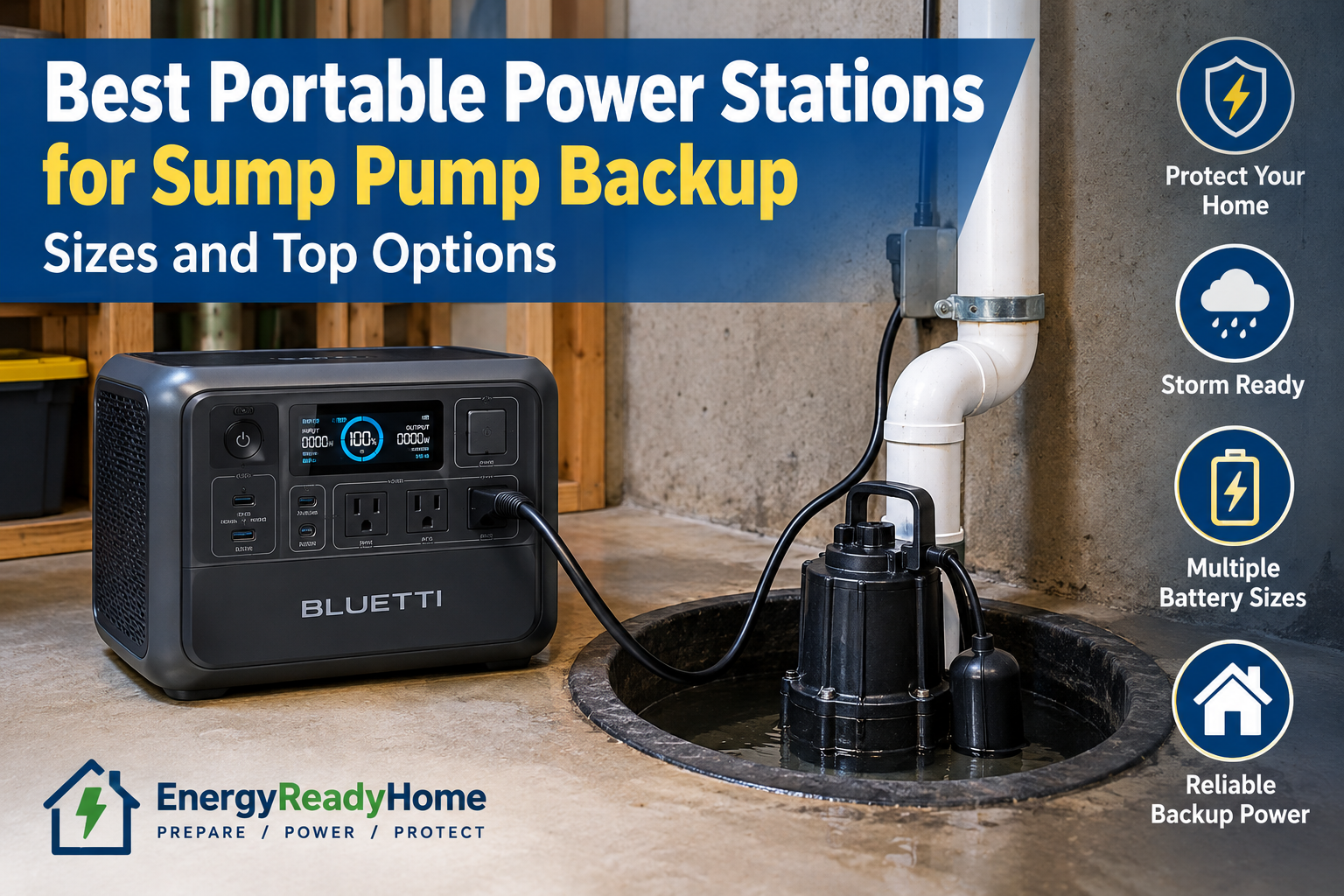
  • Best Portable Power Stations for Sump Pump Backup: Sizes and Top Options

    Best Portable Power Stations for Sump Pump Backup: Sizes and Top Options

    Power outages often happen during the same storms that put the greatest demand on your sump pump. If your basement depends on a sump pump to stay dry, choosing the right portable power station can mean the difference between a dry basement and thousands of dollars in water damage.

    The challenge is that sump pumps aren’t like televisions or laptops. Their electric motors require a large burst of power when they first start. A portable power station that appears large enough based on its advertised wattage may still fail if it can’t handle the pump’s startup surge.

    This guide explains how to choose the correct size portable power station, which features matter most, and the best types of units for reliable sump pump backup.


    Why Sump Pumps Are Different From Most Appliances

    Most household electronics draw a fairly steady amount of electricity.

    Sump pumps do not.

    Every time the float switch activates, the motor must overcome inertia to begin moving water. During that brief moment, the pump may require two to three times its normal running wattage before settling into its continuous power draw. Choosing a power station based only on running watts can leave you with a system that shuts down the instant the pump starts. Experts recommend matching both the running load and the startup surge when selecting backup power for motor-driven equipment.

    U.S. Department of Energy guidance on emergency preparedness and backup power.


    Step 1: Determine Your Sump Pump Size

    Start by identifying your pump’s horsepower (HP). You’ll usually find it on the motor label or in the owner’s manual.

    Typical residential pumps include:

    Pump SizeTypical Running WattsTypical Starting Surge
    1/4 HP300–500 W800–1,000 W
    1/3 HP500–800 W1,200–1,800 W
    1/2 HP800–1,000 W2,000–2,500 W
    3/4 HP1,000–1,500 W2,500–3,500 W

    Actual power requirements vary by manufacturer, pump design, discharge height, and plumbing configuration.


    Step 2: Choose the Right Portable Power Station Size

    Rather than shopping by battery capacity alone, consider three specifications together:

    • Continuous AC output
    • Surge (peak) output
    • Battery capacity (Wh)

    For most homeowners:

    Small Basements

    Ideal for:

    • 1/4 HP pumps
    • Occasional cycling
    • Finished basements with minimal water intrusion

    Recommended minimum:

    • 1,000–1,200Wh battery
    • 1,500W inverter
    • 2,000W surge capacity

    Average Homes

    Ideal for:

    • Most 1/3 HP pumps
    • Moderate rainfall
    • Typical residential sump systems

    Recommended minimum:

    • 2,000Wh battery
    • 2,000W inverter
    • 3,000–4,000W surge

    Many homeowners find the 2kWh class offers the best balance between runtime, surge capability, portability, and price for sump pump backup.


    Heavy Water Conditions

    Ideal for:

    • 1/2 HP pumps
    • Frequent cycling
    • High water tables
    • Long outages

    Recommended:

    • 3,000Wh or larger
    • Expandable battery capability
    • 3,000W+ inverter
    • Higher surge capacity

    Larger systems provide additional runtime during prolonged storms and allow other essentials—such as a refrigerator, modem, or lights—to run alongside the sump pump.

    Top Portable Power Station Recommendations

    When shopping for a portable power station for sump pump backup, prioritize models with strong inverter performance, reliable surge handling, fast recharging, and expandable battery options if your area experiences extended outages.

    Best Overall

    EcoFlow DELTA Pro 3

    Best for:

    • 1/3 HP to 1/2 HP sump pumps
    • Whole-home emergency preparedness
    • Long-duration outages

    Why it stands out:

    • High continuous AC output
    • Excellent surge capability
    • Expandable battery system
    • Fast AC and solar charging
    • Excellent mobile app controls

    Potential drawbacks:

    • Premium price
    • Heavy compared to smaller units

    Best Value

    Jackery Explorer 2000 Plus

    Best for:

    • Average homeowners
    • Moderate rainfall areas
    • Reliable emergency backup

    Highlights:

    • Large battery capacity
    • Expandable storage
    • Pure sine wave inverter
    • Simple operation
    • Good portability for its size

    Best for Larger Pumps

    BLUETTI AC300 with B300K Battery

    Ideal for:

    • Large basements
    • Heavy-duty sump pumps
    • Homes with frequent flooding

    Advantages:

    • Very high surge capability
    • Modular battery expansion
    • Multiple AC outlets
    • Excellent long-term backup solution

    Best Budget Option

    EcoFlow DELTA 2 Max

    Ideal for:

    • Smaller sump pumps
    • Homeowners wanting excellent value
    • Multi-purpose emergency backup

    Advantages:

    • Strong inverter
    • Good runtime
    • Fast recharge
    • Excellent solar compatibility

    How Long Will a Portable Power Station Run a Sump Pump?

    Runtime depends on two factors:

    • Battery capacity
    • How often the pump cycles

    A sump pump usually runs intermittently rather than continuously, so actual backup time is often much longer than many homeowners expect.

    For example:

    Battery CapacityLight Pump CyclingModerate CyclingHeavy Cycling
    1,000WhSeveral hours2–5 hours1–2 hours
    2,000Wh8–15 hours5–10 hours3–6 hours
    3,000Wh+12–24+ hours8–16 hours5–10+ hours

    These estimates assume the sump pump is the primary connected load. Runtime varies based on pump horsepower, battery age, inverter efficiency, water inflow, and discharge conditions.


    Can You Recharge While Running the Pump?

    Yes.

    Many premium portable power stations support pass-through charging, allowing the battery to recharge while simultaneously powering connected devices.

    This is especially valuable when paired with foldable or rooftop solar panels during multi-day outages. Even partial daytime solar charging can significantly extend backup time if weather conditions permit.


    Other Features Worth Looking For

    When comparing portable power stations, look beyond battery capacity.

    Useful features include:

    • Pure sine wave AC inverter
    • High surge output
    • LiFePO₄ battery chemistry
    • Expandable battery capability
    • Fast wall charging
    • Solar charging support
    • Weather-resistant storage case
    • Mobile app monitoring
    • Multiple AC outlets
    • Five-year warranty or longer

    These features improve long-term reliability and make the power station useful for camping, RV travel, home backup, and other emergency applications.


    Frequently Asked Questions

    Can a portable power station replace a dedicated sump pump battery backup?

    Not entirely.

    A dedicated battery backup system automatically activates when utility power fails and is permanently connected to the sump pump. A portable power station requires manual setup unless your installation is specifically designed for quick connection. Many homeowners use a portable power station as a versatile emergency backup that can also power refrigerators, lights, communications equipment, and medical devices.


    Will a 1,000Wh portable power station run my sump pump?

    It depends on the pump size and cycling frequency.

    For many 1/4 HP sump pumps, a quality 1,000Wh unit with sufficient surge capacity can provide several hours of backup. Larger pumps or heavy storm conditions typically require more battery capacity.


    Is solar charging practical during storms?

    Solar production is reduced by clouds and rain, but portable solar panels can still generate meaningful power whenever daylight is available. Solar charging becomes especially valuable after the storm passes or during prolonged outages lasting several days.


    Final Thoughts

    A portable power station is one of the most flexible emergency preparedness investments a homeowner can make. By selecting a unit with enough continuous output, adequate surge capacity, and sufficient battery storage for your sump pump, you can protect your basement while also keeping essential household devices running during an outage.

    For most homes, a 2,000Wh-class portable power station offers an excellent balance of power, runtime, portability, and long-term value. Homes with larger pumps, frequent flooding, or extended outage risks should consider expandable systems that provide additional battery capacity and higher inverter output for greater peace of mind.

    Related Articles

  • Best Solar Panels for Portable Power Stations: Top Options by Brand and Wattage

    Best Solar Panels for Portable Power Stations: Top Options by Brand and Wattage

    Portable power stations are only as useful as the method you use to recharge them. While plugging into a household outlet is the fastest option for many people, solar panels provide something just as valuable—energy independence. Whether you’re camping off-grid, preparing for extended power outages, or simply looking to reduce reliance on the electrical grid, pairing the right solar panels with your portable power station can make all the difference.

    The challenge is that not all solar panels work equally well with every portable power station. Differences in wattage, connector types, voltage limits, portability, weather resistance, and charging efficiency can significantly affect performance.

    This guide explains how to choose the best solar panels for your portable power station, compares the leading options from the major manufacturers, and helps you select the right panel based on your specific needs and budget.


    At a Glance

    Best For: Portable power station owners looking to maximize solar charging performance

    Estimated Reading Time: 14 minutes

    Last Updated: July 2026

    Who Should Read This:

    • Homeowners preparing for power outages
    • Campers and RV owners
    • Overlanding enthusiasts
    • Emergency preparedness planners
    • Anyone purchasing their first portable power station

    What You’ll Learn:

    • How solar panels work with portable power stations
    • Which panel sizes make the most sense
    • The differences between rigid and portable folding panels
    • Which brands offer the best compatibility
    • How to choose the right wattage for your needs

    Why Choosing the Right Solar Panel Matters

    A portable power station without an effective charging solution is only half of a backup power system.

    During an extended outage, the battery will eventually become depleted. Solar panels allow you to continuously recharge the battery whenever sunlight is available, dramatically extending how long your backup power system can operate.

    The right solar panel can:

    • Recharge your battery significantly faster
    • Improve charging efficiency
    • Reduce downtime between uses
    • Extend off-grid operation indefinitely under favorable conditions
    • Increase your return on investment

    The wrong panel may charge slowly, operate inefficiently, or in some cases not work at all due to voltage incompatibility.


    How Solar Panels Charge Portable Power Stations

    Portable power stations include a built-in solar charge controller that converts electricity generated by solar panels into energy that safely charges the internal battery.

    Unlike permanently installed rooftop solar systems, portable solar charging is designed to be simple:

    1. Place the solar panel in direct sunlight.
    2. Connect the panel to the power station.
    3. The built-in charge controller regulates the incoming power. To learn more about how photovoltaic technology converts sunlight into usable electricity, see the U.S. Department of Energy’s guide to solar energy.
    4. The battery begins charging automatically.

    Most modern power stations display:

    • Current solar input (watts)
    • Estimated charging time
    • Battery percentage
    • Solar charging status

    This makes it easy to optimize panel placement throughout the day.


    Understanding Solar Panel Wattage

    One of the first specifications you’ll notice is wattage.

    Solar panel wattage indicates the maximum amount of power the panel can generate under ideal laboratory conditions.

    Common portable panel sizes include:

    Solar Panel SizeTypical Uses
    60W–100WSmall power stations, phones, tablets, lighting
    100W–160WWeekend camping, small appliances
    200WMost home backup and RV applications
    350W–400WLarge-capacity power stations and faster charging

    Real-world output is usually lower than the advertised rating because of:

    • Cloud cover
    • Temperature
    • Panel angle
    • Time of day
    • Dirt or debris
    • Seasonal sun intensity

    Most users see approximately 70% to 90% of a panel’s rated output under good conditions.


    Portable Folding Panels vs. Rigid Solar Panels

    Choosing between portable and rigid panels depends on how you plan to use your portable power station.

    Portable Folding Solar Panels

    These are designed specifically for portability.

    Advantages include:

    • Fold into compact carrying cases
    • Lightweight
    • Easy to transport
    • Simple setup
    • Ideal for camping and emergency storage

    Disadvantages include:

    • Higher cost per watt
    • Slightly lower durability
    • Usually limited to smaller sizes

    Portable folding panels are the preferred option for most portable power station owners.


    Rigid Solar Panels

    Rigid panels are commonly used for residential rooftop installations but can also charge portable power stations.

    Advantages include:

    • Lower cost per watt
    • Excellent long-term durability
    • Higher efficiency
    • Better for permanent installations

    Disadvantages include:

    • Heavier
    • More difficult to transport
    • Require mounting hardware
    • Less convenient during emergencies

    Rigid panels are often the better value for homeowners planning a dedicated emergency backup system.


    Connector Compatibility Is Critical

    One of the most overlooked buying considerations is connector compatibility.

    Even if two solar panels have the same wattage, they may not connect directly to your portable power station.

    Common connector types include:

    • MC4
    • XT60
    • Anderson
    • DC7909
    • DC5521

    Many manufacturers include adapter cables, while others require them to be purchased separately.

    Before buying any solar panel, verify:

    • Connector type
    • Maximum input voltage
    • Maximum input current
    • Supported solar wattage

    Compatibility is far more important than choosing the highest advertised wattage.


    Best Solar Panels by Brand

    Many manufacturers design solar panels specifically for their own portable power stations. These panels generally offer the easiest setup and guaranteed compatibility.

    EcoFlow Solar Panels

    EcoFlow offers one of the widest selections available.

    Popular sizes include:

    • 110W
    • 160W
    • 220W
    • 400W

    Strengths include:

    • Excellent build quality
    • High conversion efficiency
    • Waterproof construction on many models
    • Easy integration with EcoFlow Delta and River series

    EcoFlow’s larger panels are particularly well suited for homeowners building a serious emergency backup system.


    Jackery SolarSaga Series

    Jackery helped popularize portable solar charging.

    Popular models include:

    • SolarSaga 100
    • SolarSaga 200

    Advantages include:

    • Lightweight
    • Excellent portability
    • Integrated kickstands
    • Very simple setup
    • Strong reputation for reliability

    These panels are especially popular with campers and RV owners.


    Bluetti Solar Panels

    Bluetti produces several high-quality portable panels designed for larger battery systems.

    Popular options include:

    • PV120
    • PV200
    • PV350

    Advantages include:

    • Excellent charging performance
    • Durable construction
    • Strong compatibility with Bluetti power stations
    • Good performance in less-than-ideal sunlight

    Bluetti’s larger panels appeal to users running higher-capacity backup systems.

    Third-Party Solar Panels Worth Considering

    Although many people purchase solar panels from the same manufacturer as their portable power station, several third-party companies produce excellent alternatives that often cost less while delivering similar performance.

    When shopping for third-party panels, always verify compatibility with your power station’s input voltage, current limits, and connector requirements before purchasing.

    Some well-regarded manufacturers include:

    Renogy

    Renogy has built a strong reputation in the RV and off-grid community.

    Strengths include:

    • Excellent efficiency
    • Durable construction
    • Wide variety of rigid and portable models
    • Good availability of accessories
    • Competitive pricing

    Renogy panels are especially popular for permanent emergency backup systems and RV installations.


    BougeRV

    BougeRV offers several portable folding panels designed for camping and emergency preparedness.

    Benefits include:

    • Lightweight construction
    • Good efficiency
    • Foldable designs
    • Competitive pricing
    • Compatible with many portable power stations using MC4 adapters

    ALLPOWERS

    ALLPOWERS produces affordable portable solar panels suitable for casual users.

    Advantages include:

    • Budget-friendly pricing
    • Good portability
    • Multiple wattage options
    • Wide compatibility

    These panels are often a good choice for first-time portable power station owners.


    Choosing the Right Solar Panel by Portable Power Station Size

    Matching the solar panel to your battery capacity helps reduce charging time while maximizing efficiency.

    Portable Power Station SizeRecommended Solar Panel
    Under 300Wh60W–100W
    300–700Wh100W–160W
    700–1,200Wh200W
    1,200–2,000Wh200W–400W
    Over 2,000WhMultiple 200W–400W panels (if supported)

    Always check your manufacturer’s maximum solar input rating. Purchasing more solar capacity than the power station can accept will not reduce charging time.


    Monocrystalline vs. Polycrystalline Solar Panels

    Nearly every premium portable solar panel today uses monocrystalline solar cells.

    Monocrystalline Panels

    Pros:

    • Higher efficiency
    • Better low-light performance
    • Longer lifespan
    • Smaller size for the same power output

    Cons:

    • Higher purchase price

    Polycrystalline Panels

    Pros:

    • Lower initial cost

    Cons:

    • Lower efficiency
    • Larger footprint
    • Reduced performance in hot weather

    For most portable power station owners, monocrystalline panels provide the best long-term value.


    Weather Resistance and Durability

    Portable solar panels spend much of their time outdoors, so durability matters.

    Look for features such as:

    • Weather-resistant fabric
    • Tempered glass (rigid panels)
    • Reinforced stitching
    • ETFE protective coating
    • Waterproof junction boxes
    • Corrosion-resistant connectors

    Keep in mind that weather-resistant does not always mean waterproof. Many folding panels should not be left outside during heavy rain or overnight unless specifically rated for those conditions.


    Tips for Faster Solar Charging

    Even the best solar panel performs poorly if it isn’t positioned correctly.

    To maximize charging speed:

    • Aim the panel directly at the sun.
    • Reposition it every few hours as the sun moves.
    • Keep the surface clean.
    • Avoid partial shade—even a small shadow can significantly reduce output.
    • Use shorter extension cables whenever practical to minimize power loss.
    • Charge during peak sunlight hours, typically between 10 a.m. and 3 p.m.

    These simple adjustments can noticeably improve charging performance.


    Common Mistakes to Avoid

    Many buyers make preventable mistakes when selecting or using solar panels.

    Avoid these common errors:

    • Buying based only on wattage
    • Ignoring connector compatibility
    • Exceeding the power station’s maximum solar input
    • Expecting advertised wattage in every weather condition
    • Leaving folding panels outside in severe weather
    • Using damaged cables or connectors
    • Forgetting to clean dust, pollen, or debris from the panel surface

    A little preparation helps protect your investment and improves charging efficiency.


    Frequently Asked Questions

    Can any solar panel charge a portable power station?

    No. The solar panel must be compatible with your portable power station’s voltage, current, connector type, and maximum solar input specifications.


    Are manufacturer-branded solar panels better?

    Not necessarily. Manufacturer-branded panels typically offer guaranteed compatibility and simple setup, while high-quality third-party panels can provide similar performance at a lower price.


    Is a 100W solar panel enough?

    A 100W panel works well for smaller portable power stations used to charge phones, laptops, lights, and other low-power devices. Larger batteries generally benefit from 200W or higher panels.


    Can I connect multiple solar panels together?

    Many larger portable power stations support multiple panels connected in series or parallel. Always follow the manufacturer’s specifications to avoid exceeding voltage or current limits.


    Do solar panels work on cloudy days?

    Yes, but they produce significantly less electricity. Charging times are longer under overcast conditions than in direct sunlight.


    Expert Tips

    • Purchase the largest compatible solar panel your portable power station can safely accept if faster charging is a priority.
    • If you expect extended outages, consider adding a second compatible panel to improve charging capacity.
    • Practice setting up your solar panels before an emergency so you’re familiar with the process.
    • Store adapter cables with your power station to avoid searching for them when you need backup power.

    Key Takeaways

    • The best solar panel depends on your portable power station’s specifications and intended use.
    • Compatibility is just as important as wattage.
    • Monocrystalline panels offer the best combination of efficiency and durability.
    • EcoFlow, Jackery, Bluetti, Renogy, BougeRV, and ALLPOWERS all offer quality options.
    • Proper positioning and maintenance significantly improve charging performance.
    • Investing in the right solar panel helps you get the most value from your portable power station while improving your preparedness for emergencies and off-grid adventures.

    Conclusion

    Choosing the best solar panels for portable power stations involves more than selecting the highest wattage available. The ideal panel balances compatibility, charging speed, portability, durability, and budget while matching your specific power station and intended use.

    Whether you’re preparing for power outages, building an emergency backup system, or planning your next camping adventure, a properly matched solar panel can transform your portable power station into a reliable, renewable source of electricity. With the right setup, you’ll spend less time waiting for batteries to recharge and more time enjoying dependable power wherever you need it.

    Related Articles

    How to Connect a Portable Power Station to Solar Panels (Step-by-Step Guide)

    How Long Do Portable Power Station Batteries Last?

    Can a Portable Power Station Run a Refrigerator?

    Best Portable Power Stations for Home Backup in 2026

    How Long Does It Take to Recharge a Portable Power Station?

    Portable Power Station vs Solar Generator Whats The Difference

  • How to Connect a Portable Power Station to Solar Panels (Step-by-Step Guide)

    How to Connect a Portable Power Station to Solar Panels (Step-by-Step Guide)

    Portable power stations become even more useful when paired with solar panels. Instead of relying only on wall outlets or vehicle charging, you can recharge your power station using free energy from the sun. Whether you’re preparing for power outages, camping off-grid, or reducing your dependence on the electrical grid, learning how to properly connect solar panels to your portable power station is an essential skill.

    The process is usually straightforward, but using the wrong panels, incompatible connectors, or incorrect voltage can prevent charging—or even damage your equipment. This guide explains exactly how to connect a portable power station to solar panels safely and efficiently.


    Why Use Solar Panels with a Portable Power Station?

    One of the biggest advantages of a portable power station is that it doesn’t require gasoline or propane to recharge. When paired with compatible solar panels, it can provide renewable electricity virtually anywhere the sun is shining.

    Common uses include:

    • Emergency home backup during power outages
    • Camping and RV travel
    • Boondocking and overlanding
    • Outdoor events
    • Remote job sites
    • Cabins without grid power
    • Disaster preparedness

    Unlike fuel-powered generators, solar charging produces no exhaust fumes, requires very little maintenance, and operates silently.


    How Solar Charging Works

    Portable solar panels convert sunlight into direct current (DC) electricity.

    That electricity flows through a charging cable into your portable power station, where the internal charge controller and Battery Management System (BMS) regulate the incoming power before charging the battery.

    The charging process is automatic. Once everything is connected correctly, the power station manages the charging process without requiring manual adjustments.


    What You’ll Need

    Before you begin, gather the following equipment:

    • Portable power station
    • Compatible solar panel or solar panels
    • Manufacturer-approved charging cable
    • Appropriate adapter (if required)
    • Stable location with full sunlight

    Many portable power stations include charging cables, while others require adapters for certain solar panel brands.

    Always verify compatibility before purchasing additional accessories.


    Step 1: Verify Solar Panel Compatibility

    Before connecting anything, confirm that your portable power station supports the solar panel you intend to use.

    Pay close attention to:

    • Maximum input voltage
    • Maximum solar input wattage
    • Maximum input current (amps)
    • Connector type

    Every portable power station has specific solar charging limits.

    Connecting a panel that exceeds those limits can prevent charging and, in some cases, damage internal electronics.

    The owner’s manual lists the acceptable solar input specifications. Solar Photovoltaic system basics.


    Step 2: Identify the Correct Connectors

    Not every solar panel uses the same connector.

    Some of the most common include:

    • MC4 connectors
    • XT60 connectors
    • Anderson Powerpole connectors
    • DC7909 connectors
    • Barrel connectors

    Many manufacturers provide adapter cables that convert standard MC4 solar panel connectors into the input connector required by their portable power station.

    Never force connectors together.

    If the connectors don’t match naturally, you likely need the proper adapter.


    Step 3: Position the Solar Panels Correctly

    Proper panel placement has a major impact on charging performance.

    For the best results:

    • Face the panels toward direct sunlight.
    • Minimize shading.
    • Tilt the panels toward the sun whenever possible.
    • Keep the panels clean.
    • Avoid placing them under trees or near buildings that create shadows.

    Even partial shade on one section of a solar panel can significantly reduce charging output.


    Step 4: Connect the Solar Panels

    Once the panels are positioned:

    1. Connect any required adapter cables.
    2. Plug the solar panel cable into the portable power station’s solar input.
    3. Confirm that the connectors are fully seated.
    4. Turn on the portable power station if required by your model.

    Many portable power stations automatically detect incoming solar power and begin charging immediately.

    Others may require selecting the charging input using the display menu.


    Step 5: Verify Charging

    After making the connection, check the display screen.

    Most portable power stations show:

    • Solar input wattage
    • Charging status
    • Battery percentage
    • Estimated charging time

    If the display shows incoming watts, your system is charging properly.

    If no charging occurs, disconnect the system and verify:

    • Connector compatibility
    • Cable connections
    • Panel orientation
    • Available sunlight
    • Input voltage compatibility

    Many charging issues are caused by loose connections or insufficient sunlight rather than equipment failure.


    Can You Connect Multiple Solar Panels?

    Yes—but only if your portable power station supports the combined electrical output.

    Many manufacturers allow multiple panels to be connected using:

    • Parallel wiring
    • Series wiring
    • Manufacturer-approved expansion cables

    The correct configuration depends on your power station’s maximum voltage and current limits.

    Before expanding your solar array, always verify the allowable specifications in your owner’s manual.

    Connecting panels incorrectly can exceed the unit’s solar input rating and prevent proper charging.

    Step 6: Understand What Affects Solar Charging Speed

    Solar charging is rarely as simple as looking at the panel’s advertised wattage. Real-world conditions often produce less power than the panel’s maximum rating.

    Several factors influence charging performance:

    Sunlight Intensity

    Bright, direct sunlight produces the fastest charging.

    Cloud cover, haze, smoke, or low-angle sunlight in the early morning and late afternoon reduce output significantly.

    Panel Angle

    Solar panels perform best when they face the sun directly.

    Repositioning the panels every few hours can noticeably increase daily energy production.

    Temperature

    Most solar panels actually become less efficient as temperatures rise.

    Cool, sunny days often generate more electricity than extremely hot summer afternoons.

    Dirt and Debris

    Dust, pollen, leaves, bird droppings, and snow can reduce panel efficiency.

    Cleaning the panels regularly helps maintain maximum charging performance.


    Should You Leave Solar Panels Connected All the Time?

    Generally, yes.

    Modern portable power stations include sophisticated Battery Management Systems (BMS) that automatically regulate charging and prevent overcharging.

    When the battery reaches full capacity, the charging system slows or stops accepting additional power.

    However, if severe weather is expected, disconnect and store portable solar panels to protect them from high winds, hail, or falling debris.


    Can You Use Any Solar Panel?

    Not necessarily.

    While many portable power stations work with third-party solar panels, compatibility depends on:

    • Input voltage
    • Maximum amperage
    • Connector type
    • Maximum solar wattage

    Many manufacturers recommend using their own panels because compatibility has already been verified.

    Third-party panels often work perfectly well—but always confirm the specifications before connecting them.


    Common Solar Connection Mistakes

    Many charging problems result from simple setup errors.

    Avoid these common mistakes:

    Using Too Much Voltage

    Exceeding the maximum solar input voltage can damage your power station.

    Always verify the panel specifications before connecting.

    Using the Wrong Adapter

    Improper adapters may prevent charging entirely.

    Use manufacturer-approved adapters whenever possible.

    Partial Shade

    Even one shaded corner of a panel can dramatically reduce power production.

    Move panels into full sunlight whenever possible.

    Incorrect Series or Parallel Wiring

    Connecting multiple panels incorrectly may exceed your power station’s input limits.

    Follow the manufacturer’s recommended wiring configuration.

    Expecting Maximum Rated Output

    A 200-watt solar panel rarely produces 200 watts continuously.

    Real-world production often ranges between 60% and 90% of the advertised rating depending on weather and sun angle.


    Frequently Asked Questions

    Can I charge a portable power station while using it?

    Yes.

    Most modern portable power stations support pass-through charging, allowing the battery to recharge while simultaneously powering connected devices.

    Check your owner’s manual to verify that your model supports this feature.


    Can solar panels damage a portable power station?

    Properly matched solar panels will not damage a portable power station.

    Problems occur only when the panel exceeds the unit’s maximum voltage or current limits.

    Always confirm compatibility before connecting.


    How long does solar charging take?

    Charging time depends on:

    • Solar panel wattage
    • Battery capacity
    • Available sunlight
    • Weather conditions

    A small power station paired with a high-output solar panel may recharge in several hours under ideal conditions.

    Larger power stations may require most of the day or multiple sunny days.


    Can I leave my solar panels outside permanently?

    Portable panels are designed for temporary deployment.

    Although many are weather-resistant, storing them indoors when not in use helps extend their lifespan and reduces unnecessary exposure to moisture, UV radiation, and severe weather.


    Do I need a separate solar charge controller?

    No.

    Portable power stations designed for solar charging already include an integrated charge controller and Battery Management System.

    Simply connect compatible solar panels directly to the solar input using the correct cable or adapter.


    Final Thoughts

    Connecting a portable power station to solar panels is one of the easiest ways to create a reliable, renewable source of backup power. Once you’ve verified compatibility and connected the correct cables, the charging process is largely automatic.

    Whether you’re preparing for emergencies, camping off-grid, or reducing your dependence on the electrical grid, understanding how solar charging works helps you get the most from your equipment while protecting your investment.

    By using compatible components, positioning panels for maximum sunlight, and avoiding common connection mistakes, you can safely recharge your portable power station almost anywhere the sun shines.

    Related Articles

  • How to Safely Store a Portable Power Station When It’s Not in Use

    How to Safely Store a Portable Power Station When It’s Not in Use

    Portable power stations are built to provide reliable backup power when you need it most. But if you store one incorrectly between uses, you can shorten its battery life, reduce its performance, or even damage the battery permanently.

    Fortunately, proper storage is simple. By keeping your portable power station at the correct charge level, protecting it from extreme temperatures, and performing occasional maintenance, you can help ensure it’s ready for your next camping trip, power outage, or emergency.

    This guide explains exactly how to store a portable power station safely, whether you’re putting it away for a few weeks or several months.


    Why Proper Storage Matters

    Modern portable power stations are a significant investment, often costing anywhere from a few hundred dollars to several thousand. Most use advanced lithium-ion or LiFePO₄ (Lithium Iron Phosphate) batteries designed to last for years—but only if they’re properly maintained.

    Poor storage practices can lead to:

    • Reduced battery capacity
    • Shorter battery lifespan
    • Longer charging times
    • Inaccurate battery percentage readings
    • Permanent battery damage
    • Reduced emergency reliability

    The good news is that most storage-related problems are completely preventable.


    The Best Battery Charge Level for Storage

    One of the biggest mistakes owners make is storing a portable power station either completely full or completely empty.

    For most manufacturers, the ideal storage charge is between 40% and 60%.

    This range minimizes stress on the battery’s internal chemistry while providing enough reserve power to prevent the battery from falling into an excessively discharged state during storage.

    Avoid Storing at 100%

    Keeping a battery fully charged for long periods places unnecessary stress on its cells, particularly if it’s stored in a warm environment.

    While occasionally leaving the battery fully charged isn’t harmful, storing it that way for several months may gradually reduce its long-term capacity.

    Never Store It Completely Empty

    Allowing a battery to remain at or near 0% is even more damaging.

    If the battery self-discharges below its safe operating voltage, the internal battery management system (BMS) may prevent it from accepting a charge. In severe cases, the battery could become permanently unusable.


    Store Your Portable Power Station Indoors Whenever Possible

    Temperature is one of the most important factors affecting long-term battery health.

    The ideal storage location is:

    • Cool
    • Dry
    • Well ventilated
    • Away from direct sunlight
    • Protected from moisture

    A finished basement, climate-controlled utility room, interior closet, or home office often provides excellent storage conditions.


    Avoid Extreme Heat

    Heat is the enemy of lithium batteries.

    Long-term exposure to high temperatures accelerates battery aging and reduces the number of charge cycles the battery can deliver over its lifetime.

    Avoid storing your power station in:

    • Attics
    • Uninsulated garages during summer
    • Vehicle trunks
    • Metal sheds
    • Areas exposed to direct sunlight

    Even if the unit is turned off, excessive heat continues to degrade the battery over time.

    High temperatures can permanently reduce battery capacity over time. The U.S. Department of Energy also recommends following proper lithium-ion battery safety and storage recommendations to help maximize battery performance and reduce safety risks.


    Protect It From Freezing Temperatures

    Cold weather affects batteries differently than heat.

    While most portable power stations tolerate cold storage reasonably well, freezing temperatures can temporarily reduce battery performance.

    More importantly, many lithium batteries should not be charged while frozen.

    If your power station has been stored in a cold garage or shed during winter:

    1. Bring it indoors.
    2. Allow it to warm to room temperature.
    3. Only then recharge or operate the unit.

    Following this simple step helps protect the battery from unnecessary stress.


    Keep the Unit Clean Before Storing

    Before putting your portable power station away, take a few minutes to clean it.

    Wipe away:

    • Dust
    • Dirt
    • Grass
    • Sand
    • Moisture
    • Debris around vents

    Check that cooling vents remain unobstructed and inspect charging ports for dirt or corrosion.

    Keeping the unit clean helps maintain proper airflow and prevents contaminants from entering electrical connections.


    Disconnect All Accessories

    Before storage, unplug everything connected to the power station.

    This includes:

    • Solar panels
    • AC charging cables
    • Car charging adapters
    • USB devices
    • Appliances
    • Extension cords

    Leaving accessories connected can sometimes allow small amounts of standby power draw or expose connectors to unnecessary wear.

    Storing cables separately also reduces strain on the ports.


    Turn the Unit Completely Off

    Many portable power stations have a true power-off mode.

    Before storing the unit:

    • Turn off all AC outputs.
    • Turn off all DC outputs.
    • Shut down the main power switch according to the manufacturer’s instructions.

    Some models continue drawing a small amount of power if left in standby mode.

    Fully powering down the unit helps preserve battery charge during long-term storage.


    Choose a Safe Storage Location

    A good storage location should be:

    • Stable and level
    • Dry
    • Free of excessive dust
    • Away from chemicals
    • Away from flammable materials
    • Out of direct sunlight
    • Out of reach of small children and pets

    Avoid placing heavy objects on top of the power station, as they can damage the housing or ventilation openings.

    How Often Should You Check a Stored Portable Power Station?

    Even when powered off, portable power stations slowly lose charge over time. This natural process, called self-discharge, varies by manufacturer and battery chemistry.

    A good rule of thumb is to inspect your power station every three to six months.

    During your inspection:

    • Check the remaining battery percentage.
    • Recharge the battery back to approximately 40%–60% if needed.
    • Inspect the case for damage.
    • Verify the charging ports are clean.
    • Confirm the unit powers on normally.

    Spending just a few minutes on periodic maintenance can significantly extend the life of your investment.


    Should You Leave It Plugged In All the Time?

    Many newer portable power stations include intelligent battery management systems that help protect the battery while connected to AC power.

    However, for long-term storage, continuously leaving the unit plugged into a wall outlet is generally not recommended unless the manufacturer specifically states it is safe for your model.

    Instead:

    • Charge the battery to the recommended storage level.
    • Disconnect the charger.
    • Store the unit properly.
    • Check it periodically.

    Following the manufacturer’s guidance helps maximize battery longevity.


    Should You Remove the Battery?

    Unlike many cordless power tools, portable power stations typically have integrated batteries that are not designed to be removed.

    There is no need—and generally no safe way—to remove the battery before storage.

    Instead, focus on:

    • Proper charge level
    • Correct storage temperature
    • Periodic inspections
    • Keeping the unit clean and dry

    What About Solar Panels?

    If you use portable solar panels with your power station, they also benefit from proper storage.

    Before storing them:

    • Disconnect them from the power station.
    • Wipe off dirt, dust, pollen, or bird droppings.
    • Allow them to dry completely if they were exposed to rain.
    • Avoid folding flexible panels while wet.
    • Store them flat or in their protective carrying case.

    Keeping your solar panels clean and protected helps maintain charging efficiency and extends their service life.


    Common Storage Mistakes to Avoid

    Avoid these common mistakes that can shorten battery life or reduce performance:

    Storing the Battery Completely Empty

    An empty battery can self-discharge below safe voltage levels, making recovery difficult or impossible.

    Leaving the Unit in a Hot Garage

    High temperatures accelerate battery aging, even when the power station is turned off.

    Ignoring It for a Year or More

    Periodic inspections help ensure the battery stays within a healthy charge range.

    Blocking the Cooling Vents

    Do not wrap the power station tightly in blankets, plastic bags, or other materials that trap moisture or block ventilation.

    Exposing It to Water or High Humidity

    Although many power stations are durable, prolonged exposure to moisture can damage electronic components and electrical connectors.


    Frequently Asked Questions

    Can I store my portable power station in my garage?

    Yes, if the garage remains relatively cool, dry, and within the manufacturer’s recommended storage temperature range. Climate-controlled indoor locations are generally a better choice.


    Can I leave my portable power station in my car?

    It’s best to avoid long-term vehicle storage. Cars can reach extremely high temperatures in summer and freezing temperatures in winter, both of which can shorten battery life.


    Should I fully charge it before hurricane season or storm season?

    Yes. If severe weather is approaching, charge your portable power station to 100% so it is ready to provide emergency backup power. After the emergency season has passed, return the battery to the recommended storage level if it will not be used for an extended period.


    How long can a portable power station sit unused?

    Most quality portable power stations can remain safely stored for several months when maintained correctly. Checking the battery every three to six months helps ensure it remains healthy and ready for use.


    Final Thoughts

    Proper portable power station storage requires only a few simple habits, but those habits can significantly extend battery life and improve long-term reliability.

    Store the battery at approximately 40% to 60% charge, keep it in a cool and dry location, protect it from extreme temperatures, inspect it every few months, and always follow the manufacturer’s recommendations for your specific model.

    With just a little preventive care, your portable power station will be ready when you need it most—whether that’s during a power outage, a camping trip, or your next outdoor adventure.

    Related Articles

    Portable Power Station Maintenance Checklist

    Can a Portable Power Station Run a Refrigerator?

    Best Backup Power Options for Apartments: Simple Solutions That Work

    Portable Power Station Maintenance Checklist: Keep Your Battery Ready for the Next Emergency

    Solar Generator vs Portable Power Station: What’s the Difference?


    How Long Do Portable Power Station Batteries Last?